

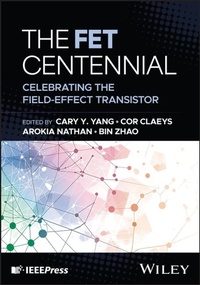
The FET Centennial
Celebrating the Field-Effect Transistor
1st Edition
Will be published approx. on 3. September 2026
Book
Hardback
928 pages
978-1-394-40648-7 (ISBN)
Description
Presents a landmark volume documenting 100 years of field-effect transistor innovation and applications
The invention of the field-effect transistor (FET) in 1925 transformed the trajectory of modern civilization, enabling virtually every electronic device in existence today. From the earliest integrated circuits to the most advanced computers and smartphones, the FET has served as the indispensable foundation of contemporary information technology. The FET Centennial: Celebrating the Field-Effect Transistor commemorates this milestone by gathering a distinguished group of contributors to provide a comprehensive account of the device's history, global development, diverse applications, and potential future directions.
This unique volume begins with an in-depth exploration of the history and evolution of FET technology, including the MOSFET's rise and international advances across the United States, Europe, and Asia. It then highlights critical applications and integration processes, ranging from memory and logic devices to CMOS image sensors, analog/RF CMOS, and emerging thin-film and wide-bandgap transistors. Finally, it addresses state-of-the-art developments, such as 3D and gate-all-around FETs, nanoscale transport phenomena, and the incorporation of novel 2D materials, while considering the possibility of what is next for the FET and what might come after.
A singular resource that not only documents a century of achievements but also contextualizes the field-effect transistor's enduring importance and likely trajectory in the decades ahead, The FET Centennial:
Addresses both historical milestones and technological disruptions shaping current and future electronics
Examines international research and development with narratives from the United States, Europe, and Asia
Covers device structures from MOSFETs to III-V and 2D-material-based FETs
Includes forward-looking analyses of nanoscale transport, 3D architectures, and GAAFET innovations
Features detailed coverage of process integration, interconnects, lithography, and compact modeling
Authored by globally recognized experts with leadership roles in academia, industry, and professional societies, The FET Centennial: Celebrating the Field-Effect Transistor is essential reading for graduate and senior undergraduate students in electrical engineering, materials science, and applied physics courses such as Semiconductor Devices, Integrated Circuit Technology, and Microelectronics. It is also an indispensable reference for researchers, practicing engineers, and historians of science and technology.
The invention of the field-effect transistor (FET) in 1925 transformed the trajectory of modern civilization, enabling virtually every electronic device in existence today. From the earliest integrated circuits to the most advanced computers and smartphones, the FET has served as the indispensable foundation of contemporary information technology. The FET Centennial: Celebrating the Field-Effect Transistor commemorates this milestone by gathering a distinguished group of contributors to provide a comprehensive account of the device's history, global development, diverse applications, and potential future directions.
This unique volume begins with an in-depth exploration of the history and evolution of FET technology, including the MOSFET's rise and international advances across the United States, Europe, and Asia. It then highlights critical applications and integration processes, ranging from memory and logic devices to CMOS image sensors, analog/RF CMOS, and emerging thin-film and wide-bandgap transistors. Finally, it addresses state-of-the-art developments, such as 3D and gate-all-around FETs, nanoscale transport phenomena, and the incorporation of novel 2D materials, while considering the possibility of what is next for the FET and what might come after.
A singular resource that not only documents a century of achievements but also contextualizes the field-effect transistor's enduring importance and likely trajectory in the decades ahead, The FET Centennial:
Addresses both historical milestones and technological disruptions shaping current and future electronics
Examines international research and development with narratives from the United States, Europe, and Asia
Covers device structures from MOSFETs to III-V and 2D-material-based FETs
Includes forward-looking analyses of nanoscale transport, 3D architectures, and GAAFET innovations
Features detailed coverage of process integration, interconnects, lithography, and compact modeling
Authored by globally recognized experts with leadership roles in academia, industry, and professional societies, The FET Centennial: Celebrating the Field-Effect Transistor is essential reading for graduate and senior undergraduate students in electrical engineering, materials science, and applied physics courses such as Semiconductor Devices, Integrated Circuit Technology, and Microelectronics. It is also an indispensable reference for researchers, practicing engineers, and historians of science and technology.
More details
Language
English
Place of publication
United States
Publishing group
John Wiley & Sons Inc
Target group
Professional and scholarly
College/higher education
ISBN-13
978-1-394-40648-7 (9781394406487)
Copyright in bibliographic data and cover images is held by Nielsen Book Services Limited or by the publishers or by their respective licensors: all rights reserved.
Schweitzer Classification
Persons
Cary Y. Yang, PhD, is a Professor of Electrical and Computer Engineering at Santa Clara University. An IEEE Life Fellow, he has served as Editor of IEEE Transactions on Electron Devices, President of the IEEE Electron Devices Society, and as a Member of the IEEE Board of Directors. His research spans silicon-based nanoelectronics, nanocarbon interconnects, and nanostructure interfaces.
Cor Claeys, PhD, is a Professor at KU Leuven, Belgium, and teaches internationally in Europe, China, India, and Brazil. A Fellow of both the Electrochemical Society and IEEE, he has co-edited books on low-temperature electronics and germanium-based technologies, authored four monographs, and contributed more than 1,400 technical papers and 16 book chapters.
Arokia Nathan, PhD, is a Bye-Fellow and Tutor at Darwin College, University of Cambridge. With over 600 publications, six books, more than 150 patents, and four spin-off companies, he is a Fellow of the IEEE, IET (UK), Royal Academy of Engineering, Canadian Academy of Engineering, and the Society for Information Displays, and a Foreign Member of the Chinese Academy of Sciences. His research has advanced thin-film electronics and sensor technologies.
Bin Zhao, PhD, has been with SEMATECH, Rockwell, Conexant, Skyworks, Freescale, Fairchild, and OnSemi in advanced IC technology and product development. An IEEE Fellow, he holds more than 100 patents and has served as Founding Co-Chair of the RF/AMS Working Group for the International Technology Roadmap for Semiconductors, IEEE Conferences Committee Chair, and President of the IEEE Electron Devices Society.
Cor Claeys, PhD, is a Professor at KU Leuven, Belgium, and teaches internationally in Europe, China, India, and Brazil. A Fellow of both the Electrochemical Society and IEEE, he has co-edited books on low-temperature electronics and germanium-based technologies, authored four monographs, and contributed more than 1,400 technical papers and 16 book chapters.
Arokia Nathan, PhD, is a Bye-Fellow and Tutor at Darwin College, University of Cambridge. With over 600 publications, six books, more than 150 patents, and four spin-off companies, he is a Fellow of the IEEE, IET (UK), Royal Academy of Engineering, Canadian Academy of Engineering, and the Society for Information Displays, and a Foreign Member of the Chinese Academy of Sciences. His research has advanced thin-film electronics and sensor technologies.
Bin Zhao, PhD, has been with SEMATECH, Rockwell, Conexant, Skyworks, Freescale, Fairchild, and OnSemi in advanced IC technology and product development. An IEEE Fellow, he holds more than 100 patents and has served as Founding Co-Chair of the RF/AMS Working Group for the International Technology Roadmap for Semiconductors, IEEE Conferences Committee Chair, and President of the IEEE Electron Devices Society.
Content
1 (I.1) The Miraculous Evolution of the Field-Effect Transistor: From Inception to Future Prospects
2 (I.2) MOSFET Device Structures and Physical Models: A Historical Review
3 (I.3) Field Effect Transistor R&D in the United States: Past, Present, and Future
4 (I.4) Asia's FET R&D Innovations - Past, Present, Future
5 (I.5) Fully-Depleted SOI Technology - From Equation to Fabrication
6 (II.1) MOS-based RAM
7 (II.2) Development of Floating Gate FETs as Non-Volatile Memories
8 (II.3) FET-Based Logic Devices and Systems
9 (II.4) SiC FETs for High-Power and High-Temperature Electronics
10 (II.5) III-V and III-N Field-Effect Transistors
11 (II.6) CMOS Image Sensors: Driving the Digital Imaging Era
12 (II.7) The Thin Film Transistor
13 (II.8) How to Manufacture the Impossible: The Secrets of Process Integration for Hyper-Scaled MOSFET Products
14 (II.9) 50 Years of RF CMOS Design
15 (II.10) Compact FET-Based Device Modeling for Circuit Simulation
16 (II.11) Evolution of Photolithography in Semiconductor Manufacturing
17 (II.12) Back-End-of-Line Interconnect Technology
18 (III.1) Three-dimensional Field-Effect Transistor - From Concept to Computing to Artificial Intelligence
19 (III,2) Developments of GAAFET Technologies and Future Challenges
20 (III.3) Contact Engineering and Performance Challenges in 2D-FETs
21 (III.4) Carrier Transport in MOSFETs: From Lilienfeld to Landauer
22 (III.5) What' Next After FET?
2 (I.2) MOSFET Device Structures and Physical Models: A Historical Review
3 (I.3) Field Effect Transistor R&D in the United States: Past, Present, and Future
4 (I.4) Asia's FET R&D Innovations - Past, Present, Future
5 (I.5) Fully-Depleted SOI Technology - From Equation to Fabrication
6 (II.1) MOS-based RAM
7 (II.2) Development of Floating Gate FETs as Non-Volatile Memories
8 (II.3) FET-Based Logic Devices and Systems
9 (II.4) SiC FETs for High-Power and High-Temperature Electronics
10 (II.5) III-V and III-N Field-Effect Transistors
11 (II.6) CMOS Image Sensors: Driving the Digital Imaging Era
12 (II.7) The Thin Film Transistor
13 (II.8) How to Manufacture the Impossible: The Secrets of Process Integration for Hyper-Scaled MOSFET Products
14 (II.9) 50 Years of RF CMOS Design
15 (II.10) Compact FET-Based Device Modeling for Circuit Simulation
16 (II.11) Evolution of Photolithography in Semiconductor Manufacturing
17 (II.12) Back-End-of-Line Interconnect Technology
18 (III.1) Three-dimensional Field-Effect Transistor - From Concept to Computing to Artificial Intelligence
19 (III,2) Developments of GAAFET Technologies and Future Challenges
20 (III.3) Contact Engineering and Performance Challenges in 2D-FETs
21 (III.4) Carrier Transport in MOSFETs: From Lilienfeld to Landauer
22 (III.5) What' Next After FET?