

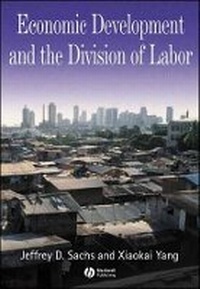
Economic Development and the Division of Labor
1st Edition
Published on 11. April 2003
Book
Hardback
660 pages
978-0-631-22003-9 (ISBN)
Description
This innovative new text from Jeffrey Sachs and Xiokai Yang introduces students to development economics from the perspectives of inframarginal analysis and marginal analysis. The book demonstrates how the new-found emphasis on inframarginal analysis has influenced a shift back to an interest in Classical Economics from Neoclassical Economics.
Inframarginal Analysis vs. Marginal Analysis is presented as a consistent theoretical framework throughout.
Shows how the relationship of Inframarginal Analysis to Marginal Analysis has influenced the shift back to an interest in Classical Economics from Neoclassical Economics with regard to economic development.
Allows economists to reduce their overall reliance on marginal analysis, which may be less relevant to development economics than it is to the economics of development countries.
Brings considerable analytic machinery to bear on important problems.
A focus on institutions and transaction costs that is very relevant to development economics.
Offers a thorough analysis of trade (CHs. 3 - 7) and macroeconomics (CHs. 16 - 19), both of which are not dealth with in depth by comparable textbooks.
Inframarginal Analysis vs. Marginal Analysis is presented as a consistent theoretical framework throughout.
Shows how the relationship of Inframarginal Analysis to Marginal Analysis has influenced the shift back to an interest in Classical Economics from Neoclassical Economics with regard to economic development.
Allows economists to reduce their overall reliance on marginal analysis, which may be less relevant to development economics than it is to the economics of development countries.
Brings considerable analytic machinery to bear on important problems.
A focus on institutions and transaction costs that is very relevant to development economics.
Offers a thorough analysis of trade (CHs. 3 - 7) and macroeconomics (CHs. 16 - 19), both of which are not dealth with in depth by comparable textbooks.
Reviews / Votes
"Economic Development and the Division of Labor is an exciting contribution that offers innovative perspectives on growth and development. It covers a void in the literature, and provides a rich and deep interpretation of the impact of endogenous specialization, institutions, and economic structure on growth. The text strikes a very good balance between the intuitive and analytical discussions, and relies constantly on references to contemporary data and the problems facing developing countries." Joshua Aizenman, Dartmouth College"Economists, whatever their speciality, will find the book rewarding to read and stimulating to teach." Merton J. Peck, Yale University
"Xiaokai Yang is one of the world's most penetrating and exacting economic theorists, and one of the most creative minds in the economics profession." Jeffrey D. Sachs, Columbia University
More details
Language
English
Place of publication
Hoboken
United Kingdom
Publishing group
John Wiley and Sons Ltd
Target group
College/higher education
Professional and scholarly
Dimensions
Height: 254 mm
Width: 173 mm
Thickness: 41 mm
Weight
1261 gr
ISBN-13
978-0-631-22003-9 (9780631220039)
Copyright in bibliographic data and cover images is held by Nielsen Book Services Limited or by the publishers or by their respective licensors: all rights reserved.
Schweitzer Classification
Other editions
Additional editions
Xiaokai Yang | Jeffrey D. Sachs
Economic Development and the Division of Labor
E-Book
05/2008
Wiley-Blackwell
€80.99
Available for download
Xiaokai Yang | Jeffrey D. Sachs
Economic Development and the Division of Labor
Book
04/2003
1st Edition
Wiley
€119.50
Shipment within 15-20 days
Persons
Xiaokai Yang is a Personal Chair Professor in the Department of Economics at Monash University and a Fellow of the Academy of Social Sciences in Australia. His research papers have appeared in The American Economic Review, Journal of Political Economy, Journal of Economics, and other journals. He is the author of Economics: New Classical versus Neoclassical Frameworks (Blackwell, 2000).
Content
Preface. 1. Introduction.
Part I: Geography and Microeconomic Mechanisms for Economic Development:.
2. Geography and Economic Development.
3. Driving Force I: Exogenous Comparative Advantage and Trading Efficiency.
4. Driving Force II: Endogenous Comparative Advantage and Trading Efficiency.
5. Driving Force III: Economies of Scale and Trading Efficiency.
6. Coexistence of Endogenous and Exogenous Comparative Advantages and Patterns of Development and Trade.
7. Structural Changes, Trade, and Economic Development.
Part II: The Institution of the Firm, Endogenous Transaction Costs, and Economic Development:.
8. Economic Development, the Institution of the Firm, and Entrepreneurship.
9. Endogenous Transaction Costs, Contract, and Economic Development.
10. Transaction Risk, Property Rights, Insurance, and Economic Development.
Part III: Urbanization and Industrialization:.
11. Urbanization, Dual Structure between Urban and Rural Areas, and Economic Development.
12. Industrialization, Structural Changes, Economic Development, and Division of Labor in Roundabout Production.
Part IV: Dynamic Mechanisms for Economic Development:.
13. Neoclassical Models of Economic Growth.
14. Economic Development Generated by Endogenous Evolution in Division of Labor.
15. Social Experiments and Evolution of Knowledge of Economic Development.
Part V: Macroeconomics of Development:.
16. Investment, Saving, and Economic Development.
17. Money, Division of Labor, and Economic Development.
18. Endogenous Business Cycles, Cyclical Unemployment, and Endogenous, Long-run Growth.
19. Economic Transition.
References.
Index.
Part I: Geography and Microeconomic Mechanisms for Economic Development:.
2. Geography and Economic Development.
3. Driving Force I: Exogenous Comparative Advantage and Trading Efficiency.
4. Driving Force II: Endogenous Comparative Advantage and Trading Efficiency.
5. Driving Force III: Economies of Scale and Trading Efficiency.
6. Coexistence of Endogenous and Exogenous Comparative Advantages and Patterns of Development and Trade.
7. Structural Changes, Trade, and Economic Development.
Part II: The Institution of the Firm, Endogenous Transaction Costs, and Economic Development:.
8. Economic Development, the Institution of the Firm, and Entrepreneurship.
9. Endogenous Transaction Costs, Contract, and Economic Development.
10. Transaction Risk, Property Rights, Insurance, and Economic Development.
Part III: Urbanization and Industrialization:.
11. Urbanization, Dual Structure between Urban and Rural Areas, and Economic Development.
12. Industrialization, Structural Changes, Economic Development, and Division of Labor in Roundabout Production.
Part IV: Dynamic Mechanisms for Economic Development:.
13. Neoclassical Models of Economic Growth.
14. Economic Development Generated by Endogenous Evolution in Division of Labor.
15. Social Experiments and Evolution of Knowledge of Economic Development.
Part V: Macroeconomics of Development:.
16. Investment, Saving, and Economic Development.
17. Money, Division of Labor, and Economic Development.
18. Endogenous Business Cycles, Cyclical Unemployment, and Endogenous, Long-run Growth.
19. Economic Transition.
References.
Index.