

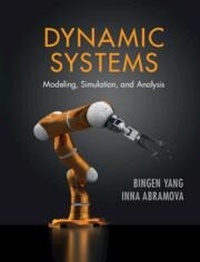
Dynamic Systems
Modeling, Simulation, and Analysis
Published on 24. November 2022
Book
Hardback
800 pages
978-1-107-17979-0 (ISBN)
Description
Presenting students with a comprehensive and efficient approach to the modelling, simulation, and analysis of dynamic systems, this textbook addresses mechanical, electrical, thermal and fluid systems, feedback control systems, and their combinations. It features a robust introduction to fundamental mathematical prerequisites, suitable for students from a range of backgrounds; clearly established three-key procedures - fundamental principles, basic elements, and ways of analysis - for students to build on in confidence as they explore new topics; over 300 end-of-chapter problems, with solutions available for instructors, to solidify a hands-on understanding; and clear and uncomplicated examples using MATLAB (R)/Simulink (R) and Mathematica (R), to introduce students to computational approaches. With a capstone chapter focused on the application of these techniques to real-world engineering problems, this is an ideal resource for a single-semester course in dynamic systems for students in mechanical, aerospace and civil engineering.
Reviews / Votes
'A good teaching reference, particularly for new faculty in this area. Certainly, the book is also good for students as it contains lots of sample codes in MATLAB and Mathematica.' Jian-qiao Sun, University of California, Merced 'An excellent fit for junior undergraduates in engineering to learn about mathematical modeling of several physical systems, and further solving the models to predict their behaviors. The relationship between inputs, system state, and outputs of a system are emphasized throughout the book. Additionally, the mathematical models are also represented using block diagrams that can then be simulated. The layout of the book strongly supports learning of fundamental principles and elements of modeling at the beginning, followed by their adaptation to both simple and complex real-world dynamic systems in other chapters.' Rajesh Ganesan, George Mason University 'Adopting a holistic approach, this book addresses the modeling, simulation, and analysis of dynamic systems at the undergraduate level. It provides comprehensive coverage of fundamental concepts, with carefully selected applications from different fields of engineering. The exposition is methodical and the accompanying illustrations are extensive, a combination that makes the book remarkably easy and enjoyable to read.' Fai Ma, University of California, Berkeley 'An excellent book on the dynamics of multi-domain systems. It is thorough and comprehensive, with a good balance of physical interpretation, mathematical formulation, practical applications, and numerical simulations.' Steve Shen, University of Washington 'Provides an excellent introduction to the subject and equips students with in-depth understanding of the fundamental principles of modeling of dynamic systems. The book contains a broad range of examples, helping students to build a strong foundation in this subject. The sequence of chapters, beginning with basics and ending with real-world applications, is well planned.' Chi-An Tan, Wayne State University 'A total chapter, Chapter 9, is dedicated to meticulously solved examples in real-life applications emphasizing the coupling among mechanical, thermo-fluidic as well as electrical systems. Detailed yet very clear implementation of underlying physics principles supported with MATLAB implementations in perfect harmony makes this book stand out in the crowd.' Burak Basaran, University of HoustonMore details
Language
English
Place of publication
Cambridge
United Kingdom
Target group
College/higher education
Edition type
New edition
Product notice
sewn/stitched
Cloth over boards
Illustrations
Worked examples or Exercises
Dimensions
Height: 248 mm
Width: 188 mm
Thickness: 42 mm
Weight
1837 gr
ISBN-13
978-1-107-17979-0 (9781107179790)
Copyright in bibliographic data and cover images is held by Nielsen Book Services Limited or by the publishers or by their respective licensors: all rights reserved.
Schweitzer Classification
Other editions
Additional editions
E-Book
12/2022
Cambridge University Press
€117.99
Available for download
Persons
Bingen 'Ben' Yang is Professor of Aerospace and Mechanical Engineering at the University of Southern California, where he has taught for more than three decades. Being an active researcher, he has more than 230 publications in the areas of structures, dynamics, vibrations, controls, and mechanics. His current research interest lies in modeling, analysis, control and design of flexible structures, electromechanical systems, and computational methods for problems in engineering applications. A fellow of the American Society of Mechanical Engineers, Dr. Yang received his Ph.D. in mechanical engineering from the University of California at Berkeley.
Content
1. Introduction; 2. Fundamentals of mathematics; 3. Mechanical systems; 4. Electrical systems; 5. Thermal and fluid systems; 6. Combined systems and system modeling techniques; 7. System response analysis; 8. Introduction to feedback control systems; 9. Application problems; Appendix A. Units; Appendix B. MATLAB/Simulink basics; Appendix C. Wolfram Mathematica basics; Index.