

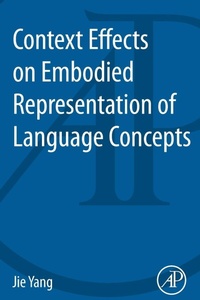
Context Effects on Embodied Representation of Language Concepts
Published on 8. April 2013
Book
Paperback/Softback
28 pages
978-0-12-407816-1 (ISBN)
Description
Embodied theories claim that semantic representations are grounded in sensorimotor systems, but the contribution of sensorimotor brain areas in representing meaning is still controversial. One current debate is whether activity in sensorimotor areas during language comprehension is automatic. Numerous neuroimaging studies reveal activity in perception and action areas during semantic processing that is automatic and independent of context, but increasing findings show that involvement of sensorimotor areas and the connectivity between word-form areas and sensorimotor areas can be modulated by contextual information. Context Effects on Embodied Representation of Language Concepts focuses on these findings and discusses the influences from word, phrase, and sentential contexts that emphasize either dominant conceptual features or non-dominant conceptual features.
More details
Language
English
Place of publication
San Diego
United States
Publishing group
Elsevier Science Publishing Co Inc
Target group
College/higher education
Professional and scholarly
Cognitive neuroscientists and psychologists interested in "grounded cognition," cognitive neuroscientists, psycholinguists
Product notice
Paperback (trade)
Dimensions
Height: 229 mm
Width: 152 mm
Thickness: 2 mm
Weight
56 gr
ISBN-13
978-0-12-407816-1 (9780124078161)
Copyright in bibliographic data and cover images is held by Nielsen Book Services Limited or by the publishers or by their respective licensors: all rights reserved.
Schweitzer Classification
Other editions
Additional editions
E-Book
05/2013
Academic Press
€16.95
Available for download
Content
1.1 Theories About Automatic Embodied Representation
1.2 Theories About Context-Dependent Embodied Representation
1.3 Evidence for Automatic Embodied Representation
1.4 EEG and MEG Evidences
1.5 fMRI Evidence
1.6 Evidence for Context-Dependent Embodied Representation
1.7 Discussion
1.8 Conclusion
References
1.2 Theories About Context-Dependent Embodied Representation
1.3 Evidence for Automatic Embodied Representation
1.4 EEG and MEG Evidences
1.5 fMRI Evidence
1.6 Evidence for Context-Dependent Embodied Representation
1.7 Discussion
1.8 Conclusion
References