

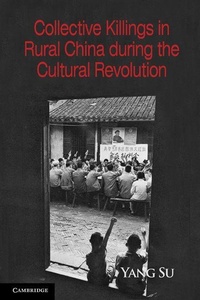
Collective Killings in Rural China during the Cultural Revolution
Published on 21. February 2011
Book
Paperback/Softback
322 pages
978-0-521-17381-0 (ISBN)
Description
The violence of Mao's China is well known, but its extreme form is not. In 1967 and 1968, during the Cultural Revolution, collective killings were widespread in rural China in the form of public execution. Victims included women, children, and the elderly. This book is the first to systematically document and analyze these atrocities, drawing data from local archives, government documents, and interviews with survivors in two southern provinces. This book extracts from the Chinese case lessons that challenge the prevailing models of genocide and mass killings and contributes to the historiography of the Cultural Revolution, in which scholarship has mainly focused on events in urban areas.
Reviews / Votes
"This is a truly terrific book, and long overdue too, leaving behind the well-trodden ground of the Red Guards in Beijing to focus unflinchingly on the horror of mass killings in the countryside. Yang Su has written a model of rigorous scholarship that squarely places the Cultural Revolution where it should have been all along, in the area of genocide studies on a par with Rwanda, as villagers turned against villagers, slaughtering each other in the hundreds of thousands."-Frank Dikotter, University of Hong Kong, author of Mao's Great Famine "Theoretically, this book is the first attempt showing that the development of modern genocide is not only shaped by the ideologically charged nation state, but also by the local actors and structural forces in ways quite unintended by the state actors. Empirically, this book reminds us once again that the Chinese Cultural Revolution (1966-1976) is one of the greatest tragedies of the modern world. It also turns our attention from the dynamics of the Cultural Revolution in China's urban settings to the less known stories in rural areas. This book will be on our shelves as an outstanding work in the study of the Cultural Revolution and the politics of the Chinese communist regime, genocide study, and social movement research."
-Dingxin Zhao, The University of Chicago "Su tells a heart-rendering story and contributes new insights to the burgeoning academic literature on contentious politics and genocide."
- Andrew J. Nathan, Foreign Affairs "Yang Su deserves great credit for uncovering the collective killings and for his penetrating analysis of their multiple causes"Jeremy Brown, Simon Fraser University, H-Net Reviews
More details
Series
Language
English
Place of publication
Cambridge
United Kingdom
Target group
Professional and scholarly
Product notice
Paperback (trade)
Illustrations
32 Tables, unspecified; 3 Maps; 2 Line drawings, unspecified
Dimensions
Height: 229 mm
Width: 152 mm
Thickness: 19 mm
Weight
525 gr
ISBN-13
978-0-521-17381-0 (9780521173810)
Copyright in bibliographic data and cover images is held by Nielsen Book Services Limited or by the publishers or by their respective licensors: all rights reserved.
Schweitzer Classification
Other editions
Additional editions
E-Book
03/2011
1st Edition
Cambridge University Press
€26.49
Available for download
Book
02/2011
Cambridge University Press
€104.20
Shipment within 15-20 days
Person
Yang Su is Associate Professor of Sociology at the University of California, Irvine. A social movement scholar, he has published work on social movements in the United States and in China. His research has appeared in flagship journals including American Sociological Review, Law and Society Review, the Journal of Asian Studies, and China Quarterly. A native of Guangdong, he holds a Ph.D. from Stanford University.
Content
1. Kill thy neighbor; 2. On the record; 3. Community and culture; 4. Class enemies; 5. Mao's ordinary men; 6. Demobilizing law; 7. Framing war; 8. Patterns of killing; 9. Understanding atrocities in plain sight.