

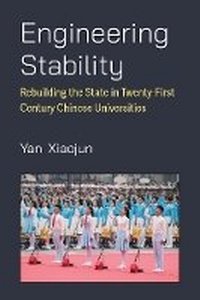
Engineering Stability
Rebuilding the State in Twenty-First Century Chinese Universities
Published on 19. November 2024
Book
Hardback
238 pages
978-0-472-07705-2 (ISBN)
Description
While the processes of founding a new state or constructing a new political order after a transition have been well-studied, there has been much less attention to how regimes that survive major political crises purposefully reinvent a postcrisis state to respond to updated concepts, new circumstances, changed social demands, and a realigned elite consensus. In Engineering Stability, Yan Xiaojun examines the Chinese Communist Party's efforts to reassert control and restore order on university campuses in the post-Tiananmen era. Since prominent national universities serve the nation-state as training grounds for the country's future political, economic, and cultural elites, public life on university campuses has immediate political relevance.
Drawing on rich materials gathered from in-depth field research in China during the Xi Jinping era, Engineering Stability invites scholars of comparative politics, state theory, contentious politics, and political development to rethink and reimagine how what Yan calls "a compromised autocratic state" is rebuilt within and from itself after overcoming a traumatic moment of vulnerability. The book further details the four types of infrastructure - institutional, significative, regulatory, and incentivizing - that state rebuilders need to overhaul, and looks into the campaign of state rebuilding in post-Tiananmen Chinese universities and its implications for our understanding of politics in general.
Drawing on rich materials gathered from in-depth field research in China during the Xi Jinping era, Engineering Stability invites scholars of comparative politics, state theory, contentious politics, and political development to rethink and reimagine how what Yan calls "a compromised autocratic state" is rebuilt within and from itself after overcoming a traumatic moment of vulnerability. The book further details the four types of infrastructure - institutional, significative, regulatory, and incentivizing - that state rebuilders need to overhaul, and looks into the campaign of state rebuilding in post-Tiananmen Chinese universities and its implications for our understanding of politics in general.
Reviews / Votes
"The book thus makes an important contribution to our understanding of the success of the current regime in maintaining a remarkable stability in conditions where China's achievements in surveillance technology are being used to reinforce this notable degree of conformity." -- The China QuarterlyMore details
Series
Language
English
Place of publication
Ann Arbor
United States
Target group
Professional and scholarly
Illustrations
13 figures, 5 tables
Dimensions
Height: 229 mm
Width: 152 mm
ISBN-13
978-0-472-07705-2 (9780472077052)
Copyright in bibliographic data and cover images is held by Nielsen Book Services Limited or by the publishers or by their respective licensors: all rights reserved.
Schweitzer Classification
Person
Yan Xiaojun is Associate Professor of Politics and Public Administration at the University of Hong Kong.
Content
Figures
Tables
Acknowledgment
Introduction
Chapter 1: The Compromised State and its Reinvention
Chapter 2: Concentric Circles: The Institutional Infrastructure
Chapter 3: A Torrent of Encounters: The Significative Infrastructure
Chapter 4: Shaping Public Life the Regulatory Infrastructure
Chapter 5: Nurturing Compliance: The Incentivisation Infrastructure
Chapter 6: At the Perilous Moment: Critical and Sensitive Periods
Chapter 7: Conclusion
Bibliography
Tables
Acknowledgment
Introduction
Chapter 1: The Compromised State and its Reinvention
Chapter 2: Concentric Circles: The Institutional Infrastructure
Chapter 3: A Torrent of Encounters: The Significative Infrastructure
Chapter 4: Shaping Public Life the Regulatory Infrastructure
Chapter 5: Nurturing Compliance: The Incentivisation Infrastructure
Chapter 6: At the Perilous Moment: Critical and Sensitive Periods
Chapter 7: Conclusion
Bibliography