

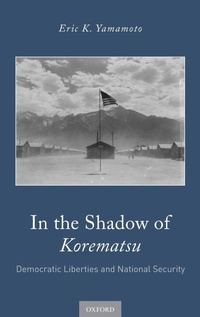
In the Shadow of Korematsu
Democratic Liberties and National Security
Published on 26. April 2018
Book
Hardback
264 pages
978-0-19-087895-5 (ISBN)
Description
The national security and civil liberties tensions of the World War II mass incarceration link 9/11 and the 2015 Paris-San Bernardino attacks to the Trump era in America. This marked an era darkened by accelerating discrimination against, and intimidation of those asserting rights of freedom of religion, association and speech, and by increasingly volatile protests. This book discusses the broad civil liberties challenges posed by these past-into-the-future linkages highlighting pressing questions about the significance of judicial independence for a constitutional democracy committed both to security and to the rule of law. One of which is: Will courts fall passively in line with the elective branches, as they did in Korematsu v. United States, or serve as the guardian of the Bill of Rights, scrutinizing claims of "pressing public necessity" as justification for curtailing fundamental liberties?
This book portrays the present-day significance of the Supreme Court's partially discredited, yet never overruled, 1944 decision upholding the constitutional validity of the mass Japanese American exclusion leading to indefinite incarceration. Second, it implicates prospects for judicial independence in adjudging Harassment, Exclusion, Incarceration disputes in contemporary America and beyond. Third, it engages the American populace in shaping law and policy at the ground level by placing the courts' legitimacy on center stage. This book addresses who we are as Americans and whether we are genuinely committed to democracy governed by the Constitution.
This book portrays the present-day significance of the Supreme Court's partially discredited, yet never overruled, 1944 decision upholding the constitutional validity of the mass Japanese American exclusion leading to indefinite incarceration. Second, it implicates prospects for judicial independence in adjudging Harassment, Exclusion, Incarceration disputes in contemporary America and beyond. Third, it engages the American populace in shaping law and policy at the ground level by placing the courts' legitimacy on center stage. This book addresses who we are as Americans and whether we are genuinely committed to democracy governed by the Constitution.
Reviews / Votes
Is the Korematsu case wrongly decided, yet capable of repetition? At a time when nativism and racism again parade in the disguise of national security, Eric Yamamoto (one of Fred Korematsu's lawyers) deftly illuminates that landmark's long shadow, unraveling its conflicting strands and calling for determined constitutional advocacy to follow active remembering. * Harold Hongju Koh, Sterling Professor of International Law, Yale Law School * It is truly a book for our times when political claims of pressing public necessity serve as justification for the curtailment of fundamental liberties. * Michael Omi, Professor, University of California * Professor Yamamoto's compelling and insightful book opens a path from historical injustice toward a more just America today and tomorrow. * Karen Korematsu, Executive Director, Fred T. Korematsu Institute *More details
Language
English
Place of publication
New York
United States
Target group
Professional and scholarly
Dimensions
Height: 240 mm
Width: 161 mm
Thickness: 19 mm
Weight
564 gr
ISBN-13
978-0-19-087895-5 (9780190878955)
Copyright in bibliographic data and cover images is held by Nielsen Book Services Limited or by the publishers or by their respective licensors: all rights reserved.
Schweitzer Classification
Other editions
Additional editions
E-Book
03/2018
1st Edition
OUP eBook
€24.99
Available for download
E-Book
03/2018
1st Edition
OUP eBook
€24.99
Available for download
Person
Eric K. Yamamoto is the Fred T. Korematsu Professor of Law and Social Justice at the William S. Richardson School of Law, University of Hawai`i. He is nationally and internationally recognized for his legal work and scholarship on civil procedure as well as national security and civil liberties, civil rights and social justice, with an emphasis on reconciliation initiatives and redress for historic injustice. He authored Interracial Justice: Conflict and Reconciliation in Post-Civil Rights America (2000); Race, Rights and Reparation: Law and the Japanese American Internment (Second Edition, 2013), co-authored with Margaret Chon. He has been a visiting professor at the University of California, Berkeley School of Law, the Santa Clara Law School, and the City University of New York Law School.
Content
Preface
Part One: The Challenge
Prologue
Chapter I: Overview: Judging National Security and Civil Liberties Controversies
Part Two: The Contested Cases
Chapter II: The 1944 Korematsu Supreme Court Decision
Chapter III: The 1980s Coram Nobis Cases
Chapter IV: Korematsu's Chameleonic Deployment
Part Three: The Next Steps
Chapter V: Jurisprudential Foundations
Chapter VI: A Workable Method
Chapter VII: Realpolitik Influences
Part Four: Looking Back, Moving Ahead
Chapter VIII: In the Shadow of Korematsu
Chapter IX: In the Light of Justice - Concluding Thoughts
Table of Authorities
Index
Part One: The Challenge
Prologue
Chapter I: Overview: Judging National Security and Civil Liberties Controversies
Part Two: The Contested Cases
Chapter II: The 1944 Korematsu Supreme Court Decision
Chapter III: The 1980s Coram Nobis Cases
Chapter IV: Korematsu's Chameleonic Deployment
Part Three: The Next Steps
Chapter V: Jurisprudential Foundations
Chapter VI: A Workable Method
Chapter VII: Realpolitik Influences
Part Four: Looking Back, Moving Ahead
Chapter VIII: In the Shadow of Korematsu
Chapter IX: In the Light of Justice - Concluding Thoughts
Table of Authorities
Index