

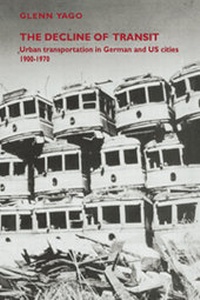
The Decline of Transit
Urban Transportation in German and U.S. Cities, 1900-1970
Published on 27. April 1984
Book
Hardback
272 pages
978-0-521-25633-9 (ISBN)
Description
Automobiles dominate transportation today in most American cities. After World War II, urban planners embraced highway transportation as the solution to urban congestion, while mass transit was shunned as outmoded and appropriate only for older, densely populated cities. Yet the prolonged energy crisis, beginning in 1973, shattered most previously held attitudes about the role of mass transit, and it was now promoted as central to energy efficiency and rational land use. If mass transit is now possible and even desirable in new, auto-oriented cities - Los Angeles, Frankfurt, Tokyo - why did it decline in the first place? In examining the historical conditions that led to the current crisis of urban transportation, the book offers an explanation of past urban and economic policy failures. The Decline of Transit will be essential reading for urban planners, politicians, economists, historians, and all others interested in the state of urban transportation today.
Reviews / Votes
'Dr. Yago has done a great service by clearly delineating the deplorable state of public transportation in the United States. His book provides a powerful motivation for, at last, bringing American public transportation up to the level which is common in other industrialized countries.' Barry Commoner, Center for the Biology of Natural Systems 'At last, a book that explains transportation planning and technology in terms of class power and interest group politics. A must for anyone interested in the past and future of cities.' Chester Hartman, Institute for Policy Studies 'This book is the product of careful, at times rich and meticulous, research, combining in unusual fashion, historical, statistical and case study approaches. Its topic is important and of current interest, and it contributes to scholarly literature not only about transportation and urbanism, but also about the state and public policy more generally. It persuasively tries to move beyond ecological and technological determinism in accounting for the major changes in public transportation in Germany and the United States in this century. Overall, Glenn Yago succeeds in presenting a gold mine of information about transportation issues.' Ira Katznelson, New School for Social ResearchMore details
Language
English
Place of publication
Cambridge
United Kingdom
Target group
Professional and scholarly
Dimensions
Height: 235 mm
Width: 152 mm
Thickness: 20 mm
Weight
550 gr
ISBN-13
978-0-521-25633-9 (9780521256339)
Copyright in bibliographic data and cover images is held by Nielsen Book Services Limited or by the publishers or by their respective licensors: all rights reserved.
Schweitzer Classification
Other editions
New editions
Book
11/2006
Cambridge University Press
€49.20
Shipment within 15-20 days
Additional editions
Book
11/2006
Cambridge University Press
€49.20
Shipment within 15-20 days
Content
Preface; 1. Introduction; 2. Twentieth-century mass transit in German and US cities; 3. The formation of national transportation policy: the case of Germany; 4. The formation of national transportation policy: the case of the United States; 5. Transportation politics: the case of Frankfurt am Main; 6. Transportation politics: the case of Chicago; 7. Conclusion: urban transportation for whom?; Statistical appendix; Notes; References; Index.