

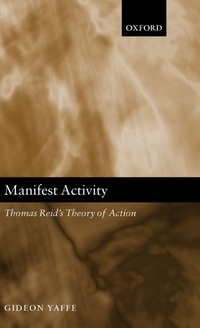
Manifest Activity
Thomas Reid's Theory of Action
Published on 25. March 2004
Book
Hardback
180 pages
978-0-19-926855-9 (ISBN)
Description
Manifest Activity presents and critically examines Thomas Reid's doctrines about the model of human power, the will, our capacities for purposeful conduct, and the place of our agency in the natural world. Reid is one of the most important philosophers of the 18th century, but hitherto under-appreciated; through the reconstruction of his arguments, many of which have never before been discussed, Gideon Yaffe demonstrates that Reid's simple prose and direct style belie the complexity of the views he advocates and the subtlety of the reasons he offers in their favour.
For Reid, contrary to the view of many of his predecessors, it is simply manifest that we are active with respect to our behaviours; it is manifest, he thinks, that our actions are not merely remote products of forces that lie outside of our control. Reid holds, instead, that actions are all and only those events that spring from active power, and he produces insightful and imaginative arguments for the claim that only a creature with a mind is capable of having active power. He believes that only human beings, and creatures 'above us', are capable of directing events towards ends, of endowing them with purpose or direction, the distinctive feature of action. However, he also holds that all events, and not merely human actions, are products of active power, power possessed either by human beings or by God. This collection of theses leads Reid to the view that human behaviour and the progress of nature are both essentially teleological. Patterns in nature are the products of laws of which God is the author; patterns in human conduct are the products of character and the laws that individuals set for themselves.
Manifest Activity examines Reid's arguments for this view and the view's implications for the nature of character, motivation, and the special kind of causation involved in the production of human behaviour. Yaffe's assessment will greatly profit anyone working on current theories of action and free will, as well as historians of ideas.
For Reid, contrary to the view of many of his predecessors, it is simply manifest that we are active with respect to our behaviours; it is manifest, he thinks, that our actions are not merely remote products of forces that lie outside of our control. Reid holds, instead, that actions are all and only those events that spring from active power, and he produces insightful and imaginative arguments for the claim that only a creature with a mind is capable of having active power. He believes that only human beings, and creatures 'above us', are capable of directing events towards ends, of endowing them with purpose or direction, the distinctive feature of action. However, he also holds that all events, and not merely human actions, are products of active power, power possessed either by human beings or by God. This collection of theses leads Reid to the view that human behaviour and the progress of nature are both essentially teleological. Patterns in nature are the products of laws of which God is the author; patterns in human conduct are the products of character and the laws that individuals set for themselves.
Manifest Activity examines Reid's arguments for this view and the view's implications for the nature of character, motivation, and the special kind of causation involved in the production of human behaviour. Yaffe's assessment will greatly profit anyone working on current theories of action and free will, as well as historians of ideas.
Reviews / Votes
Thomas Reid is widely regarded as having made important contributions to philosophy in three broad areas--the philosophy of perception, epistemology, and the theory of human action. Of Reid's contributions to philosophy, the third has been the least explored and, thus, it is especially welcome to have Gideon Yaffe's book length treatment of Reid's theory of action. Yaffe's book is, in my estimation, excellent: it is deftly and concisely argued, resourceful, and offers a charitable interpretation of Reid's position . . . the book repays close study, and scholars in both early modern philosophy and contemporary action theory will have much to learn from it. * Terence Cuneo, Notre Dame Philosophical Reviews * No one interested in the philosophy of action could fail to be intrigued by Yaffe's study of Reid. * James A. Harris, TLS *More details
Language
English
Place of publication
Oxford
United Kingdom
Target group
Professional and scholarly
Dimensions
Height: 222 mm
Width: 145 mm
Thickness: 13 mm
Weight
365 gr
ISBN-13
978-0-19-926855-9 (9780199268559)
Copyright in bibliographic data and cover images is held by Nielsen Book Services Limited or by the publishers or by their respective licensors: all rights reserved.
Schweitzer Classification
Other editions
Additional editions
Book
09/2007
Oxford University Press
€53.10
Shipment within 15-20 days
Person
Content
Introduction: Teleoology and the Science of Action ; 1. From Power to Mind - An Argument from the Power to Exert ; 2. From Power to Mind - An Argument from the Power to do Otherwise ; 3. From Change to Power ; 4. From End-Directedness to Power ; 5. The Influence of Motives - The Push of Power? ; 6. The Influence of Motives - The Push of Law? ; Conclusion: Agent-Causation and the Regress of Effort ; Bibliography ; Indes