

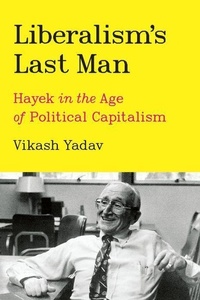
Liberalism's Last Man
Hayek in the Age of Political Capitalism
Published on 23. August 2023
Book
Hardback
288 pages
978-0-226-82147-4 (ISBN)
Description
A modern reframing of Friedrich Hayek's most famous work for the 21st century.
Friedrich Hayek's The Road to Serfdom was both an intellectual milestone and a source of political division, spurring fiery debates around capitalism and its discontents. In the ensuing discord, Hayek's true message was lost: liberalism is a thing to be protected above all else, and its alternatives are perilous.
In Liberalism's Last Man, Vikash Yadav revives the core of Hayek's famed work to map today's primary political anxiety: the tenuous state of liberal meritocratic capitalism-particularly in North America, Europe, and Asia-in the face of strengthening political-capitalist powers like China, Vietnam, and Singapore. As open societies struggle to match the economic productivity of authoritarian-capitalist economies, the promises of a meritocracy fade; Yadav channels Hayek to articulate how liberalism's moral backbone is its greatest defense against repressive social structures.
Friedrich Hayek's The Road to Serfdom was both an intellectual milestone and a source of political division, spurring fiery debates around capitalism and its discontents. In the ensuing discord, Hayek's true message was lost: liberalism is a thing to be protected above all else, and its alternatives are perilous.
In Liberalism's Last Man, Vikash Yadav revives the core of Hayek's famed work to map today's primary political anxiety: the tenuous state of liberal meritocratic capitalism-particularly in North America, Europe, and Asia-in the face of strengthening political-capitalist powers like China, Vietnam, and Singapore. As open societies struggle to match the economic productivity of authoritarian-capitalist economies, the promises of a meritocracy fade; Yadav channels Hayek to articulate how liberalism's moral backbone is its greatest defense against repressive social structures.
Reviews / Votes
"Yadav debuts with a vigorous reappraisal of 20th-century economist Friedrich Hayek in light of today?s increasing authoritarian encroachment on liberal, meritocratic, free-market societies. . . . Seamlessly intertwining political philosophy, intellectual history, and textual criticism, this is an expansive and robust defense of capitalist liberalism." * Publisher's Weekly * "Liberalism's Last Man performs an exceptional service in recasting The Road to Serfdom in a form that modern readers may ?nd easier to appreciate than the original work. For too long Hayek has been treated-by admirers and critics alike-as a slogan or a caricature rather than a serious thinker. It's time for a comeback." * The Wall Street Journal * "In Liberalism's Last Man, Vikash Yadav argues that Hayek has been mischaracterized as an extreme libertarian and market fundamentalist. Yadav points out [Hayek's] support for several progressive positions, including the state's provision of a minimum income, the promotion of social mobility, the taxation and regulation of pollution, and antitrust laws to restrain monopolies." * The New York Review of Books * "Hayek is a complex figure. A careful analysis of his work is necessarily complex. Yadav provides clarity and understanding around this oft-misunderstood intellectual who is too important to misconstrue or misrepresent." * Law & Liberty * "Liberalism's Last Man is, in many respects, one of the most remarkable contributions to Hayekian scholarship post-1989...Vikash Yadav's book is outstanding in its approach, originality, and relevance." * The Independent Review * "Liberalism's Last Man is a welcome reflection of the fragility of liberal capitalism and what is required to adapt the system to be robust in the face of its own internal tensions, the modern challenges of inequality, etc., and the attraction of state control of the market with the promise of well-orchestrated prosperity. The reader will come to appreciate Yadav's approach to teaching contending perspectives in political economy as much as the core argument that emerges in the exercise. The book is well researched, well written, and an important addition to the bookshelf of teacher/scholars of the history of political and economic thought, and to the field of development economics." * EH.Net * "Does Hayek's critique of socialism and defense of liberalism in his 1944 book The Road to Serfdom have any relevance for the very different challenges the international order faces today? Yadav's ambitious goal is to answer that question via a close reading of Hayek's classic text. The result is a penetrating, insightful, sometimes provocative and always stimulating performance." -- Bruce Caldwell | coauthor of "Hayek: A Life, 1899-1950" | Duke University "Well-written, well-researched, and engrossing, the great accomplishment of Liberalism's Last Man is its engagement with modern political theory through the lens of Hayek. It's a highly original work-and refreshing in that it takes Hayek's critics seriously while also refraining from shortchanging Hayek for his supposed intellectual sins." -- Peter Boettke | author of "F. A. Hayek: Economics, Political Economy and Social Philosophy"More details
Language
English
Place of publication
Chicago
United States
Publishing group
The University of Chicago Press
Target group
Professional and scholarly
Product notice
sewn/stitched
Cloth over boards
Illustrations
2 line drawings
Dimensions
Height: 235 mm
Width: 158 mm
Thickness: 27 mm
Weight
624 gr
ISBN-13
978-0-226-82147-4 (9780226821474)
Copyright in bibliographic data and cover images is held by Nielsen Book Services Limited or by the publishers or by their respective licensors: all rights reserved.
Schweitzer Classification
Other editions
Additional editions
E-Book
08/2023
University of Chicago Press
€45.99
Available for download
Person
Vikash Yadav is associate professor of international relations and Asian studies at Hobart and William Smith Colleges.
Content
Preface
Introduction
Chapter One The Abandoned Road
Chapter Two The Great Utopia
Chapter Three Individualism and Collectivism
Chapter Four The "Inevitability" of Planning
Chapter Five Planning and Democracy
Chapter Six Planning and the Rule of Law
Chapter Seven Economic Control and Totalitarianism
Chapter Eight Who, Whom?
Chapter Nine Security and Freedom
Chapter Ten Why the Worst Get on Top
Chapter Eleven The End of Truth
Chapter Twelve The Socialist Roots of Nazism
Chapter Thirteen The Totalitarians in Our Midst
Chapter Fourteen Material Conditions and Ideal Ends
Chapter Fifteen The Prospects of International Order
Conclusion
Acknowledgments
Notes
Bibliography
Introduction
Chapter One The Abandoned Road
Chapter Two The Great Utopia
Chapter Three Individualism and Collectivism
Chapter Four The "Inevitability" of Planning
Chapter Five Planning and Democracy
Chapter Six Planning and the Rule of Law
Chapter Seven Economic Control and Totalitarianism
Chapter Eight Who, Whom?
Chapter Nine Security and Freedom
Chapter Ten Why the Worst Get on Top
Chapter Eleven The End of Truth
Chapter Twelve The Socialist Roots of Nazism
Chapter Thirteen The Totalitarians in Our Midst
Chapter Fourteen Material Conditions and Ideal Ends
Chapter Fifteen The Prospects of International Order
Conclusion
Acknowledgments
Notes
Bibliography