

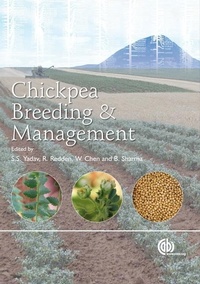
Chickpea Breeding and Management
Published on 28. March 2007
Book
Hardback
638 pages
978-1-84593-213-8 (ISBN)
Description
The chickpea is an ancient crop that is still important in both developed and developing nations. This authoritative account by international experts covers all aspects of chickpea breeding and management, and the integrated pest management and biotechnology applications that are important to its improvement. With topics covered including origin and taxonomy, ecology, distribution and genetics, this book combines the many and varied research issues impacting on production and utilization of the chickpea crop on its journey from paddock to plate.
More details
Language
English
Place of publication
Wallingford
United Kingdom
Target group
Professional and scholarly
Adult education
Product notice
sewn/stitched
Cloth over boards
Dimensions
Height: 244 mm
Width: 176 mm
Thickness: 44 mm
Weight
1592 gr
ISBN-13
978-1-84593-213-8 (9781845932138)
Copyright in bibliographic data and cover images is held by Nielsen Book Services Limited or by the publishers or by their respective licensors: all rights reserved.
Schweitzer Classification
Persons
is working as Senior Agronomist (Pulses) (equivalent to Professor) in the Department of Plant Breeding and Genetics, Punjab Agricultural University, Ludhiana, India. He received his BSc Agri. (Hons.) and MSc Agronomy degrees from the Punjab Agricultural University, Ludhiana, India and he was scholarship holder. He did his PhD from the University of Wales, Bangor, United Kingdom on Commonwealth Scholarship where he studied the effects of herbicides on biological nitrogen fixation in peas (Pisum sativum).
He has about 20 years experience of working on various grain legumes at the Punjab Agricultural University, Ludhiana, India. His main areas of research include conservation agriculture, planting method and planting time, weed management, nutrient management, plant population and planting geometry, water management, etc. He has given very useful recommendations to farmers for raising productivity of their grain legume crops and reducing the cost of cultivation. He is actively involved in teaching of Agronomy courses to students as well as extension education programmes for farmers. He also worked with the International Centre for Agricultural Research in the Dry Areas (ICARDA) at its Regional Office for Central Asia and the Caucasus, Tashkent, Uzbekistan for one year (2005-2006) where he worked as Technical Coordinator of an Asian Development Bank funded project on 'Improving rural livelihoods through efficient water and soil fertility management in Central Asia'.
He has about 20 years experience of working on various grain legumes at the Punjab Agricultural University, Ludhiana, India. His main areas of research include conservation agriculture, planting method and planting time, weed management, nutrient management, plant population and planting geometry, water management, etc. He has given very useful recommendations to farmers for raising productivity of their grain legume crops and reducing the cost of cultivation. He is actively involved in teaching of Agronomy courses to students as well as extension education programmes for farmers. He also worked with the International Centre for Agricultural Research in the Dry Areas (ICARDA) at its Regional Office for Central Asia and the Caucasus, Tashkent, Uzbekistan for one year (2005-2006) where he worked as Technical Coordinator of an Asian Development Bank funded project on 'Improving rural livelihoods through efficient water and soil fertility management in Central Asia'.
Editor
National Agricultural Research Institute, Papua New Guinea
Victoria Institute for Dryland Agriculture Horsham, Australia
USDA-ARS, Washington State University, USA
formerly Indian Agricultural Research Institute, New Delhi, India
Contributions
Washington State University, USA
Punjab Agricultural University, India
Content
1: History and Origin of Chickpea 2: Taxonomy of the Genus Cicer Revisited 3: The Ecology of Chickpea 4: Uses, Consumption and Utilization 5: Nutritional Value of Chickpea 6: Antinutritional Factors 7: Area, Production and Distribution 8: Chickpea: Rhizobium Management and Nitrogen Fixation 9: Chickpea in Cropping Systems 10: Nutrient Management in Chickpea 11: Weed Management in Chickpea 12: Irrigation Management in Chickpea 13: Integrated Crop Production and Management Technology of Chickpea 14: Commercial Cultivation and Profitability 15: Genetics and Cytogenetics 16: Utilization of Wild Relatives 17: Biodiversity Management in Chickpea 18: Conventional Breeding Methods 19: Breeding Achievements 20: Chickpea Seed Production 21: Ciceromics: Advancement in Genomics and Recent Molecular Techniques 22: Development of Transgenics in Chickpea 23: Abiotic Stresses 24: Diseases and Their Management 25: Host Plant Resistance and Insect Pest Management in Chickpea 26: Storage of Chickpea 27: International Trade 28: Crop Simulation Models for Yield Prediction 29: Chickpea Farmers 30: Genotype by Environment Interaction and Chickpea Improvement