

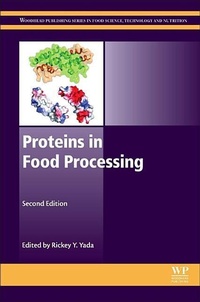
Proteins in Food Processing
2nd Edition
Published on 15. November 2017
Book
Hardback
674 pages
978-0-08-100722-8 (ISBN)
Description
Proteins in Food Processing, Second Edition, reviews how proteins may be used to enhance the nutritional, textural and other qualities of food products. After two introductory chapters, the book discusses sources of proteins, examining the caseins, whey, muscle and soy proteins, and proteins from oil-producing plants, cereals and seaweed. Part Two illustrates the analysis and modification of proteins, with chapters on testing protein functionality, modeling protein behavior, extracting and purifying proteins and reducing their allergenicity. A final group of chapters delves into the functional value of proteins and how they are used as additives in foods.
More details
Series
Edition
2nd edition
Language
English
Place of publication
Cambridge
United Kingdom
Publishing group
Elsevier Science & Technology
Target group
Professional and scholarly
Product notice
sewn/stitched
Cloth over boards
Dimensions
Height: 236 mm
Width: 159 mm
Thickness: 40 mm
Weight
1213 gr
ISBN-13
978-0-08-100722-8 (9780081007228)
Copyright in bibliographic data and cover images is held by Nielsen Book Services Limited or by the publishers or by their respective licensors: all rights reserved.
Schweitzer Classification
Other editions
Additional editions
Rickey Y. Yada
Proteins in Food Processing
E-Book
11/2017
2nd Edition
Woodhead Publishing
€275.00
Available for download
Previous edition
Rickey Y. Yada
Proteins in Food Processing
Book
04/2004
Woodhead Publishing Ltd
€341.69
Article exhausted; check for reprint
Person
Professor Rickey Yada is Dean of The University of British Columbia, Canada, and specializes in the structure-function relationships of food and non-food related enzymes using molecular biology and various physico-chemical techniques, carbohydrate metabolism as it related to process quality as well as various applications of food-related nanoscale science and technology. Prior to his appointment at UBC, he was a Professor in the Department of Food Science, Chair of the Department of Food Science, Assistant Vice President Research, a Canada Research Chair in Food Protein Structure, the Scientific Director of the Food Institute at the University of Guelph and the Vice Chair of the Canadian Institutes of Health Research, Institute of Nutrition, Metabolism and Diabetes. Prof. Yada is the EiC for Trends in Food Science and Technology (Elsevier Food Science journal), and is on the editorial boards for several journals. He is the author of over 200 refereed journal publications and several book chapters.
Content
1. Introduction
2. Properties of proteins in food systems
Part One: Sources of proteins
3. The caseins
4. Whey proteins
5. Muscle proteins
6. Soy as a food ingredient
7. Proteins from oil-producing plants
8. Cereal proteins
9. Seaweed proteins
10. Alternative protein source (e.g. insects)
11. Cultured meat protein
Part Two: Analysing and modifying protein
12. Bioactivity
13. Modelling protein behaviour
14. Factors affecting enzyme activity in foods
15. Detection and methods to reduce food allergens
16. The extraction and purification of proteins: an introduction
17. Modifying seeds to produce proteins
Part Three: Applications
18. Seafood proteins
19. Edible films and coatings from proteins
20. Protein gels
21. Health-related functional value of dairy proteins and peptides
22. The use of immobilized enzymes to improve functionality
23. Impact of proteins on food colour
24. Use of proteins as nano encapsulants
2. Properties of proteins in food systems
Part One: Sources of proteins
3. The caseins
4. Whey proteins
5. Muscle proteins
6. Soy as a food ingredient
7. Proteins from oil-producing plants
8. Cereal proteins
9. Seaweed proteins
10. Alternative protein source (e.g. insects)
11. Cultured meat protein
Part Two: Analysing and modifying protein
12. Bioactivity
13. Modelling protein behaviour
14. Factors affecting enzyme activity in foods
15. Detection and methods to reduce food allergens
16. The extraction and purification of proteins: an introduction
17. Modifying seeds to produce proteins
Part Three: Applications
18. Seafood proteins
19. Edible films and coatings from proteins
20. Protein gels
21. Health-related functional value of dairy proteins and peptides
22. The use of immobilized enzymes to improve functionality
23. Impact of proteins on food colour
24. Use of proteins as nano encapsulants