

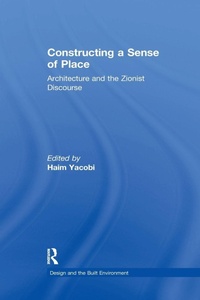
Constructing a Sense of Place
Architecture and the Zionist Discourse
1st Edition
Published on 27. February 2017
Book
Paperback/Softback
370 pages
978-1-138-26427-4 (ISBN)
Description
While it is widely recognized that architects and their architecture play a key role in constructing a sense of place, the inherent nexus between an architectural ideology and the production of national space and place has so far been neglected. Focusing on the Zionist ideology, this book brings together practising architects and academics to critically examine the role of architects, architecture and spatial practices as mediators between national ideology and the politicization of space. The book first of all sets out the wider context of theoretical debates concerning the role of architecture in the process of constructing a sense of place then divides into six main sections. The book not only provides an innovative new perspective on how the Israeli state had developed, but also sheds light on how architecture shapes national identity in any post-colonial and settler state.
Reviews / Votes
'The book is topical and will be essential reading for those who wish to scrape through some of the tough surfaces which coat the role of settlement in the Israel-Palestine conflict. At the same time, it offers important insights into the contribution of built space and the urban fabric for disciplines such as sociology, geography and politics, both historically and in terms of post-modern conditions.' Wendy Pullan, University of Cambridge, UK 'These...scholarly essays...explain the relationship between ideology and the building, in every sense, of the Jewish Homeland. And they make a good stab at it...A searching, self-critical, and at times partisan, perspective on how architecture has helped to shape Israel and politicised its space.' Building Design 'The book is on the whole well written...the quality of writing is excellent. The thematic organization works well...Many of the chapters will be enlightening and indeed thought provoking, both for the Israeli, or Near-Eastern practitioner designing modern? buildings in the local context, and for other readers wishing to reflect on designing for diverse populations, as well as for those wishing to learn more about how Israeli architecture and urban design have developed its individual character today.' Landscape Research 'Given the great variety and subtleness of the chapters and themes this text makes a major contribution to both architectural studies and contemporary social theory...the major theoretical and empirical contribution this book gives will...be important in developing what is a new and ultimately important research area.' Geografiska Annaler '...the significance of this volume is in its being a first step towards cracking the monolithic unified idea of place? by understanding its identity as a contested ideological discourse...the book is an important reader for anyone who wants to go beyond binary perceptions of place.' Political Geography '...the valuable caseMore details
Series
Language
English
Place of publication
London
United Kingdom
Publishing group
Taylor & Francis Ltd
Target group
College/higher education
Dimensions
Height: 234 mm
Width: 156 mm
Thickness: 20 mm
Weight
565 gr
ISBN-13
978-1-138-26427-4 (9781138264274)
Copyright in bibliographic data and cover images is held by Nielsen Book Services Limited or by the publishers or by their respective licensors: all rights reserved.
Schweitzer Classification
Other editions
Additional editions
E-Book
05/2017
Routledge
€77.99
Available for download
E-Book
05/2017
Routledge
€77.99
Available for download
Book
05/2004
1st Edition
Routledge
€207.30
Shipment within 10-20 days
Person
Dr Haim Yacobi is a Lecturer within the Department of Architecture at Bezalel Academy of Art and Design, Jerusalem.
Content
Contents: Introduction: Whose order, whose planning?, Haim Yacobi. Part I: Reshaping Terra Nullius: Contested Zionism - alternative modernism: Erich Mendelsohn and the Tel Aviv Chug in mandate Palestine, Alona Nitzan-Shiftan; The flight of the camel: the Levant fair of 1934 and the creation of a situated modernism, Sigal Davidi Kunda and Robert Oxman; Mold, Zvi Efrat; Horizontal ideology, vertical version: Oscar Niemeyer and Israel's height dilemma, Zvi Elhyani. Part II: Frontiers: Trapped sense of peripheral place in frontier space, Erez Tzfadia; The political construct of the 'everyday': the role of housing in making place and identity, Rachel Kallus. Part III: Mixed Spaces - Separated Places: Urban iconoclasm: the case of the 'mixed city' of Lod, Haim Yacobi; Planning to conquer: modernity and its antinomies in the 'new-old Jaffa', Mark LeVine. Part IV: Landmarks of Identity: Academia and spatial control: the case of the Hebrew University campus on Mount Scopus, Jerusalem, Diana Dolev; Re-placing memory, Yael Padan; Geometrical wounds: the work of Zvi Hecker in Israel, 1990 and 2000, Timothy Brittain-Catlin. Part V: Place/Knowledge: On belonging and spatial planning in Israel, Tovi Fenster; Fragile guardians: nature reserves and forests facing Arab villages, Naama Meishar. Epilogue: A moment of change? Transformations in Israeli architectural consciousness following the 'Israeli Pavilion' exhibition, Shelly Cohen; Index.