

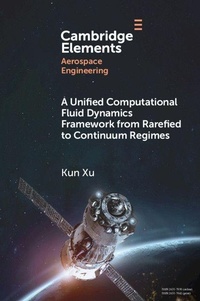
A Unified Computational Fluid Dynamics Framework from Rarefied to Continuum Regimes
Published on 10. June 2021
Book
Paperback/Softback
106 pages
978-1-108-79248-6 (ISBN)
Description
This Element presents a unified computational fluid dynamics framework from rarefied to continuum regimes. The framework is based on the direct modelling of flow physics in a discretized space. The mesh size and time step are used as modelling scales in the construction of discretized governing equations. With the variation-of-cell Knudsen number, continuous modelling equations in different regimes have been obtained, and the Boltzmann and Navier-Stokes equations become two limiting equations in the kinetic and hydrodynamic scales. The unified algorithms include the discrete velocity method (DVM)-based unified gas-kinetic scheme (UGKS), the particlebased unified gas-kinetic particle method (UGKP), and the wave and particle-based unified gas-kinetic wave-particle method (UGKWP). The UGKWP is a multi-scale method with the particle for non-equilibrium transport and wave for equilibrium evolution. The particle dynamics in the rarefied regime and the hydrodynamic flow solver in the continuum regime have been unified according to the cell's Knudsen number.
More details
Series
Language
English
Place of publication
Cambridge
United Kingdom
Target group
Professional and scholarly
Product notice
Paperback (trade)
Illustrations
Worked examples or Exercises
Dimensions
Height: 229 mm
Width: 152 mm
Thickness: 6 mm
Weight
167 gr
ISBN-13
978-1-108-79248-6 (9781108792486)
Copyright in bibliographic data and cover images is held by Nielsen Book Services Limited or by the publishers or by their respective licensors: all rights reserved.
Schweitzer Classification
Other editions
Additional editions
E-Book
06/2021
Cambridge University Press
€15.49
Available for download
Person
Content
1. Introduction; 2. Gas-kinetic scheme; 3. Unified gas-kinetic scheme; 4. Unified gas-kinetic particle and wave-particle methods; 5. Perspectives and future outlook; References.