

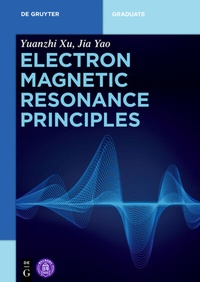
Electron Magnetic Resonance Principles
1st Edition
Published on 5. August 2019
Book
Paperback/Softback
XIII, 451 pages
978-3-11-052800-8 (ISBN)
Description
The book presents principles of electron magnetic resonance from a chemist's point-of-view, covering g-tensor theory, isotropical hyperfine structure, anisotropical hyperfine structure and fine structure of spectrum, and relaxation theory. Detailed explanations on quantitative determination of paramagnetic species are given to address readers' difficulties. Written as a physical chemistry graduate textbook, it is also suitable for industry users.
More details
Series
Language
English
Place of publication
Berlin/Boston
Germany
Target group
College/higher education
US School Grade: From College Freshman to College Senior
Product notice
Klappenbroschur
Illustrations
52 s/w Tabellen, 204 Abbildungen
204 ill., 52 tbl.
Dimensions
Height: 240 mm
Width: 170 mm
Thickness: 26 mm
Weight
785 gr
ISBN-13
978-3-11-052800-8 (9783110528008)
Schweitzer Classification
Other editions
Additional editions
Yuanzhi Xu | Jia Yao
Electron Magnetic Resonance Principles
E-Book
08/2019
1st Edition
De Gruyter
€94.95
Available for download
Yuanzhi Xu | Jia Yao
Electron Magnetic Resonance Principles
E-Book
08/2019
1st Edition
De Gruyter
€94.95
Available for download
Persons
Content
Table of Content:
Chapter 1: Introduction
Chapter 2: Theoretical basics
Chapter 3: g-tensor theory
Chapter 4: Isotropical hyperfine structure of spectrum
Chapter 5: Anisotropical hyperfine structure of spectrum
Chapter 6: Fine structure of spectrum
Chapter 7: Relaxation theory & linesharpe, linewidths
Chapter 8: Quantitative determination
Chapter 9: Paramagnetic species in gas phase and inorganic radicals
Chapter 10: Spectra of transition metal ions and complexes
Appendix 1: Expansion & elongation of EMR
Appendix 2: Mathematics preparation
Appendix 3: Angular momentum theory & stable state perturbation of quantum mechanics
Appendix 4: Fundamental constants & conversion factors
Appendix 5: Characteristic property of some common nuclei
Chapter 1: Introduction
Chapter 2: Theoretical basics
Chapter 3: g-tensor theory
Chapter 4: Isotropical hyperfine structure of spectrum
Chapter 5: Anisotropical hyperfine structure of spectrum
Chapter 6: Fine structure of spectrum
Chapter 7: Relaxation theory & linesharpe, linewidths
Chapter 8: Quantitative determination
Chapter 9: Paramagnetic species in gas phase and inorganic radicals
Chapter 10: Spectra of transition metal ions and complexes
Appendix 1: Expansion & elongation of EMR
Appendix 2: Mathematics preparation
Appendix 3: Angular momentum theory & stable state perturbation of quantum mechanics
Appendix 4: Fundamental constants & conversion factors
Appendix 5: Characteristic property of some common nuclei