

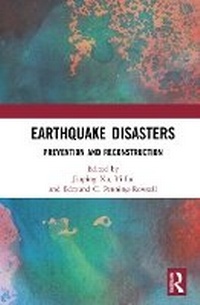
Earthquake Disasters
Prevention and Reconstruction
1st Edition
Published on 27. September 2021
Book
Hardback
190 pages
978-1-032-00248-4 (ISBN)
Description
This book explores practices and approaches on pre-disaster prevention and post-disaster reconstruction for vulnerable countries and areas enhancing earthquake disaster resilience.
Destructive earthquakes have frequently occurred in urban or rural areas around the world, causing severe damage on human societies. Pre-earthquake prevention and post-earthquake reconstruction effect the disaster resilience building and long-term development of the affected communities and areas. In recent years, researchers from around the world have made a lot of efforts to study on the theme 'earthquake disaster prevention and reconstruction'.
The chapters in this edited volume contribute to the literature of earthquake disaster research from scientific, social and institutional aspects. These interdisciplinary studies mainly focus on human and policy dimensions of earthquake disaster, such as earthquake risk mitigation, social-physical resilience building, resilience capability assessment, healthcare surge capacity, house reconstruction, the roles of schools, households, civil societies and public participation in earthquake disaster prevention and reconstruction. The authors come from several counties, including China, Bangladesh, Iran, New Zealand, Saudi Arabia, the United Kingdom, Denmark, and Indonesia, covering the cases from those countries prone to earthquakes.
These nine distinctive chapters have been elaborately selected and integrated from the international, ranked, peer-reviewed journal, Environmental Hazards.
Destructive earthquakes have frequently occurred in urban or rural areas around the world, causing severe damage on human societies. Pre-earthquake prevention and post-earthquake reconstruction effect the disaster resilience building and long-term development of the affected communities and areas. In recent years, researchers from around the world have made a lot of efforts to study on the theme 'earthquake disaster prevention and reconstruction'.
The chapters in this edited volume contribute to the literature of earthquake disaster research from scientific, social and institutional aspects. These interdisciplinary studies mainly focus on human and policy dimensions of earthquake disaster, such as earthquake risk mitigation, social-physical resilience building, resilience capability assessment, healthcare surge capacity, house reconstruction, the roles of schools, households, civil societies and public participation in earthquake disaster prevention and reconstruction. The authors come from several counties, including China, Bangladesh, Iran, New Zealand, Saudi Arabia, the United Kingdom, Denmark, and Indonesia, covering the cases from those countries prone to earthquakes.
These nine distinctive chapters have been elaborately selected and integrated from the international, ranked, peer-reviewed journal, Environmental Hazards.
More details
Language
English
Place of publication
London
United Kingdom
Publishing group
Taylor & Francis Ltd
Target group
College/higher education
Dimensions
Height: 246 mm
Width: 174 mm
Weight
530 gr
ISBN-13
978-1-032-00248-4 (9781032002484)
Copyright in bibliographic data and cover images is held by Nielsen Book Services Limited or by the publishers or by their respective licensors: all rights reserved.
Schweitzer Classification
Other editions
Additional editions
Book
09/2023
1st Edition
Routledge
€71.98
Shipment within 10-20 days
E-Book
09/2021
1st Edition
Routledge
€59.49
Available for download
E-Book
09/2021
1st Edition
Routledge
€59.49
Available for download
Persons
Jiuping Xu is Associate Vice President, Dean of the Business School and Director of the Emergency Management Institute at Sichuan University. He has published more than 700 peer-reviewed journal articles and over 40 books in Springer, Taylor & Francis, Wiley, Elsevier, Cambridge University Press, and others.
Yi Lu is a professor in the Business School at Sichuan University. He is the Vice Director of the Emergency Management Institute at Sichuan University, and an editorial board member of Environmental Hazards. His research interests focus on disaster resilience and post-earthquake recovery and reconstruction.
Edmund Penning-Rowsell is Emeritus Professor of Geography and Pro Vice-Chancellor at Middlesex University, where he founded the Flood Hazard Research Centre in 1970. Since 2010 he has been a visiting academic at the School of Geography and the Environment at the University of Oxford. He is also the editor of the journal Environmental Hazards (Taylor & Francis).
Yi Lu is a professor in the Business School at Sichuan University. He is the Vice Director of the Emergency Management Institute at Sichuan University, and an editorial board member of Environmental Hazards. His research interests focus on disaster resilience and post-earthquake recovery and reconstruction.
Edmund Penning-Rowsell is Emeritus Professor of Geography and Pro Vice-Chancellor at Middlesex University, where he founded the Flood Hazard Research Centre in 1970. Since 2010 he has been a visiting academic at the School of Geography and the Environment at the University of Oxford. He is also the editor of the journal Environmental Hazards (Taylor & Francis).
Content
Introduction: Towards an earthquake-resilient world: from post-disaster reconstruction to pre-disaster prevention 1. The geo-genetic status of earthquake-related hazards and the role of human and policy dimensions in impact mitigation 2. Understanding the causes of vulnerabilities for enhancing social-physical resilience: lessons from the Wenchuan earthquake 3. Assessing the capabilities of resilience against earthquake in the city of Yasuj, Iran 4. The role of schools in helping communities copes with earthquake disasters: the case of the 2010-2011 New Zealand earthquakes 5. Devastating earthquakes facilitating civil societies in developing countries: across-national analysis 6. Public participation in NGO-oriented communities for disaster prevention and mitigation (N-CDPM) in the Longmen Shan fault area during the Wenchuan and Lushan earthquake periods 7. Earthquake preparedness of households in Jeddah, Saudi Arabia: a perceptual study 8. Learning lessons from the 2011 Van Earthquake to enhance healthcare surge capacity in Turkey 9. Redistributing vulnerabilities: house reconstruction following the 2006 Central Java earthquake