

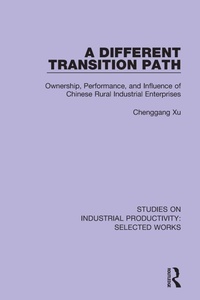
A Different Transition Path
Ownership, Performance, and Influence of Chinese Rural Industrial Enterprises
1st Edition
Published on 1. July 2020
Book
Paperback/Softback
186 pages
978-1-138-31439-9 (ISBN)
Description
Originally published in 1995 this volume examines and analyzes the factors that have made the township-village enterprise (TVE) such a driver of growth in the Chinese economy in recent years. The book analyzes the background of the TVE and discusses regional differences in TVE efficiency as well as examining the apparent contradiction of the success of the TVE despite the lack of well-defined property rights. Issues of rural-rural and rural-urban migration phenomena are discussed and the differences discussed between the Chinese economy and those of other developing nations.
More details
Series
Language
English
Place of publication
London
United Kingdom
Publishing group
Taylor & Francis Ltd
Target group
College/higher education
Professional and scholarly
General, Postgraduate, Professional, and Undergraduate
Dimensions
Height: 234 mm
Width: 156 mm
Thickness: 10 mm
Weight
295 gr
ISBN-13
978-1-138-31439-9 (9781138314399)
Copyright in bibliographic data and cover images is held by Nielsen Book Services Limited or by the publishers or by their respective licensors: all rights reserved.
Schweitzer Classification
Other editions
Additional editions
Chenggang Xu
A Different Transition Path
Ownership, Performance, and Influence of Chinese Rural Industrial Enterprises
E-Book
07/2018
1st Edition
Routledge
€48.49
Available for download
Chenggang Xu
A Different Transition Path
Ownership, Performance, and Influence of Chinese Rural Industrial Enterprises
Book
07/2018
1st Edition
Routledge
€148.80
Shipment within 10-20 days
Person
Multivolume collection by leading authors in the field
Content
1. Introduction 2. Productivity and Behavior of Chinese Rural Industrial Enterprises 3. Chinese Township-Village Enterprises as Vaguely Defined Cooperatives (with Martin L. Weitzman) 4. Risk-Aversion, Rural-Urban Wage Differentiation and Migration