

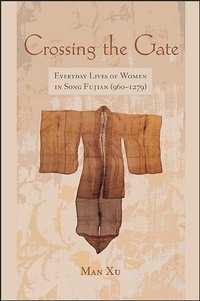
Crossing the Gate
Everyday Lives of Women in Song Fujian (960-1279)
Published on 1. December 2016
Book
Hardback
372 pages
978-1-4384-6321-6 (ISBN)
Description
Challenges the accepted wisdom about women and gender roles in medieval China.
In Crossing the Gate, Man Xu examines the lives of women in the Chinese province of Fujian during the Song dynasty. Tracking women's life experience across class lines, outside as well as inside the domestic realm, Xu challenges the accepted wisdom about women and gender roles in medieval China. She contextualizes women in a much broader physical space and social network, investigating the gaps between ideals and reality and examining women's own agency in gender construction. She argues that women's autonomy and mobility, conventionally attributed to Ming-Qing women of late imperial China, can be traced to the Song era. This thorough study of Song women's life experience connects women to the great political, economic, and social transitions of the time, and sheds light on the so-called "Song-Yuan-Ming transition" from the perspective of gender studies. By putting women at the center of analysis and by focusing on the local and the quotidian, Crossing the Gate offers a new and nuanced picture of the Song Confucian revival.
In Crossing the Gate, Man Xu examines the lives of women in the Chinese province of Fujian during the Song dynasty. Tracking women's life experience across class lines, outside as well as inside the domestic realm, Xu challenges the accepted wisdom about women and gender roles in medieval China. She contextualizes women in a much broader physical space and social network, investigating the gaps between ideals and reality and examining women's own agency in gender construction. She argues that women's autonomy and mobility, conventionally attributed to Ming-Qing women of late imperial China, can be traced to the Song era. This thorough study of Song women's life experience connects women to the great political, economic, and social transitions of the time, and sheds light on the so-called "Song-Yuan-Ming transition" from the perspective of gender studies. By putting women at the center of analysis and by focusing on the local and the quotidian, Crossing the Gate offers a new and nuanced picture of the Song Confucian revival.
Reviews / Votes
"Xu's provocative study breaks new ground on gender studies in imperial China ... Highly recommended." - CHOICEMore details
Series
Language
English
Place of publication
Albany, NY
United States
Target group
College/higher education
Professional and scholarly
US School Grade: College Graduate Student and over
Product notice
sewn/stitched
Cloth over boards
Illustrations
4 Tables, black and white; 1 Maps; 9 Illustrations, black and white; 6 Figures
Dimensions
Height: 231 mm
Width: 155 mm
Thickness: 30 mm
Weight
635 gr
ISBN-13
978-1-4384-6321-6 (9781438463216)
Copyright in bibliographic data and cover images is held by Nielsen Book Services Limited or by the publishers or by their respective licensors: all rights reserved.
Schweitzer Classification
Other editions
Additional editions
E-Book
10/2016
1st Edition
De Gruyter
from
€88.99
Available for download
Person
Man Xu is Assistant Professor of History at Tufts University.
Content
List of Illustrations
Acknowledgments
Introduction
1. Gates in and out of the Jia
The House Gate (Men ?) and Lane Gate (Lue?)
The Middle Gate (Zhong Men ??)
Gate Titles for Mothers
2. Women on Journeys
Vehicles
Traces
Conclusion
3. Women in Local Communities
Inner Affairs (Nei Shi ??) and Outer Affairs (Wai Shi ??)
Women and Household Economy
Women and Local Welfare
Women and Public Projects
4. Women and Local Governments
Women's Participation in Local Administration
Women and Governmental Structures
Women and Lawsuits
Women Under the Administration of Local Governments
Gender Consideration in Local Governments' Public Projects
Conclusion
5. Women and Religion
Laywomen in Confucian Eyes
Personal Practices
Religious Communication with Relatives and Outsiders
Religious Excursions
Buddhist Funeral
6. Women and Burial
Tomb Structure: From Single Chamber to Multichamber
Joint Burial: Partition Wall and Passageway
From Inner/Outer to Left/Right
The Problem of One Man, Many Wives
Funerary Accessories from Seven Multichamber Tombs
Three Late Southern Song Tombs
Mural Tombs
Conclusion
Epilogue
Appendix: Bibliography of Excavation Reports of Song Tombs from Fujian
Notes
Bibliography
Index
Acknowledgments
Introduction
1. Gates in and out of the Jia
The House Gate (Men ?) and Lane Gate (Lue?)
The Middle Gate (Zhong Men ??)
Gate Titles for Mothers
2. Women on Journeys
Vehicles
Traces
Conclusion
3. Women in Local Communities
Inner Affairs (Nei Shi ??) and Outer Affairs (Wai Shi ??)
Women and Household Economy
Women and Local Welfare
Women and Public Projects
4. Women and Local Governments
Women's Participation in Local Administration
Women and Governmental Structures
Women and Lawsuits
Women Under the Administration of Local Governments
Gender Consideration in Local Governments' Public Projects
Conclusion
5. Women and Religion
Laywomen in Confucian Eyes
Personal Practices
Religious Communication with Relatives and Outsiders
Religious Excursions
Buddhist Funeral
6. Women and Burial
Tomb Structure: From Single Chamber to Multichamber
Joint Burial: Partition Wall and Passageway
From Inner/Outer to Left/Right
The Problem of One Man, Many Wives
Funerary Accessories from Seven Multichamber Tombs
Three Late Southern Song Tombs
Mural Tombs
Conclusion
Epilogue
Appendix: Bibliography of Excavation Reports of Song Tombs from Fujian
Notes
Bibliography
Index