

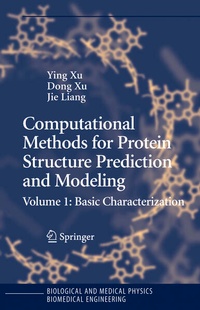
Computational Methods for Protein Structure Prediction and Modeling
Volume 1: Basic Characterization
Published on 15. December 2006
Book
Hardback
XX, 396 pages
978-0-387-33319-9 (ISBN)
Description
An ultimate goal of modern biology is to understand how the genetic blueprint of cells(genotype)determinesthestructure,function,andbehaviorofalivingorganism (phenotype). At the center of this scienti?c endeavor is characterizing the bioch- ical and cellular roles of proteins, the working molecules of the machinery of life. A key to understanding of functional proteins is the knowledge of their folded str- tures in a cell, as the structures provide the basis for studying proteins' functions and functional mechanisms at the molecular level. Researchers working on structure determination have traditionally selected - dividual proteins due to their functional importance in a biological process or pa- way of particular interest. Major research organizations often have their own protein X-ray crystallographic or/and nuclear magnetic resonance facilities for structure - termination, which have been conducted at a rate of a few to dozens of structures a year. Realizing the widening gap between the rates of protein identi?cation (through DNA sequencing and identi?cation of potential genes through bioinformatics an- ysis) and the determination of protein structures, a number of large scienti?c init- tives have been launched in the past few years by government funding agencies in the United States, Europe, and Japan, with the intention to solve protein structures en masse, an effort called structural genomics. A number of structural genomics centers (factory-like facilities) have been established that promise to produce solved protein structures in a similar fashion to DNA sequencing.
More details
Series
Edition
2007 ed.
Language
English
Place of publication
New York
United States
Target group
Professional and scholarly
Research
Product notice
Unsewn / adhesive bound
Paper over boards
Illustrations
88 s/w Abbildungen
XX, 396 p. 88 illus.
Dimensions
Height: 240 mm
Width: 164 mm
Thickness: 24 mm
Weight
703 gr
ISBN-13
978-0-387-33319-9 (9780387333199)
DOI
10.1007/978-0-387-68372-0
Schweitzer Classification
Other editions
Additional editions
Ying Xu | Dong Xu | Jie Liang
Computational Methods for Protein Structure Prediction and Modeling
Volume 1: Basic Characterization
Book
11/2010
Springer
€160.49
Shipment within 15-20 days
Ying Xu | Dong Xu | Jie Liang
Computational Methods for Protein Structure Prediction and Modeling
Volume 1: Basic Characterization
E-Book
08/2007
Springer
€149.79
Available for download
Persons
Dr. Ying Xu is Regents-GRA Eminent Scholar and Professor at the University of Georgia. Dr. Dong Xu is the Director of the Digital Biology Laboratory at the University of Missouri-Columbia. Dr. Jie Liang is the Director for the Center for Bioinformatics at the University of Illinois at Chicago.
Content
A Historical Perspective and Overview of Protein Structure Prediction.- Empirical Force Fields.- Knowledge-Based Energy Functions for Computational Studies of Proteins.- Computational Methods for Domain Partitioning of Protein Structures.- Protein Structure Comparison and Classification.- Computation of Protein Geometry and Its Applications: Packing and Function Prediction.- Local Structure Prediction of Proteins.- Protein Contact Map Prediction.- Modeling Protein Aggregate Assembly and Structure.- Homology-Based Modeling of Protein Structure.- Modeling Protein Structures Based on Density Maps at Intermediate Resolutions.