

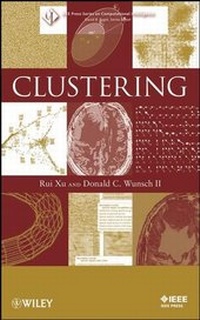
Clustering
Published on 7. November 2008
Book
Hardback
368 pages
978-0-470-27680-8 (ISBN)
Description
The only thorough, comprehensive book available on clustering
From two of the best-known experts in the field comes the first book to take a truly comprehensive look at clustering. The book begins with a complete introduction to cluster analysis in which readers will become familiarized with classification and clustering; definition of clusters; clustering applications; and the literature of clustering algorithms. The authors then present a detailed outline of the book's content and go on to explore:
* Proximity measures
* Hierarchical clustering
* Partition clustering
* Neural network-based clustering
* Kernel-based clustering
* Sequential data clustering
* Large-scale data clustering
* Data visualization and high-dimensional data clustering
* Cluster validation
The authors assume no previous background in clustering and their generous inclusion of examples and references help make the subject matter comprehensible for readers of varying levels and backgrounds. The book is intended as a professional reference for computer scientists and applied mathematicians working with data-intensive applications, and for computational intelligence researchers who use clustering for feature selection or data reduction. Its selection of homework exercises also makes it appropriate as a textbook for graduate students in mathematics, science, and engineering.
Reviews / Votes
"This book provides a comprehensive and thorough presentation of this research area, describing some of the most important clustering algorithms proposed in research literature." (Computing Reviews, June 2009) "The book covers a lot of ground in a relatively small number of pages, and should work well as a learning tool and reference." (Computing Reviews, May 28, 2009)More details
Product info
gebunden
Series
Edition
1. Auflage
Language
English
Place of publication
United States
Publishing group
John Wiley & Sons Inc
Target group
College/higher education
Product notice
sewn/stitched
Cloth over boards
Illustrations
Charts: 85 B&W, 0 Color; Photos: 15 B&W, 0 Color; Tables: 10 B&W, 0 Color; Graphs: 55 B&W, 0 Color
Dimensions
Height: 240 mm
Width: 161 mm
Thickness: 24 mm
Weight
721 gr
ISBN-13
978-0-470-27680-8 (9780470276808)
Schweitzer Classification
Other editions
Additional editions
Persons
Rui Xu, PhD, is a Research Associate in the Department of Electrical and Computer Engineering at Missouri University of Science and Technology. His research interests include computational intelligence, machine learning, data mining, neural networks, pattern classification, clustering, and bioinformatics. Dr. Xu is a member of the IEEE, the IEEE Computational Intelligence Society (CIS), and Sigma Xi.
Donald C. Wunsch II, PhD, is the M.K. Finley Missouri Distinguished Professor at Missouri University of Science and Technology. His key contributions are in adaptive resonance and reinforcement learning hardware and applications, neurofuzzy regression, improved Traveling Salesman Problem heuristics, clustering, and bioinformatics. He is an IEEE Fellow, the 2005 International Neural Networks Society (INNS) President, and Senior Fellow of the INNS.
Content
PREFACE.
1. CLUSTER ANALYSIS.
1.1. Classifi cation and Clustering.
1.2. Defi nition of Clusters.
1.3. Clustering Applications.
1.4. Literature of Clustering Algorithms.
1.5. Outline of the Book.
2. PROXIMITY MEASURES.
2.1. Introduction.
2.2. Feature Types and Measurement Levels.
2.3. Defi nition of Proximity Measures.
2.4. Proximity Measures for Continuous Variables.
2.5. Proximity Measures for Discrete Variables.
2.6. Proximity Measures for Mixed Variables.
2.7. Summary.
3. HIERARCHICAL CLUSTERING.
3.1. Introduction.
3.2. Agglomerative Hierarchical Clustering.
3.3. Divisive Hierarchical Clustering.
3.4. Recent Advances.
3.5. Applications.
3.6. Summary.
4. PARTITIONAL CLUSTERING.
4.1. Introduction.
4.2. Clustering Criteria.
4.3. K-Means Algorithm.
4.4. Mixture Density-Based Clustering.
4.5. Graph Theory-Based Clustering.
4.6. Fuzzy Clustering.
4.7. Search Techniques-Based Clustering Algorithms.
4.8. Applications.
4.9. Summary.
5. NEURAL NETWORK-BASED CLUSTERING.
5.1. Introduction.
5.2. Hard Competitive Learning Clustering.
5.3. Soft Competitive Learning Clustering.
5.4. Applications.
5.5. Summary.
6. KERNEL-BASED CLUSTERING.
6.1. Introduction.
6.2. Kernel Principal Component Analysis.
6.3. Squared-Error-Based Clustering with Kernel Functions.
6.4. Support Vector Clustering.
6.5. Applications.
6.6. Summary.
7. SEQUENTIAL DATA CLUSTERING.
7.1. Introduction.
7.2. Sequence Similarity.
7.3. Indirect Sequence Clustering.
7.4. Model-Based Sequence Clustering.
7.5. Applications--Genomic and Biological Sequence.
7.6. Summary.
8. LARGE-SCALE DATA CLUSTERING.
8.1. Introduction.
8.2. Random Sampling Methods.
8.3. Condensation-Based Methods.
8.4. Density-Based Methods.
8.5. Grid-Based Methods.
8.6. Divide and Conquer.
8.7. Incremental Clustering.
8.8. Applications.
8.9. Summary.
9. DATA VISUALIZATION AND HIGH-DIMENSIONAL DATA CLUSTERING.
9.1. Introduction.
9.2. Linear Projection Algorithms.
9.3. Nonlinear Projection Algorithms.
9.4. Projected and Subspace Clustering.
9.5. Applications.
9.6. Summary.
10. CLUSTER VALIDITY.
10.1. Introduction.
10.2. External Criteria.
10.3. Internal Criteria.
10.4. Relative Criteria.
10.5. Summary.
11. CONCLUDING REMARKS.
PROBLEMS.
REFERENCES.
AUTHOR INDEX.
SUBJECT INDEX.