

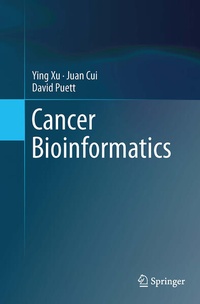
Cancer Bioinformatics
Published on 17. September 2016
Book
Paperback/Softback
XXVI, 368 pages
978-1-4939-4303-6 (ISBN)
Description
This book provides a framework for computational researchers studying the basics of cancer through comparative analyses of omic data. It discusses how key cancer pathways can be analyzed and discovered to derive new insights into the disease and identifies diagnostic and prognostic markers for cancer. Chapters explain the basic cancer biology and how cancer develops, including the many potential survival routes. The examination of gene-expression patterns uncovers commonalities across multiple cancers and specific characteristics of individual cancer types. The authors also treat cancer as an evolving complex system, explore future case studies, and summarize the essential online data sources. Cancer Bioinformatics is designed for practitioners and researchers working in cancer research and bioinformatics. It is also suitable as a secondary textbook for advanced-level students studying computer science, biostatistics or biomedicine.
More details
Edition
Softcover reprint of the original 1st ed. 2014
Language
English
Place of publication
New York
United States
Target group
Professional and scholarly
Illustrations
68 s/w Abbildungen
XXVI, 368 p. 68 illus.
Dimensions
Height: 235 mm
Width: 155 mm
Thickness: 22 mm
Weight
598 gr
ISBN-13
978-1-4939-4303-6 (9781493943036)
DOI
10.1007/978-1-4939-1381-7
Schweitzer Classification
Other editions
Additional editions
Ying Xu | Juan Cui | David Puett
Cancer Bioinformatics
Book
09/2014
Springer
€53.49
Shipment within 15-20 days
Content
Basic cancer biology.-
Omic
data, information derivable and computational needs.- Cancer classification and molecular signature identification.- Understanding cancer at the genomic level.- Elucidation of cancer divers through comparative
omic
analyses.- Hyaluronic acid: A key facilitator of cancer evolution.- Multiple routes for survival: Understanding how cancer evades apoptosis.- Cancer development in competitive and hostile environments.- Cell proliferation from regulated to deregulated state via epigenomic responses.- Understanding cancer invasion and metastasis.- Cancer after metastasis: The second transformation.- Searching for cancer biomarkers in human body fluids.-
In silico
investigation of cancer using publicly available data.- Understanding cancer as an evolving complex system: our perspective.