

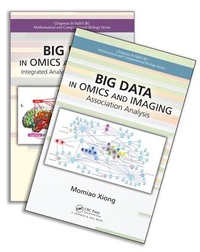
Big Data in Omics and Imaging, Two Volume Set
1st Edition
Published on 14. May 2026
Book
1466 pages
978-0-367-00218-3 (ISBN)
Description
FEATURES
Bridges the gap between the traditional statistical methods and computational tools for small genetic and epigenetic data analysis and the modern advanced statistical methods for big data
Provides tools for high dimensional data reduction
Discusses searching algorithms for model and variable selection including randomization algorithms, Proximal methods and matrix subset selection
Provides real-world examples and case studies
Will have an accompanying website with R code
Provides a natural extension and companion volume to Big Data in Omic and Imaging: Association Analysis, but can be read independently.
Introduce causal inference theory to genomic, epigenomic and imaging data analysis
Develop novel statistics for genome-wide causation studies and epigenome-wide causation studies.
Bridge the gap between the traditional association analysis and modern causation analysis
Use combinatorial optimization methods and various causal models as a general framework for inferring multilevel omic and image causal networks
Present statistical methods and computational algorithms for searching causal paths from genetic variant to disease
Develop causal machine learning methods integrating causal inference and machine learning
Develop statistics for testing significant difference in directed edge, path, and graphs, and for assessing causal relationships between two networks
The book is designed for graduate students and researchers in genomics, bioinformatics, and data science. It represents the paradigm shift of genetic studies of complex diseases- from shallow to deep genomic analysis, from low-dimensional to high dimensional, multivariate to functional data analysis with next-generation sequencing (NGS) data, and from homogeneous populations to heterogeneous population and pedigree data analysis. Topics covered are: advanced matrix theory, convex optimization algorithms, generalized low rank models, functional data analysis techniques, deep learning principle and machine learning methods for modern association, interaction, pathway and network analysis of rare and common variants, biomarker identification, disease risk and drug response prediction.
Bridges the gap between the traditional statistical methods and computational tools for small genetic and epigenetic data analysis and the modern advanced statistical methods for big data
Provides tools for high dimensional data reduction
Discusses searching algorithms for model and variable selection including randomization algorithms, Proximal methods and matrix subset selection
Provides real-world examples and case studies
Will have an accompanying website with R code
Provides a natural extension and companion volume to Big Data in Omic and Imaging: Association Analysis, but can be read independently.
Introduce causal inference theory to genomic, epigenomic and imaging data analysis
Develop novel statistics for genome-wide causation studies and epigenome-wide causation studies.
Bridge the gap between the traditional association analysis and modern causation analysis
Use combinatorial optimization methods and various causal models as a general framework for inferring multilevel omic and image causal networks
Present statistical methods and computational algorithms for searching causal paths from genetic variant to disease
Develop causal machine learning methods integrating causal inference and machine learning
Develop statistics for testing significant difference in directed edge, path, and graphs, and for assessing causal relationships between two networks
The book is designed for graduate students and researchers in genomics, bioinformatics, and data science. It represents the paradigm shift of genetic studies of complex diseases- from shallow to deep genomic analysis, from low-dimensional to high dimensional, multivariate to functional data analysis with next-generation sequencing (NGS) data, and from homogeneous populations to heterogeneous population and pedigree data analysis. Topics covered are: advanced matrix theory, convex optimization algorithms, generalized low rank models, functional data analysis techniques, deep learning principle and machine learning methods for modern association, interaction, pathway and network analysis of rare and common variants, biomarker identification, disease risk and drug response prediction.
More details
Series
Language
English
Place of publication
United Kingdom
Publishing group
Taylor & Francis Ltd
Target group
Professional and scholarly
Professional Practice & Development
Dimensions
Height: 254 mm
Width: 178 mm
Weight
2870 gr
ISBN-13
978-0-367-00218-3 (9780367002183)
Copyright in bibliographic data and cover images is held by Nielsen Book Services Limited or by the publishers or by their respective licensors: all rights reserved.
Schweitzer Classification
Person
Momiao Xiong is a professor of Biostatistics at the University of Texas Health Science Center in Houston where he has worked since 1997. He received his PhD in 1993 from the University of Georgia.
Content
K25794:
Mathematical Foundation.
Linkage Disequilibrium.
Association Studies for Qualitative Traits.
Association Studies for Quantitative Traits.
Multiple Phenotype Association Studies.
K345128
Preface
Author
1. Genotype-Phenotype Network Analysis
2. Causal Analysis and Network Biology
3. Wearable Computing and Genetic Analysis of Function-Valued Traits
4. RNA-Seq Data Analysis
5. Methylation Data Analysis
6. Imaging and Genomics
7. From Association Analysis to Integrated Causal Inference
References
Index
Mathematical Foundation.
Linkage Disequilibrium.
Association Studies for Qualitative Traits.
Association Studies for Quantitative Traits.
Multiple Phenotype Association Studies.
K345128
Preface
Author
1. Genotype-Phenotype Network Analysis
2. Causal Analysis and Network Biology
3. Wearable Computing and Genetic Analysis of Function-Valued Traits
4. RNA-Seq Data Analysis
5. Methylation Data Analysis
6. Imaging and Genomics
7. From Association Analysis to Integrated Causal Inference
References
Index