

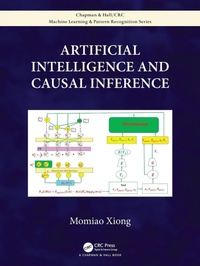
Artificial Intelligence and Causal Inference
1st Edition
Published on 27. May 2024
Book
Paperback/Softback
368 pages
978-1-032-19328-1 (ISBN)
Description
Artificial Intelligence and Causal Inference address the recent development of relationships between artificial intelligence (AI) and causal inference. Despite significant progress in AI, a great challenge in AI development we are still facing is to understand mechanism underlying intelligence, including reasoning, planning and imagination. Understanding, transfer and generalization are major principles that give rise intelligence. One of a key component for understanding is causal inference. Causal inference includes intervention, domain shift learning, temporal structure and counterfactual thinking as major concepts to understand causation and reasoning. Unfortunately, these essential components of the causality are often overlooked by machine learning, which leads to some failure of the deep learning. AI and causal inference involve (1) using AI techniques as major tools for causal analysis and (2) applying the causal concepts and causal analysis methods to solving AI problems. The purpose of this book is to fill the gap between the AI and modern causal analysis for further facilitating the AI revolution. This book is ideal for graduate students and researchers in AI, data science, causal inference, statistics, genomics, bioinformatics and precision medicine.
Key Features:
Cover three types of neural networks, formulate deep learning as an optimal control problem and use Pontryagin's Maximum Principle for network training.
Deep learning for nonlinear mediation and instrumental variable causal analysis.
Construction of causal networks is formulated as a continuous optimization problem.
Transformer and attention are used to encode-decode graphics. RL is used to infer large causal networks.
Use VAE, GAN, neural differential equations, recurrent neural network (RNN) and RL to estimate counterfactual outcomes.
AI-based methods for estimation of individualized treatment effect in the presence of network interference.
Key Features:
Cover three types of neural networks, formulate deep learning as an optimal control problem and use Pontryagin's Maximum Principle for network training.
Deep learning for nonlinear mediation and instrumental variable causal analysis.
Construction of causal networks is formulated as a continuous optimization problem.
Transformer and attention are used to encode-decode graphics. RL is used to infer large causal networks.
Use VAE, GAN, neural differential equations, recurrent neural network (RNN) and RL to estimate counterfactual outcomes.
AI-based methods for estimation of individualized treatment effect in the presence of network interference.
Reviews / Votes
" Both deep learning and causal inference are fast-moving fields, and the author covers the latest topics and methods well. The book has a high ratio of equations to text, and even more technical material is contained in appendices at the end of each chapter."Stanley E. Lazic, University of Ottawa, Series A: Statisics in Society, 2022.
"The book is suitable for use in a graduate-level course on AI. The exercises are challenging but their answers are provided in the end of the book. Not all contents are understandable by the statistics community or commonly useful in the practice of statistics. I enjoyed reading this book. I recommend this book to engineering, data science, predictive business, statistics and computing professionals."
Ramalingam Shanmugam, School of Health Administration, Texas State University, San Marcos, Texas, Journal of Statistical Computation and Simulation, 2023.
More details
Series
Language
English
Place of publication
Boca Raton
United Kingdom
Publishing group
Taylor & Francis Ltd
Illustrations
72 s/w Abbildungen, 72 s/w Zeichnungen, 3 s/w Tabellen
3 Tables, black and white; 72 Line drawings, black and white; 72 Illustrations, black and white
Dimensions
Height: 280 mm
Width: 210 mm
Thickness: 21 mm
Weight
965 gr
ISBN-13
978-1-032-19328-1 (9781032193281)
Copyright in bibliographic data and cover images is held by Nielsen Book Services Limited or by the publishers or by their respective licensors: all rights reserved.
Schweitzer Classification
Other editions
Additional editions
Momiao Xiong
Artificial Intelligence and Causal Inference
Book
03/2022
1st Edition
Chapman & Hall/CRC
€154.75
Shipment within 15-20 days
Momiao Xiong
Artificial Intelligence and Causal Inference
E-Book
02/2022
1st Edition
Chapman & Hall/CRC
€63.49
Available for download
Momiao Xiong
Artificial Intelligence and Causal Inference
E-Book
02/2022
1st Edition
Chapman & Hall/CRC
€63.49
Available for download
Person
Momiao Xiong, is a professor in the Department of Biostatistics and Data Science, University of Texas School of Public Health, and a regular member in the Genetics & Epigenetics (G&E) Graduate Program at The University of Texas MD Anderson Cancer Center, UTHealth Graduate School of Biomedical Science. His interests are artificial intelligence, causal inference, bioinformatics and genomics.
Content
1. Deep Neural Networks. 2. Deep Wide Neural Networks. 3. Dynamics of Output of Neural Networks. 4. Deep Generative Models. 5. Representation Learning. 5. Graph Representation Learning. 6. Deep Learning for Causal Inference. 7. Deep Learning for Counterfactual Inference and Treatment Estimation. 8. Reinforcement Learning, Meta-Learning for Causal Inference and Quantum Causal Analysis.