

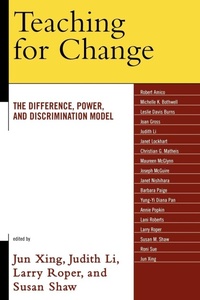
Teaching for Change
The Difference, Power, and Discrimination Model
Published on 3. February 2007
Book
Paperback/Softback
262 pages
978-0-7391-1914-3 (ISBN)
Description
Over the past three decades, American higher education has witnessed a shift in demographics which has created a more diverse student body. However, many university campuses remain unsupportive or even hostile to minority faculty and students. This anthology introduces to readers the Difference, Power, and Discrimination (DPD) Program, a 15-year-old curricular model, at Oregon State University. DPD is concerned with helping students understand the complex dynamics of difference, power, and discrimination and how these dynamics influence institutions, with the goal of empowering students to alleviate oppression and other negative outcomes. Teaching for Change addresses the needs of those who are engaged in diversity training and curricular reforms both in higher education and public schools. It will serve as a useful guide for administrators as well as teaching faculty who are interested in initiating similar programs.
Reviews / Votes
Overall, I think that the book was well written and provided much important information that other institutions could use to help in developing or refining the courses they are currently teaching. The most distinctive contribution of this book was its description of the reason for developing the program and how it has been sustained for several years. * The Review of Higher Education *More details
Language
English
Place of publication
United States
Publishing group
Bloomsbury Publishing Plc
Dimensions
Height: 229 mm
Width: 152 mm
Thickness: 16 mm
Weight
430 gr
ISBN-13
978-0-7391-1914-3 (9780739119143)
Copyright in bibliographic data and cover images is held by Nielsen Book Services Limited or by the publishers or by their respective licensors: all rights reserved.
Schweitzer Classification
Persons
Jun Xing is the Director of the Difference, Power, and Discrimination Program at Oregon State University and a professor in the Department of Ethnic Studies. Judith L. Li is Associate Professor in the Department of Fisheries and Wildlife at Oregon State University. Larry D. Roper is Vice Provost for Student Affairs and Professor of Ethnic Studies at Oregon State University. Susan M. Shaw is Associate Professor and Director of Women's Studies at Oregon State University.
Content
Chapter 1 Introduction: Difference, Power and Discrimination (DPD), Social Justice and Curricular Reform
Part 2 Overview
Chapter 3 Chapter 1: A History of Difference, Power, and Discrimination at Oregon State University
Part 4 Rationale and Need
Chapter 5 Chapter 2: Course Rationale, Criteria, and Design
Chapter 6 Chapter 3: Difference, Power, and Discrimination: Role in the OSU Baccalaureate Core
Part 7 Faculty Development: The DPD Faculty Seminar
Chapter 8 Chapter 4: The DPD Seminar: A Pedagogical Model for Negotiating Difference
Chapter 9 Chapter 5: Teaching Teachers to Transgress: Facilitating the DPD Seminar
Part 10 Pedagogy, Curriculum Development, and Curriculum Transformation
Chapter 11 Chapter 6: Challenges and Rewards of Teaching DPD in a Science Curriculum
Chapter 12 Chapter 7: Writing-to-Learn and Writing for Change
Chapter 13 Chapter 8: Difference, Power, and Discrimination in Engineering Education
Chapter 14 Chapter 9: DPD and Graduate Education: Earning an Advanced Degree in a Fragmented Curriculum
Chapter 15 Chapter 10: Transcending "Just Another Baccalaureate Requirement": Operationalizing the Teachings of Difference, Power and Discrimination
Part 16 Institutional Strategies
Chapter 17 Chapter 11: Applying DPD at Other Institutions: An Incremental Additive Approach
Chapter 18 Chapter 12: Difference, Power, and Responsibility at Chemeketa Community College
Chapter 19 Chapter 13: Creating, Sustaining, and Transforming Difference, Power and Discrimination Programs
Part 2 Overview
Chapter 3 Chapter 1: A History of Difference, Power, and Discrimination at Oregon State University
Part 4 Rationale and Need
Chapter 5 Chapter 2: Course Rationale, Criteria, and Design
Chapter 6 Chapter 3: Difference, Power, and Discrimination: Role in the OSU Baccalaureate Core
Part 7 Faculty Development: The DPD Faculty Seminar
Chapter 8 Chapter 4: The DPD Seminar: A Pedagogical Model for Negotiating Difference
Chapter 9 Chapter 5: Teaching Teachers to Transgress: Facilitating the DPD Seminar
Part 10 Pedagogy, Curriculum Development, and Curriculum Transformation
Chapter 11 Chapter 6: Challenges and Rewards of Teaching DPD in a Science Curriculum
Chapter 12 Chapter 7: Writing-to-Learn and Writing for Change
Chapter 13 Chapter 8: Difference, Power, and Discrimination in Engineering Education
Chapter 14 Chapter 9: DPD and Graduate Education: Earning an Advanced Degree in a Fragmented Curriculum
Chapter 15 Chapter 10: Transcending "Just Another Baccalaureate Requirement": Operationalizing the Teachings of Difference, Power and Discrimination
Part 16 Institutional Strategies
Chapter 17 Chapter 11: Applying DPD at Other Institutions: An Incremental Additive Approach
Chapter 18 Chapter 12: Difference, Power, and Responsibility at Chemeketa Community College
Chapter 19 Chapter 13: Creating, Sustaining, and Transforming Difference, Power and Discrimination Programs