

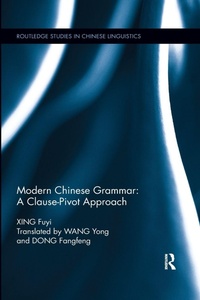
Modern Chinese Grammar - a Clause-Pivot Approach
1st Edition
Published on 28. April 2020
Book
Paperback/Softback
640 pages
978-0-367-51672-7 (ISBN)
Description
Modern Chinese Grammar provides a comprehensive coverage of Chinese grammar through the clause-pivot theory and the double triangle approach, first proposed by Fuyi Xing in 1996.
Translated into English for the first time, the book is widely regarded by linguists as a seminal text, and ground-breaking in linguistics research. The book contains discussion of the topics which are essential to Chinese grammar, from words and phrases, to complex sentences and sentence groups. It addresses such controversial issues as word class identification, the distinction between words and phrases, and between clauses and complex sentences. The book also shows, through a wealth of examples, how the clause-pivot theory and the double triangle approach can be applied productively in grammatical studies.
Modern Chinese Grammar: A Clause-Pivot Theoretical Approach is an essential purchase for researchers and graduate students of Chinese grammar and syntax.
Translated into English for the first time, the book is widely regarded by linguists as a seminal text, and ground-breaking in linguistics research. The book contains discussion of the topics which are essential to Chinese grammar, from words and phrases, to complex sentences and sentence groups. It addresses such controversial issues as word class identification, the distinction between words and phrases, and between clauses and complex sentences. The book also shows, through a wealth of examples, how the clause-pivot theory and the double triangle approach can be applied productively in grammatical studies.
Modern Chinese Grammar: A Clause-Pivot Theoretical Approach is an essential purchase for researchers and graduate students of Chinese grammar and syntax.
More details
Series
Language
English
Place of publication
London
United Kingdom
Publishing group
Taylor & Francis Ltd
Target group
College/higher education
Illustrations
17 s/w Tabellen
17 Tables, black and white
Dimensions
Height: 234 mm
Width: 156 mm
Thickness: 36 mm
Weight
998 gr
ISBN-13
978-0-367-51672-7 (9780367516727)
Copyright in bibliographic data and cover images is held by Nielsen Book Services Limited or by the publishers or by their respective licensors: all rights reserved.
Schweitzer Classification
Other editions
Additional editions
Book
11/2016
1st Edition
Routledge
€462.50
Shipment within 10-20 days
E-Book
11/2016
Routledge
€60.49
Available for download
E-Book
11/2016
Routledge
€60.49
Available for download
Persons
Fuyi Xing has won many prizes and honours for his contribution to the study of Chinese grammar in China. His influence is felt internationally, and he is recognized as the founder to logic-oriented Chinese grammar in Russia, and as one of the most important Chinese grammarians of the 20th century in China.
Yong Wang is a professor at the Department of English Language and Literature, Central China Normal University, China.
Fangfeng Dong is a professor in the School of Foreign Languages, Central China Normal University, China.
Yong Wang is a professor at the Department of English Language and Literature, Central China Normal University, China.
Fangfeng Dong is a professor in the School of Foreign Languages, Central China Normal University, China.
Content
INTRODUCTION
PART I THE CLAUSE
Chapter 1. The Clause as the Pivot in Chinese Grammar
Chapter 2. The Principles of Clause Formation, Inclusion, and Conjoining
Chapter 3. Functional Assignment, Nucleus, and Clause Patterns
Chapter 4 Subject-Predicate and Predicator-Object
Chapter 5 Attribute-Head, Adverbial-Head, and Head-Complement
Chapter 6 Clause-Specific Features
PART II CLAUSE CONSTITUENTS
Chapter 7 Introduction of Constituent Units
Chapter 8 Constituent Words
Chapter 9 Special Constituent Words
Chapter 10 Non-constituent Words
Chapter 11 Phrases
Chapter 12 Problems in Word Class Identification
PART III CLAUSE-CONJOINING
Chapter 13 Formation of Complex Sentences
Chapter 14 Connectives in Complex Sentences
Chapter 15 Inter-clausal Relations and Patterns of Complex Sentences
Chapter 16 Diversity of Complex Sentence Patterns
Chapter 17 Sentence Groups
PART IV METHODOLOGY
Chapter 18 Complex Sentences and Related Issues
Chapter 19 Methodology: The minor triangle
Chapter 20 Methodology: The major triangle
Chapter 21 Methodology: The three adequacies in grammatical studies
PART I THE CLAUSE
Chapter 1. The Clause as the Pivot in Chinese Grammar
Chapter 2. The Principles of Clause Formation, Inclusion, and Conjoining
Chapter 3. Functional Assignment, Nucleus, and Clause Patterns
Chapter 4 Subject-Predicate and Predicator-Object
Chapter 5 Attribute-Head, Adverbial-Head, and Head-Complement
Chapter 6 Clause-Specific Features
PART II CLAUSE CONSTITUENTS
Chapter 7 Introduction of Constituent Units
Chapter 8 Constituent Words
Chapter 9 Special Constituent Words
Chapter 10 Non-constituent Words
Chapter 11 Phrases
Chapter 12 Problems in Word Class Identification
PART III CLAUSE-CONJOINING
Chapter 13 Formation of Complex Sentences
Chapter 14 Connectives in Complex Sentences
Chapter 15 Inter-clausal Relations and Patterns of Complex Sentences
Chapter 16 Diversity of Complex Sentence Patterns
Chapter 17 Sentence Groups
PART IV METHODOLOGY
Chapter 18 Complex Sentences and Related Issues
Chapter 19 Methodology: The minor triangle
Chapter 20 Methodology: The major triangle
Chapter 21 Methodology: The three adequacies in grammatical studies