

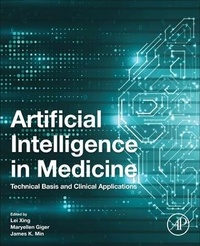
Artificial Intelligence in Medicine
Technical Basis and Clinical Applications
Published on 3. September 2020
Book
Paperback/Softback
568 pages
978-0-12-821259-2 (ISBN)
Description
Artificial Intelligence Medicine: Technical Basis and Clinical Applications presents a comprehensive overview of the field, ranging from its history and technical foundations, to specific clinical applications and finally to prospects. Artificial Intelligence (AI) is expanding across all domains at a breakneck speed. Medicine, with the availability of large multidimensional datasets, lends itself to strong potential advancement with the appropriate harnessing of AI.
The integration of AI can occur throughout the continuum of medicine: from basic laboratory discovery to clinical application and healthcare delivery. Integrating AI within medicine has been met with both excitement and scepticism. By understanding how AI works, and developing an appreciation for both limitations and strengths, clinicians can harness its computational power to streamline workflow and improve patient care. It also provides the opportunity to improve upon research methodologies beyond what is currently available using traditional statistical approaches. On the other hand, computers scientists and data analysts can provide solutions, but often lack easy access to clinical insight that may help focus their efforts. This book provides vital background knowledge to help bring these two groups together, and to engage in more streamlined dialogue to yield productive collaborative solutions in the field of medicine.
The integration of AI can occur throughout the continuum of medicine: from basic laboratory discovery to clinical application and healthcare delivery. Integrating AI within medicine has been met with both excitement and scepticism. By understanding how AI works, and developing an appreciation for both limitations and strengths, clinicians can harness its computational power to streamline workflow and improve patient care. It also provides the opportunity to improve upon research methodologies beyond what is currently available using traditional statistical approaches. On the other hand, computers scientists and data analysts can provide solutions, but often lack easy access to clinical insight that may help focus their efforts. This book provides vital background knowledge to help bring these two groups together, and to engage in more streamlined dialogue to yield productive collaborative solutions in the field of medicine.
Reviews / Votes
"Packed full of latest developments and expert discussions, Artificial Intelligence in Medicine covers a wide range of general and specialty medical AI topics. The discussed medical AI applications are fueled with a vast range of medical big data such as imaging, video, text, audio, genomics, demographics, and laboratory measurements, and these include both standard medical data and those mass collected from mobile devices. In addition to covering the technical basis and computing algorithms, the book also details the unique success and challenges in each clinical area ranging from specific medical problems, different health specialties, to global epidemic monitoring and control. The book also folds in the regulatory and industry perspectives as well as experts' outlook of the future of medical AI. Compared with similar books on the market, Artificial Intelligence in Medicine is uniquely suited as a foundation reading for anyone interested in working with AI in medicine. Unlike single-author books such as Deep Medicine, Artificial Intelligence in Healthcare, and Machine Learning and AI for Healthcare that were written to introduce the medical AI topic to and engage a general discussion with lay audience, this book is a comprehensive, scientific, and technical volume contributed by a large team of expert authors for professional and scientific audience. Compared with other relevant technical books such as Big Data in Radiation Oncology, Radiomics and Radiogenomics, and Machine Learning in Radiation Oncology, this book goes beyond radiation oncology and medical physics to comprehensively cover the wide field of medicine. For medical physics readers, the book not only touches on the applications familiar to us but also offers valuable inspirations from those others that we may not usually encounter in our specialty. The wide range of applications and topics addressed by the book could help readers from any field to frame a global perspective on AI in medicine.The field of AI is rapidly evolving, making any paper publication difficult to encompass this ever-changing body of knowledge. Released in September 2020, Artificial Intelligence in Medicine provides the best available comprehensive and fundamental volume on the topic. The book highlights a current dichotomy: despite the enormous promise AI holds in medicine, it has yet to show revolutionary clinical benefits, indicating that we may still be at the dawn of a new AI age in medicine. Written by a large team of influential editors and authors, Artificial Intelligence in Medicine undoubtedly provides a great resource for anyone interested in playing a part in this exciting, upcoming new age." --Journal of Applied Clinical Medical PhysicsMore details
Language
English
Place of publication
San Diego
United States
Publishing group
Elsevier Science Publishing Co Inc
Target group
Professional and scholarly
Clinicians, medical doctors, bioinformaticians, bioengineers, data scientists
Product notice
Paperback (trade)
Unsewn / adhesive bound
Illustrations
Approx. 100 illustrations (50 in full color)
Dimensions
Height: 232 mm
Width: 191 mm
Thickness: 30 mm
Weight
1172 gr
ISBN-13
978-0-12-821259-2 (9780128212592)
Copyright in bibliographic data and cover images is held by Nielsen Book Services Limited or by the publishers or by their respective licensors: all rights reserved.
Schweitzer Classification
Other editions
Additional editions
Lei Xing | Maryellen L. Giger | James K. Min
Artificial Intelligence in Medicine
Technical Basis and Clinical Applications
E-Book
09/2020
Academic Press
€175.00
Available for download
Persons
Dr. Lei Xing is currently the Jacob Haimson Professor of Medical Physics and Director of Medical Physics Division of Radiation Oncology Department at Stanford University. He also holds affiliate faculty positions in Department of Electrical Engineering, Bio-X and Molecular Imaging Program at Stanford. Dr. Xing's research has been focused on artificial intelligence in medicine, medical imaging, treatment planning, molecular imaging instrumentations, image guided interventions, and nanomedicine. He has made unique and significant contributions to each of the above areas. Dr. Xing is an author on more than 400 peer reviewed publications, a co-inventor on many issued and pending patents, and a principal investigator on numerous NIH, ACS, DOD, AAPM, RSNA and corporate grants. He is a fellow of AAPM (American Association of Physicists in Medicine) and AIMBE (American Institute for Medical and Biological Engineering). He has received numerous awards from various societies and organizations for his work in artificial intelligence, medical physics and medical imaging. Dr. Maryellen L. Giger is the A.N. Pritzker Professor of Radiology, the Committee on Medical Physics, and the College at the University of Chicago. She also serves as Vice-Chair in the Department of Radiology for Basic Science Research. Dr. Giger is one of the pioneers in the field of CAD (computer-aided diagnosis) and her artificial intelligence research in cancer imaging for risk assessment, diagnosis, prognosis, and therapeutic response has yielded various translated components, including the use of these "virtual biopsies? in imaging-genomics association studies. She is a recipient of multiple NIH, DOD, and other grants, has authored more than 240 peer-reviewed journal papers, and is inventor on 30 patents. Dr. Giger is a member of the National Academy of Engineering (NAE) of the National Academies; Fellow of AAPM, AIMBE, SPIE, SBMR, IEEE, and IAMBE; recipient of the William D. Coolidge Gold Medal from the AAPM; a former president of AAPM and of SPIE; and is the current Editor-in-Chief of the Journal of Medical Imaging. She was cofounder of Quantitative Insights [now Qlarity Imaging], which produced QuantX, the first FDA-cleared, machine-learning driven CADx system to aid in cancer diagnosis. Her lab focuses on the development of multimodality CAD, quantitative image analysis/machine learning methods, and radiomics for AI in medical imaging. Dr. James K. Min is the founder and CEO of Cleerly, Inc. Prior to this, Dr. Min was a Professor of Radiology and Medicine at the Weill Cornell Medical College. He also served as the Director of the Dalio Institute of Cardiovascular Imaging at New York-Presbyterian Hospital. He is an expert in cardiovascular imaging, having led numerous multicenter clinical trials and applying artificial intelligence methods to improve diagnosis and prognostication of coronary heart disease. Dr. Min has published over 450 peer-reviewed journal papers and has been the recipient of continual NIH grants for nearly a decade. Dr. Min is a Fellow of the American College of Cardiology and the European Society of Cardiology, and a Master of the Society of Cardiovascular Computed Tomography. He has received numerous awards from professional societies for his work in cardiovascular imaging and coronary heart disease. In his current role at Cleerly, Dr. Min is dedicating his efforts to developing end-to-end AI-based care pathways to prevent heart attacks.
Editor
Radiation Oncology Department, Stanford University, Stanford, CA, United States
Committee on Medical Physics, The University of Chicago, Chicago, IL, United States
Weill Cornell Medical College, New York, NY, United States
Dalio Institute of Cardiovascular Imaging, NewYork-Presbyterian Hospital/Weill Cornell Medical Center,
New York, NY, United States
Dalio Institute of Cardiovascular Imaging, NewYork-Presbyterian Hospital/Weill Cornell Medical Center,
New York, NY, United States
Content
I Introduction
1. Artificial intelligence in medicine: past, present, and future2. Artificial intelligence in medicine: Technical basis and clinical applications
II Technical basis
3. Deep learning for biomedical videos: perspective and recommendations4. Biomedical imaging and analysis through deep learning5. Expert systems in medicine6. Privacy-preserving collaborative deep learning methods for multiinstitutional training without sharing patient data7. Analytics methods and tools for integration of biomedical data in medicine
III Clinical applications
8. Electronic health record data mining for artificial intelligence healthcare9. Roles of artificial intelligence in wellness, healthy living, and healthy status sensing10. The growing significance of smartphone apps in data-driven clinical decision-making: Challenges and pitfalls11. Artifical intelligence for pathology12. The potential of deep learning for gastrointestinal endoscopy-a disruptive new technology13. Lessons learnt from harnessing deep learning for real-world clinical applications in ophthalmology: detecting diabetic retinopathy from retinal fundus photographs14. Artificial intelligence in radiology15. Artificial intelligence and interpretations in breast cancer imaging 16. Prospect and adversity of artificial intelligence in urology17. Meaningful incorporation of artificial intelligence for personalized patient management during cancer: Quantitative imaging, risk assessment, and therapeutic outcomes18. Artificial intelligence in oncology19. Artificial intelligence in cardiovascular imaging20. Artificial intelligence as applied to clinical neurological conditions21. Harnessing the potential of artificial neural networks for pediatric patient management22. Artificial intelligence-enabled public health surveillance-from local detection to global epidemic monitoring and control
IV Future outlook
23. Regulatory, social, ethical, and legal issues of artificial intelligence in medicine24. Industry perspectives and commercial opportunities of artificial intelligence in medicine25. Outlook of the future landscape of artificial intelligence in medicine and new challenges
1. Artificial intelligence in medicine: past, present, and future2. Artificial intelligence in medicine: Technical basis and clinical applications
II Technical basis
3. Deep learning for biomedical videos: perspective and recommendations4. Biomedical imaging and analysis through deep learning5. Expert systems in medicine6. Privacy-preserving collaborative deep learning methods for multiinstitutional training without sharing patient data7. Analytics methods and tools for integration of biomedical data in medicine
III Clinical applications
8. Electronic health record data mining for artificial intelligence healthcare9. Roles of artificial intelligence in wellness, healthy living, and healthy status sensing10. The growing significance of smartphone apps in data-driven clinical decision-making: Challenges and pitfalls11. Artifical intelligence for pathology12. The potential of deep learning for gastrointestinal endoscopy-a disruptive new technology13. Lessons learnt from harnessing deep learning for real-world clinical applications in ophthalmology: detecting diabetic retinopathy from retinal fundus photographs14. Artificial intelligence in radiology15. Artificial intelligence and interpretations in breast cancer imaging 16. Prospect and adversity of artificial intelligence in urology17. Meaningful incorporation of artificial intelligence for personalized patient management during cancer: Quantitative imaging, risk assessment, and therapeutic outcomes18. Artificial intelligence in oncology19. Artificial intelligence in cardiovascular imaging20. Artificial intelligence as applied to clinical neurological conditions21. Harnessing the potential of artificial neural networks for pediatric patient management22. Artificial intelligence-enabled public health surveillance-from local detection to global epidemic monitoring and control
IV Future outlook
23. Regulatory, social, ethical, and legal issues of artificial intelligence in medicine24. Industry perspectives and commercial opportunities of artificial intelligence in medicine25. Outlook of the future landscape of artificial intelligence in medicine and new challenges