

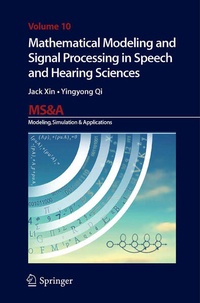
Mathematical Modeling and Signal Processing in Speech and Hearing Sciences
Published on 27. August 2016
Book
Paperback/Softback
XI, 208 pages
978-3-319-35416-3 (ISBN)
Description
The aim of the book is to give an accessible introduction of mathematical models and signal processing methods in speech and hearing sciences for senior undergraduate and beginning graduate students with basic knowledge of linear algebra, differential equations, numerical analysis, and probability. Speech and hearing sciences are fundamental to numerous technological advances of the digital world in the past decade, from music compression in MP3 to digital hearing aids, from network based voice enabled services to speech interaction with mobile phones. Mathematics and computation are intimately related to these leaps and bounds. On the other hand, speech and hearing are strongly interdisciplinary areas where dissimilar scientific and engineering publications and approaches often coexist and make it difficult for newcomers to enter.
Reviews / Votes
From the book reviews:
"The value of the book is enforced by the fact that each chapter is accompanied with specific sections: chapter summary, MATLAB programs, proposed exercises. It is intended for students at the level of senior undergraduate and beginning graduate ones." (Dumitru Stanomir, zbMATH, Vol. 1293, 2014)More details
Series
Edition
Softcover reprint of the original 1st ed. 2014
Language
English
Place of publication
Cham
Switzerland
Publishing group
Springer International Publishing
Illustrations
10 s/w Abbildungen
XI, 208 p. 10 illus.
Dimensions
Height: 235 mm
Width: 155 mm
Thickness: 13 mm
Weight
347 gr
ISBN-13
978-3-319-35416-3 (9783319354163)
DOI
10.1007/978-3-319-03086-9
Schweitzer Classification
Other editions
Additional editions
Jack Xin | Yingyong Qi
Mathematical Modeling and Signal Processing in Speech and Hearing Sciences
Book
12/2013
Springer
€53.49
Shipment within 10-15 days
Content
1 Background Signal Processing, Statistical and Optimization Methods.- 2 Speech Modeling.- 3 Auditory Modeling.- 4 Speech Recognition.- 5 Blind Source Separation and Speech Enhancement.