

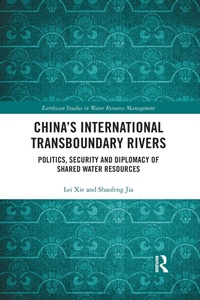
China's International Transboundary Rivers
Politics, Security and Diplomacy of Shared Water Resources
1st Edition
Published on 25. July 2019
Book
Paperback/Softback
232 pages
978-0-367-40370-6 (ISBN)
Description
China has forty major transboundary watercourses with neighbouring countries, and has frequently been accused of harming its downstream neighbours through its domestic water management policies, such as the construction of dams for hydropower. This book provides an understanding of water security in Asia by investigating how shared water resources affect China's relationships with neighbouring countries in South, East, Southeast and Central Asia.
Since China is an upstream state on most of its shared transboundary rivers, the country's international water policy is at the core of Asia's water security. These water disputes have had strong implications for China's interstate relations, and also influenced its international water policy alongside domestic concerns over water resource management.
This book investigates China's policy responses to domestic water crises and examines China's international water policy as well as its strategy in dealing with international cooperation. The authors describe the key elements of water diplomacy in Asia which demonstrate varying degrees of effectiveness of environmental agreements. It shows how China has established various institutional arrangements with neighbouring countries, primarily in the form of bilateral agreements over hydrological data exchange. Detailed case studies are included of the Mekong, Brahmaputra, Ili and Amur rivers.
Since China is an upstream state on most of its shared transboundary rivers, the country's international water policy is at the core of Asia's water security. These water disputes have had strong implications for China's interstate relations, and also influenced its international water policy alongside domestic concerns over water resource management.
This book investigates China's policy responses to domestic water crises and examines China's international water policy as well as its strategy in dealing with international cooperation. The authors describe the key elements of water diplomacy in Asia which demonstrate varying degrees of effectiveness of environmental agreements. It shows how China has established various institutional arrangements with neighbouring countries, primarily in the form of bilateral agreements over hydrological data exchange. Detailed case studies are included of the Mekong, Brahmaputra, Ili and Amur rivers.
Reviews / Votes
"Lei Xie and Shaofeng Jia's book makes a robust contribution to the discussion of international fresh watercourses by combining the Chinese perspective on national interests with the Global South narrative of riparian neighbouring states, all of which are developing countries. Xie and Jia examine and link research areas such as human security, diplomacy, intergovernmental relations, and policies, and the authors contribute insights to the current debate on fresh water management in relation to sustainability and the reduction of tension and conflict." - Francisco Jose Leandro in China Information (2018)More details
Series
Language
English
Place of publication
London
United Kingdom
Publishing group
Taylor & Francis Ltd
Target group
College/higher education
Illustrations
49 s/w Abbildungen
49 Illustrations, black and white
Dimensions
Height: 234 mm
Width: 156 mm
Thickness: 13 mm
Weight
363 gr
ISBN-13
978-0-367-40370-6 (9780367403706)
Copyright in bibliographic data and cover images is held by Nielsen Book Services Limited or by the publishers or by their respective licensors: all rights reserved.
Schweitzer Classification
Other editions
Additional editions
Lei Xie | Jia Shaofeng
China's International Transboundary Rivers
Politics, Security and Diplomacy of Shared Water Resources
E-Book
12/2017
Routledge
€61.99
Available for download
Lei Xie | Jia Shaofeng
China's International Transboundary Rivers
Politics, Security and Diplomacy of Shared Water Resources
E-Book
12/2017
Routledge
€61.99
Available for download
Lei Xie | Jia Shaofeng
China's International Transboundary Rivers
Politics, Security and Diplomacy of Shared Water Resources
Book
11/2017
1st Edition
Routledge
€206.30
Shipment within 10-20 days
Persons
Lei Xie is Professor in Governance at Shandong University. She is also a Research Fellow at Nottingham University. Before joining Shandong University, she lectured in University of Exeter and was a visiting scholar of the Chinese Academy of Sciences. Her research focuses on global environmental governance and transnational environmental movement with particular interest on the international cooperation of transbondary river basins. She is author of Environmental Activism in China (Routledge, 2009).
Shaofeng Jia is Deputy Director of the Center for Water Resources Research, CAS, Vice Chair of Special Committee for Water Resources, the Hydraulic Engineering Society of China?editorial board member of Water International, Geographic Research, Geographic Progress, and Journal of Economics of Water Resources.. His main interests include water resources management, integrated basin management and regional sustainable development, He has authored more than 100 papers and 5 books.
Shaofeng Jia is Deputy Director of the Center for Water Resources Research, CAS, Vice Chair of Special Committee for Water Resources, the Hydraulic Engineering Society of China?editorial board member of Water International, Geographic Research, Geographic Progress, and Journal of Economics of Water Resources.. His main interests include water resources management, integrated basin management and regional sustainable development, He has authored more than 100 papers and 5 books.
Content
1. China's transboundary rivers: politics, diplomacy and security: an introduction 2. The governance of water resources in China 3. China's policy over international rivers: Perception and diplomatic practices 4. Theoretical debate: water diplomacy 5. Southeast Asia: China's water diplomacy on the Mekong River 6. South Asia: China's evolving attitude over the GBM 7. Central Asia: Sino-Kazakh water diplomacy on Ili and Irtysh Rivers 8. Northeast Asia: Sino-Russian cooperation over the Amur River 9. Comparison and conclusions 10. Policy recommendations