

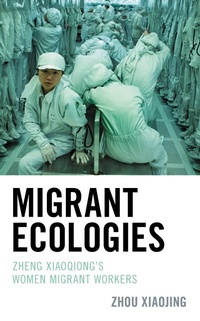
Migrant Ecologies
Zheng Xiaoqiong's Women Migrant Workers
Published on 17. June 2021
Book
Hardback
152 pages
978-1-4985-8063-2 (ISBN)
Description
Migrant Ecologies investigates the ways in which Zheng Xiaoqiong's poetry exposes the entanglements of migrant ecologies embedded within local and global networks of capital and labor. The author contends that women migrant workers in particular, as portrayed in Zheng's poems, are the visible manifestation of the interconnections between the so-called "factories of the world" and slum villages-in-the-city, between urban development and rural decline, and between the local environmental degradation and the global market. By adopting an ecological approach to Zheng's poems about women migrant workers in China, the author explores what Donna Haraway calls "webbed ecologies" (49). The concept of "ecologies" serves to enhance not only the layered, complex interconnections underlying women migrant workers' plight and environmental degradation in China, but also the emergence and transformation of migrant spaces, subjects, activism, and networks resulting in part from globalization.
Reviews / Votes
In Migrant Ecologies, Zhou Xiaojing articulates the hidden intricacies and intimacies of gendered labor, mass migration, ecological devastation, rural decline, and worker resistance in China through her brilliant analysis and translations of Zheng Xioaquion's poetry. This book makes an invaluable contribution to global ecocriticism, the environmental humanities, and migration studies. -- Craig Santos Perez, University of Hawai?i, Manoa Migrant Ecologies represents an imaginative, innovative and sophisticated way of understanding social change in contemporary China. Through the prism of Zheng Xiaoqiong's intimate yet powerful poems, Zhou demonstrates both the human and planetary consequences of social inequality, industrialization and environmental degradation. -- Wanning Sun, University of Technology Sydney China's migrant worker poetry raises fundamental questions about literature and social justice, and Zheng Xiaoqiong crucially brings gender into the equation. Grim yet hopeful, Migrant Ecologies draws on Zheng's poetry for charting the entanglements of global capitalism, migration, environmental destruction, and inequality. -- Maghiel van Crevel, Leiden University When Zheng Xiaoqiong's poetry first appeared in print, it was a seismic event. Only a voice as brutally beautiful as her's could have opened a space large enough in her readers hearts to take in the full vulnerable resilience of China's migrant workers. Once caught in the crossweave of her unflinching witness and the buoyant even sublimity lyricsim, the Chinese poetry world cracked open and has never been put back together again. We have been waiting for a scholar like Zhou Xiaojing to tell this story. And only one as attentive to poetic details as the larger picture they reveal could have done so. Be prepared, and do not delay. Reading this book is as urgent as it is unforgettable. -- Johanthan Stalling, University of Oklahoma Migrant Ecologies is Zhou Xiaojing's excellent, acute, and moving translation of the poetry of Zheng Xiaoqiong, a contemporary Chinese woman migrant worker, poet, and activist. Zhou's Introduction offers eloquent and rigorous critiques of the complex relationships between the exploitation of the gendered labor of Chinese migrant women workers, the health risks in toxic working environment, sexual trafficking, poverty in the large slums in Southern Chinese cities, the contemporary Chinese industrialization, urbanization, environmental degradation, and global capitalism. Zhou advocates for the formation of the Chinese and Third World working class migrant women workers' agency and resistance against environmental and social injustice. This is an important and unique contribution to the literature and scholarship on global eco-feminist ecology and activism. -- Dr. Lingyan Yang, Indiana University of PennsylvaniaMore details
Series
Language
English
Place of publication
United States
Publishing group
Bloomsbury Publishing Plc
Target group
Professional and scholarly
Product notice
sewn/stitched
Cloth over boards
With dust jacket
Illustrations
8 colour photos;
Dimensions
Height: 230 mm
Width: 154 mm
Thickness: 14 mm
Weight
363 gr
ISBN-13
978-1-4985-8063-2 (9781498580632)
Copyright in bibliographic data and cover images is held by Nielsen Book Services Limited or by the publishers or by their respective licensors: all rights reserved.
Schweitzer Classification
Other editions
Additional editions
E-Book
06/2021
1st Edition
Lexington Books
€90.99
Available for download
E-Book
06/2021
1st Edition
Bloomsbury eBooks US
€90.99
Available for download
Person
Zheng Xiaoqiong, a critically acclaimed contemporary poet in China, has published twelve collections of poetry.
Zhou Xiaojing is professor of English at University of the Pacific. She is the author of Cities of Others: Reimagining Urban Spaces in Asian American Literature and The Ethics and Poetics of Alterity in Asian American Poetry.
Zhou Xiaojing is professor of English at University of the Pacific. She is the author of Cities of Others: Reimagining Urban Spaces in Asian American Literature and The Ethics and Poetics of Alterity in Asian American Poetry.
Content
List of Figures
Acknowledgments
Introduction: Migrant Ecologies as a Site of Critical Inquiry
Chapter 1: Vignettes of Material Memoirs: Toxic Environment and Women Migrant Workers' Industrial Diseases
Chapter 2: "Carceral Capitalism": Factory Cities and Villages-in-the-City
Chapter 3: The Other Scene of Globalization: Hollow Villages and Migrant Workers' Families
Conclusion: A Politics of Migrant Ecologies
Bibliography
Index
About the Author and Translator
Acknowledgments
Introduction: Migrant Ecologies as a Site of Critical Inquiry
Chapter 1: Vignettes of Material Memoirs: Toxic Environment and Women Migrant Workers' Industrial Diseases
Chapter 2: "Carceral Capitalism": Factory Cities and Villages-in-the-City
Chapter 3: The Other Scene of Globalization: Hollow Villages and Migrant Workers' Families
Conclusion: A Politics of Migrant Ecologies
Bibliography
Index
About the Author and Translator