

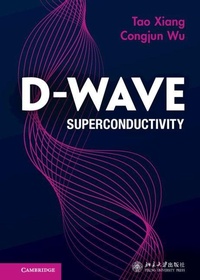
D-wave Superconductivity
Published on 9. June 2022
Book
Hardback
400 pages
978-1-009-21859-7 (ISBN)
Description
This volume provides a comprehensive introduction to the theory of d-wave superconductivity, focused on d-wave pairing symmetry and its physical consequences in the superconducting state. It discusses the basic concepts and methodologies related to high-temperature superconductivity and compares experimental phenomena with theoretical predictions. After a brief introduction to the basic theory of superconductivity and several models for high-temperature superconductivity, this book presents detailed derivations and explanations for various single-particle and collective properties of d-wave superconductors that can be monitored experimentally, including thermodynamics, angular-resolved photo-emission, single-particle and Josephson tunnelling, impurity scattering, magnetic and superfluid responses, transport and optical properties and mixed states. Various universal behaviours of d-wave superconductors are highlighted. Aimed primarily at graduate students and research scientists in condensed matter and materials physics, this text enables readers to understand systematically the physical properties of high-temperature superconductors.
More details
Language
English
Place of publication
Cambridge
United Kingdom
Target group
College/higher education
Illustrations
Worked examples or Exercises
Dimensions
Height: 250 mm
Width: 175 mm
Thickness: 26 mm
Weight
867 gr
ISBN-13
978-1-009-21859-7 (9781009218597)
Copyright in bibliographic data and cover images is held by Nielsen Book Services Limited or by the publishers or by their respective licensors: all rights reserved.
Schweitzer Classification
Other editions
Additional editions
Tao Xiang | Congjun Wu
D-wave Superconductivity
E-Book
06/2022
Cambridge University Press
€63.49
Available for download
Persons
Tao Xiang is a Professor at the Institute of Physics, Chinese Academy of Sciences (CAS), working on Condensed Matter Physics. He is an elected CAS member and a fellow of the World Academy of Sciences. He received the He-Leung-He-Lee Prize for Scientific and Technological Progress and several other awards.
Content
1. Introduction to superconductivity; 2. Microscopic models for high temperature superconductors; 3. Basic properties of d-wave superconductors; 4. Quasiparticle excitation spectra; 5. Tunneling effect; 6. Josephson effect; 7. Single impurity scattering; 8. Many-impurity scattering; 9. Superfluid response; 10. Optical and thermal conductivities; 11. Raman spectroscopy; 12. Nuclear magnetic resonance; 13. Neutron scattering spectroscopy; 14. Mixed state; Appendices; Bibliography; Index.