

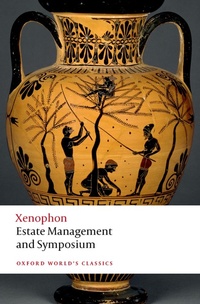
Estate Management and Symposium
Published on 28. April 2022
Book
Paperback/Softback
160 pages
978-0-19-882351-3 (ISBN)
Description
Xenophon was acknowledged in Antiquity as a philosopher, a historian (third in the triad of great Classical historians, alongside Herodotus and Thucydides), and a literary artist. His narrative was appreciated for its literary qualities including its charm, wit, vigour, and sweetness (for which he was hailed as 'Attic Muse': Diogenes Laertius, 2.6.57).
The Oeconomicus describes Socrates conversing on the topic of successful management of one's oikos (household, estate). The focus is a well-to-do Athenian household, which proves a testing ground for the moral qualities or 'gentlemanliness' of the male head of household, but also a space in which the role and agency of women turns out to be key. Symposium shifts to the male space of the men's quarters of the private home, to describe an evening of conversation and entertainment at the house of an Athenian plutocrat. Far from being simply a lighthearted affair, the conversation probes timeless questions regarding wisdom, love, and female capacity, and over it looms the deadly serious matter of Socrates' trial and death.
Both works are rich sources for Athenian social history of the Classical period. Oeconomicus in particular offers insights on the role and status of women in Ancient Athens. Xenophon doesn't, however, passively reflect the social realities he saw around him or supply snapshots of historical actuality.
The Oeconomicus describes Socrates conversing on the topic of successful management of one's oikos (household, estate). The focus is a well-to-do Athenian household, which proves a testing ground for the moral qualities or 'gentlemanliness' of the male head of household, but also a space in which the role and agency of women turns out to be key. Symposium shifts to the male space of the men's quarters of the private home, to describe an evening of conversation and entertainment at the house of an Athenian plutocrat. Far from being simply a lighthearted affair, the conversation probes timeless questions regarding wisdom, love, and female capacity, and over it looms the deadly serious matter of Socrates' trial and death.
Both works are rich sources for Athenian social history of the Classical period. Oeconomicus in particular offers insights on the role and status of women in Ancient Athens. Xenophon doesn't, however, passively reflect the social realities he saw around him or supply snapshots of historical actuality.
Reviews / Votes
This edition of Xenophon's Oeconomicus and Symposium features a high-quality translation by Anthony Verity and a thought-provoking introduction by Emily Baragwanath. It is Baragwanath's introduction that makes this edition stand out from the competition. * David M. Johnson, Southern Illinois University Carbondale, Bryn Mawr Classical Review * Baragwanath guides the reader through the two works, highlighting areas of interest and possible influences upon Xenophon's choice of topics. Baragwanath also provides a succinct description of a Socratic dialogue, which both Estate Management and Symposium are, emphasizing that the genre is most likely one of fiction in which "an author uses Socrates as a vehicle for exploring his own ideas". The repeated comparisons between Xenophon's Symposium and Plato's work of the same name were particularly illuminating in this regard, demonstrating how students of the same teacher could reach vastly different conclusions....Verity has done an admirable job of rendering the Greek in readable English. * Owain Williams, Ancient History * This little book gives a fine account of these two works of Xenophon, both for those who are familiar and unfamiliar with him. * Colin McDonald, Classics for All *More details
Series
Language
English
Place of publication
Oxford
United Kingdom
Product notice
Paperback (trade)
Unsewn / adhesive bound
Dimensions
Height: 196 mm
Width: 131 mm
Thickness: 10 mm
Weight
127 gr
ISBN-13
978-0-19-882351-3 (9780198823513)
Copyright in bibliographic data and cover images is held by Nielsen Book Services Limited or by the publishers or by their respective licensors: all rights reserved.
Schweitzer Classification
Other editions
Additional editions
Xenophon | Emily Baragwanath
Estate Management and Symposium
E-Book
05/2022
1st Edition
OUP eBook
€5.49
Available for download
Persons
Anthony Verity is a classical scholar and educationalist whose appointments include Head of Classics at Bristol Grammar School, Headmaster of Leeds Grammar School, and Master of Dulwich College from 1986 to 1995. His translations for Oxford World's Classics include Theocritus, Idylls, Pindar, The Complete Odes, and Homer's Iliad.
Emily Baragwanath is Associate Professor of Classics at the University of North Carolina at Chapel Hill. Her main area of scholarly interest is the literary techniques employed by Greek historians in their construction of historical narratives. Her book Motivation and Narrative in Herodotus (Oxford University Press, 2008) was the winner of Oxford's Conington Prize and the CAMWS Award for Outstanding Publication 2010.
Emily Baragwanath is Associate Professor of Classics at the University of North Carolina at Chapel Hill. Her main area of scholarly interest is the literary techniques employed by Greek historians in their construction of historical narratives. Her book Motivation and Narrative in Herodotus (Oxford University Press, 2008) was the winner of Oxford's Conington Prize and the CAMWS Award for Outstanding Publication 2010.
Content
Introduction
Note on the Text
Select Bibliography
OECONOMICUS
SYMPOSIUM
Explanatory Notes
Note on the Text
Select Bibliography
OECONOMICUS
SYMPOSIUM
Explanatory Notes