

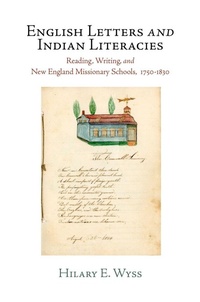
English Letters and Indian Literacies
Reading, Writing, and New England Missionary Schools, 175-183
Published on 8. May 2012
Book
Hardback
264 pages
978-0-8122-4413-7 (ISBN)
Description
As rigid and unforgiving as the boarding schools established for the education of Native Americans could be, the intellectuals who engaged with these schools-including Mohegans Samson Occom and Joseph Johnson, and Montauketts David and Jacob Fowler in the eighteenth century, and Cherokees Catharine and David Brown in the nineteenth-became passionate advocates for Native community as a political and cultural force. From handwriting exercises to Cherokee Syllabary texts, Native students negotiated a variety of pedagogical practices and technologies, using their hard-won literacy skills for their own purposes. By examining the materials of literacy-primers, spellers, ink, paper, and instructional manuals-as well as the products of literacy-letters, journals, confessions, reports, and translations-English Letters and Indian Literacies explores the ways boarding schools were, for better or worse, a radical experiment in cross-cultural communication.
Focusing on schools established by New England missionaries, first in southern New England and later among the Cherokees, Hilary E. Wyss explores both the ways this missionary culture attempted to shape and define Native literacy and the Native response to their efforts. She examines the tropes of "readerly" Indians-passive and grateful recipients of an English cultural model-and "writerly" Indians-those fluent in the colonial culture but also committed to Native community as a political and cultural concern-to develop a theory of literacy and literate practice that complicates and enriches the study of Native self-expression. Wyss's literary readings of archival sources, published works, and correspondence incorporate methods from gender studies, the history of the book, indigenous intellectual history, and transatlantic American studies.
Focusing on schools established by New England missionaries, first in southern New England and later among the Cherokees, Hilary E. Wyss explores both the ways this missionary culture attempted to shape and define Native literacy and the Native response to their efforts. She examines the tropes of "readerly" Indians-passive and grateful recipients of an English cultural model-and "writerly" Indians-those fluent in the colonial culture but also committed to Native community as a political and cultural concern-to develop a theory of literacy and literate practice that complicates and enriches the study of Native self-expression. Wyss's literary readings of archival sources, published works, and correspondence incorporate methods from gender studies, the history of the book, indigenous intellectual history, and transatlantic American studies.
Reviews / Votes
"Wyss's emphasis on the material culture of native experience and the missionary schools is fresh and compelling; her analysis of the Wheelock-Occum letters is perhaps the best reading of them to date; and the book's highlighting of figures whom history has shuffled aside-such as the Cherokee David Brown-make this volume well worth the read." (Journal of American History) "Hillary Wyss's English Letters and Indian Literacies quite fruitfully revises and expands existing accounts of Native participation in networks of written English in the eighteenth and nineteenth centuries." (American Literature) "Wyss skillfully draws on the fascinating history of literacy and literacy instruction in early New England to show how the process of learning to read was taught separately from the ability to comprehend the meaning of written words and how the act of learning to write was taught separately from the skill of self-expression." (History: Reviews of New Books) "English Letters and Indian Literacies promises to advance our understanding of the encounter between American Indians and Protestant English missionaries significantly. It deserves much attention from scholars in religion, literature, and history focused on the colonial period, Native responses to contact, the history of education, and literacy studies." (Laura M. Stevens, University of Tulsa)More details
Series
Language
English
Place of publication
Pennsylvania
United States
Target group
College/higher education
Product notice
Paper over boards
Illustrations
7 illus.
Dimensions
Height: 231 mm
Width: 157 mm
Thickness: 23 mm
Weight
522 gr
ISBN-13
978-0-8122-4413-7 (9780812244137)
Copyright in bibliographic data and cover images is held by Nielsen Book Services Limited or by the publishers or by their respective licensors: all rights reserved.
Schweitzer Classification
Other editions
Additional editions
Hilary E. Wyss
English Letters and Indian Literacies
Reading, Writing, and New England Missionary Schools, 175-183
E-Book
07/2012
1st Edition
University of Pennsylvania Press
from
€74.99
Available for download
Person
Hilary E. Wyss is Hargis Associate Professor of American Literature at Auburn University.
Content
Preface
Introduction: Technologies of Literacy
Chapter 1. Narratives and Counternarratives: Producing Readerly Indians in Eighteenth-Century New England
Chapter 2. The Writerly Worlds of Joseph Johnson
Chapter 3. Brainerd's Missionary Legacy: Death and the Writing of Cherokee Salvation
Chapter 4. The Foreign Mission School and the Writerly Indian
After Words: Native Literacy and Autonomy
Notes
Works Cited
Index
Acknowledgments
Introduction: Technologies of Literacy
Chapter 1. Narratives and Counternarratives: Producing Readerly Indians in Eighteenth-Century New England
Chapter 2. The Writerly Worlds of Joseph Johnson
Chapter 3. Brainerd's Missionary Legacy: Death and the Writing of Cherokee Salvation
Chapter 4. The Foreign Mission School and the Writerly Indian
After Words: Native Literacy and Autonomy
Notes
Works Cited
Index
Acknowledgments