

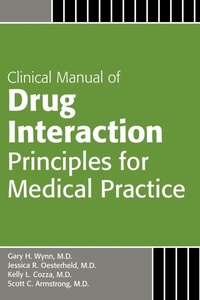
Clinical Manual of Drug Interaction Principles for Medical Practice
Published on 2. January 2009
Book
Paperback/Softback
608 pages
978-1-58562-296-2 (ISBN)
Description
Drug interactions have become a significant iatrogenic
complication, with as many as 5% of hospitalizations and 7,000 deaths
annually attributable to drug-drug interactions in the United States. There
are several reasons these numbers have increased. First, many new
medications have been brought to market in recent years. Second, advances in
medical care have resulted in increased longevity and more elderly patients
than ever before-patients who are more likely to be following polypharmacy
regimens. Population patterns in the U.S. have amplified this trend, with
aging baby boomers swelling the patient pool and demanding treatment with
medications advertised on television and in print.
Fortunately, drug
interactions can be prevented with access to current, comprehensive,
reliable information, and the Clinical Manual of Drug Interaction
Principles for Medical Practice provides just that in a
user-friendly format psychiatry clinicians (including residents and nurses)
and forensics experts will find indispensable. With this new edition, the
book has evolved from "Concise Guide" to "Clinical Manual" and offers the
expanded coverage and features healthcare providers need to keep up with
this critical field.
The book is well organized, with major sections
on metabolism; cytochrome P450 enzymes; drug interactions by medical
specialty; and practical matters, such as the medicolegal implications of
drug-drug interactions and how to retrieve and review the literature. In the
section on P450 enzymes, each chapter addresses what the individual enzyme
does and where, its polymorphisms, and drugs that inhibit or induce
activity. Each chapter also includes extensive references and study cases to
help the reader understand and contextualize the information. A number of
additional features enhance the book's scope and utility:
* The book boasts the very latest information in the area of drug
metabolism, transport, and interaction.
* The chapter on P-glycoprotein
(a drug transporter) was expanded from the last edition to include a broader
array of transport mechanisms.
* The highest ethical standard was
adhered to in the development of this volume, which was not supported in any
way by pharmaceutical makers or distributors.
All eight contributors
to this excellent resource are experts in the fields they have addressed,
and clinicians can trust that the information contained in the Manual
reflects the very latest research. This exceptionally practical manual is
essential to maintaining the highest standard of care.
complication, with as many as 5% of hospitalizations and 7,000 deaths
annually attributable to drug-drug interactions in the United States. There
are several reasons these numbers have increased. First, many new
medications have been brought to market in recent years. Second, advances in
medical care have resulted in increased longevity and more elderly patients
than ever before-patients who are more likely to be following polypharmacy
regimens. Population patterns in the U.S. have amplified this trend, with
aging baby boomers swelling the patient pool and demanding treatment with
medications advertised on television and in print.
Fortunately, drug
interactions can be prevented with access to current, comprehensive,
reliable information, and the Clinical Manual of Drug Interaction
Principles for Medical Practice provides just that in a
user-friendly format psychiatry clinicians (including residents and nurses)
and forensics experts will find indispensable. With this new edition, the
book has evolved from "Concise Guide" to "Clinical Manual" and offers the
expanded coverage and features healthcare providers need to keep up with
this critical field.
The book is well organized, with major sections
on metabolism; cytochrome P450 enzymes; drug interactions by medical
specialty; and practical matters, such as the medicolegal implications of
drug-drug interactions and how to retrieve and review the literature. In the
section on P450 enzymes, each chapter addresses what the individual enzyme
does and where, its polymorphisms, and drugs that inhibit or induce
activity. Each chapter also includes extensive references and study cases to
help the reader understand and contextualize the information. A number of
additional features enhance the book's scope and utility:
* The book boasts the very latest information in the area of drug
metabolism, transport, and interaction.
* The chapter on P-glycoprotein
(a drug transporter) was expanded from the last edition to include a broader
array of transport mechanisms.
* The highest ethical standard was
adhered to in the development of this volume, which was not supported in any
way by pharmaceutical makers or distributors.
All eight contributors
to this excellent resource are experts in the fields they have addressed,
and clinicians can trust that the information contained in the Manual
reflects the very latest research. This exceptionally practical manual is
essential to maintaining the highest standard of care.
Reviews / Votes
The wrong mixture of over the counter drugs can be fetal,and doctors and pharmacists must be aware of these lethal combos. "Clinical
Manual of Drug Interaction Principles for Medical Practice" is a scholarly
work discussing this very real possibility that can be prevented with the
right research and foresight. With the hundreds upon hundreds of new drugs
entering the market every year, the research into this subject is now
invaluable, as it could save thousands of lives. Filled with complete and
comprehensive and up to date research on drug interaction, "Clinical Manual
of Drug Interaction Principles" is strongly recommended for community and
college library medicine collections. * The Midwest Book Review * As a resident physician in a combined internal
medicine/psychiatry residency program, I found this book extremely helpful.
It serves as a great source when caring for patients with multiple medical
problems coupled with mental illness.The large amount of information in this
book justifies its change from a concise guide to a clinical manual. * Doddy Enterprises *
More details
Language
English
Place of publication
VA
United States
Target group
Professional and scholarly
US School Grade: College Graduate Student and over
Product notice
Paperback (trade)
Illustrations
9 Line drawings, black and white; 79 Tables, unspecified
Dimensions
Height: 211 mm
Width: 143 mm
Thickness: 30 mm
Weight
694 gr
ISBN-13
978-1-58562-296-2 (9781585622962)
Copyright in bibliographic data and cover images is held by Nielsen Book Services Limited or by the publishers or by their respective licensors: all rights reserved.
Schweitzer Classification
Other editions
Additional editions
Gary H. Wynn | Jessica R. Oesterheld | Kelly L. Cozza
Clinical Manual of Drug Interaction Principles for Medical Practice
E-Book
06/2009
1st Edition
American Psychiatric Association Publishing
€57.99
Available for download
Previous edition

Kelly L. Cozza | Scott C. Armstrong | Jessica R. Oesterheld
Concise Guide to Drug Interaction Principles for Medical Practice
Cytochrome P450, UGTs, P-glycoproteins
Book
04/2003
2nd Edition
American Psychiatric Press Inc.
€48.46
Article exhausted; check for reprint
Persons
Gary H. Wynn, M.D., is Staff Psychiatrist at the
Walter Reed Army Medical Center, in Washington, D.C., and Assistant
Professor, Uniformed Services University School of Medicine in Bethesda,
Maryland.
Jessica R. Oesterheld, M.D., is Acting Director of
the Spurwink Department of Psychiatry, at the Maine Medical Center, and
Clinical Associate Professor at the University of Vermont College of
Medicine in Burlington, Vermont.
Kelly L. Cozza, M.D., FAPM,
FAPA, is Associate Professor at Uniformed Services University School
of Medicine in Bethesda, Maryland, and Consultant in the Department of
Psychiatry at Walter Reed Army Medical Center in Washington,
D.C.
Scott C. Armstrong, M.D., DFAPA, FAPM, is Medical
Director of Tuality Center for Geriatric Psychiatry, and Associate Clinical
Professor of Psychiatry at Oregon Health and Science University in Forest
Grove, Oregon.
Walter Reed Army Medical Center, in Washington, D.C., and Assistant
Professor, Uniformed Services University School of Medicine in Bethesda,
Maryland.
Jessica R. Oesterheld, M.D., is Acting Director of
the Spurwink Department of Psychiatry, at the Maine Medical Center, and
Clinical Associate Professor at the University of Vermont College of
Medicine in Burlington, Vermont.
Kelly L. Cozza, M.D., FAPM,
FAPA, is Associate Professor at Uniformed Services University School
of Medicine in Bethesda, Maryland, and Consultant in the Department of
Psychiatry at Walter Reed Army Medical Center in Washington,
D.C.
Scott C. Armstrong, M.D., DFAPA, FAPM, is Medical
Director of Tuality Center for Geriatric Psychiatry, and Associate Clinical
Professor of Psychiatry at Oregon Health and Science University in Forest
Grove, Oregon.
Content
Contributors
Preface
Acknowledgments
PART I:
Introduction and Basic Pharmacology of Metabolic Drug
Interactions
Chapter 1. Introduction to Drug Interactions and to This
Clinical Manual
Chapter 2. Definitions and Phase I
Metabolism
Chapter 3. Metabolism in Depth: Phase II
Chapter 4.
Transporters
PART II: P450 Enzymes
Introduction to Part
II
Chapter 5. 2D6
Chapter 6. 3A4
Chapter 7. 1A2
Chapter 8.
2C9
Chapter 9. 2C19
Chapter 10. 2E1
Chapter 11. 2A6, 2B6, and
2C8
PART III: Drug Interactions by Medical Specialty
Chapter 12.
Gynecology: Oral Contraceptives
Chapter 13. Internal
Medicine
Chapter 14. Infectious Diseases
Chapter 15.
Neurology
Chapter 16. Oncology
Chapter 17. Pain Management I:
Nonnarcotic Analgesics
Chapter 18. Pain Management II: Narcotic
Analgesics
Chapter 19. Psychiatry
Chapter 20. Transplant Surgery and
Rheumatology: Immunosuppressants
PART IV: Practical Matters
Chapter
21. Guidelines
Chapter 22. Medicolegal Implications of Drug-Drug
Interactions
Chapter 23. How to Retrieve and Review the
Literature
Appendix: Tables of Drug Interaction
Pharmacokinetics
Index
Preface
Acknowledgments
PART I:
Introduction and Basic Pharmacology of Metabolic Drug
Interactions
Chapter 1. Introduction to Drug Interactions and to This
Clinical Manual
Chapter 2. Definitions and Phase I
Metabolism
Chapter 3. Metabolism in Depth: Phase II
Chapter 4.
Transporters
PART II: P450 Enzymes
Introduction to Part
II
Chapter 5. 2D6
Chapter 6. 3A4
Chapter 7. 1A2
Chapter 8.
2C9
Chapter 9. 2C19
Chapter 10. 2E1
Chapter 11. 2A6, 2B6, and
2C8
PART III: Drug Interactions by Medical Specialty
Chapter 12.
Gynecology: Oral Contraceptives
Chapter 13. Internal
Medicine
Chapter 14. Infectious Diseases
Chapter 15.
Neurology
Chapter 16. Oncology
Chapter 17. Pain Management I:
Nonnarcotic Analgesics
Chapter 18. Pain Management II: Narcotic
Analgesics
Chapter 19. Psychiatry
Chapter 20. Transplant Surgery and
Rheumatology: Immunosuppressants
PART IV: Practical Matters
Chapter
21. Guidelines
Chapter 22. Medicolegal Implications of Drug-Drug
Interactions
Chapter 23. How to Retrieve and Review the
Literature
Appendix: Tables of Drug Interaction
Pharmacokinetics
Index