

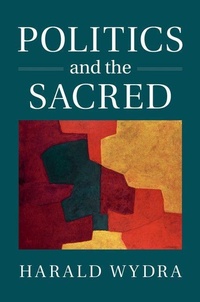
Politics and the Sacred
Published on 30. April 2015
Book
Hardback
276 pages
978-1-107-07537-5 (ISBN)
Description
This path-breaking book argues that practices of the sacred are constitutive of modern secular politics. Following a tradition of enquiry in anthropology and political theory, it examines how limit situations shape the political imagination and collective identity. As an experiential and cultural fact, the sacred emerges within, and simultaneously transcends, transgressive dynamics such as revolutions, wars or globalisation. Rather than conceive the sacred as a religious doctrine or a metaphysical belief, Wydra examines its adaptive functions as origins, truths and order which are historically contingent across time and transformative of political aspirations. He suggests that the brokenness of political reality is a permanent condition of humanity, which will continue to produce quests for the sacred, and transcendental political frames. Working in the spirit of the genealogical mode of enquiry, this book examines the secular sources of political theologies, the democratic sacred, the communist imagination, European political identity, the sources of human rights and the relationship of victimhood to new wars.
Reviews / Votes
'This book is a first-class contribution to the reflection on the anthropological foundations of politics. By laying stress on meanings, and through judicious use of a wide-ranging number of illustrations, Harald Wydra's work offers a well-grounded reformulation of the key question of the sacred. It is essential reading not only for political anthropologists, but also for comparativists and specialists of international relations.' Jean-Pascal Daloz, CNRS Research Professor, University of Strasbourg (SAGE), France 'Having been ostracized for decades, the term 'political religion' made a comeback in the 1990s and the 'religious' aspect of totalitarian regimes is now widely recognized to the point of cliche. But Professor Wydra's erudite and paradigm-changing book locates modern 'religious politics' within a far more archetypal and subtle human cognitive process. It is one which, silkworm-like, spins gossamer threads of the sacred out of liminal, life-threatening situations to bind human communities together and renew their bonds to the earth. But, as he shows, the political consequences of defying cosmic absurdity in this way are deeply ambivalent.' Roger Griffin, author of Modernism and Fascism (2007) 'Two of the driving forces in contemporary life - politics and the sacred - are not necessarily separate, as this thoughtful book reveals. The striking analysis focuses on lived aspects of practice and performance rather than on images and concepts, and its arresting reconception of both politics and the sacred is brought to life in chapters that focus on communism, democracy, human rights and collective victimhood. These fertile ideas will change our ways of thinking about the way politics and religion interact and how they affect public life in the global era.' Mark Juergensmeyer, author of Global Rebellion: Religious Challenges to the Secular StateMore details
Language
English
Place of publication
Cambridge
United Kingdom
Target group
Professional and scholarly
Dimensions
Height: 235 mm
Width: 157 mm
Thickness: 19 mm
Weight
554 gr
ISBN-13
978-1-107-07537-5 (9781107075375)
Copyright in bibliographic data and cover images is held by Nielsen Book Services Limited or by the publishers or by their respective licensors: all rights reserved.
Schweitzer Classification
Other editions
Additional editions
Harald Wydra
Politics and the Sacred
Book
08/2017
Cambridge University Press
€49.10
Shipment within 15-20 days
Harald Wydra
Politics and the Sacred
E-Book
04/2015
Cambridge University Press
€24.49
Available for download
Harald Wydra
Politics and the Sacred
E-Book
04/2015
Cambridge University Press
€32.49
Available for download
Person
Harald Wydra is a Fellow of St Catharine's College, Cambridge. He has previously taught political science at the University of Regensburg, held visiting fellowships at the Ecole des hautes etudes en sciences sociales (Paris) and the National University of Australia (Canberra), and was Visiting Professor at the University of Paris Ouest Nanterre-La Defense. He is the founding Editor of the journal International Political Anthropology and his books include Continuities in Poland's Permanent Transition (2001), Communism and the Emergence of Democracy (Cambridge University Press, 2007), Democracy and Myth in Russia and Eastern Europe (2008, co-edited with Alexander Woell) and Breaking Boundaries: Varieties of Liminality (2015, co-edited with Agnes Horvath and Bjorn Thomassen).
Content
Introduction: the sacred and the political; 1. The extraordinary and the political imagination; 2. The politics of transcendence; 3. Secular sources of political theologies; 4. Democracy and the sacred; 5. The power of symbols: Communism and beyond; 6. Generations of European imaginations; 7. The spell of humanity; 8. Victim and new wars; Epilogue: rationalities of the sacred.