

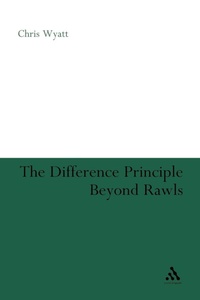
The Difference Principle Beyond Rawls
Published on 5. January 2012
Book
Paperback/Softback
192 pages
978-1-4411-3486-8 (ISBN)
Description
Since the publication of John Rawls' A Theory of Justice (1971) - followed up by Political Liberalism (1993) and Justice as Fairness: A Restatement (2001) - discussions on social justice and redistributive liberalism have taken center stage in contemporary political theory. This book adds to an enormous body of literature. It does not question Rawlsian principles, but it does reject the liberal institutions he advocates. A debate is constructed in which his liberalism is contrasted with a libertarian socialism informed by the English theorist of guild socialism G.D.H. Cole (1889-1959). These two authors visualize alternative macro socio-economic schemes. Although they are set within modern liberal and libertarian socialist frameworks respectively, they share a commitment to reducing vast inequalities in wealth. Central to the Rawlsian scheme is the difference principle - that inequalities are only permitted if they benefit the least well off.
Rawls proposes that citizens deliberating without awareness of subjective talents - a collective lack of knowledge captured by the Rawlsian term the veil of ignorance - will be compelled to prioritize a society structured to accommodate this principle to other systems in which inequalities are allowed to concentrate with lesser degrees of regulation. This assertion will not be challenged. However, it is shown how the difference principle will be more easily realized in the left libertarian scheme, in which the author defends. The argument is that Rawlsian premises point to a more radical conclusion than Rawls acknowledges.
Rawls proposes that citizens deliberating without awareness of subjective talents - a collective lack of knowledge captured by the Rawlsian term the veil of ignorance - will be compelled to prioritize a society structured to accommodate this principle to other systems in which inequalities are allowed to concentrate with lesser degrees of regulation. This assertion will not be challenged. However, it is shown how the difference principle will be more easily realized in the left libertarian scheme, in which the author defends. The argument is that Rawlsian premises point to a more radical conclusion than Rawls acknowledges.
Reviews / Votes
Mention --Chronicle of Hither Education, August 15, 2008More details
Language
English
Place of publication
New York
United States
Target group
Professional and scholarly
Dimensions
Height: 234 mm
Width: 156 mm
Thickness: 11 mm
Weight
301 gr
ISBN-13
978-1-4411-3486-8 (9781441134868)
Copyright in bibliographic data and cover images is held by Nielsen Book Services Limited or by the publishers or by their respective licensors: all rights reserved.
Schweitzer Classification
Other editions
Additional editions
Chris Wyatt
The Difference Principle Beyond Rawls
E-Book
11/2011
1st Edition
Bloomsbury Continuum
€43.49
Available for download
Person
Chris Wyatt is lecturer in Social Theory and Sociology at the University of Brighton. He is also affiliated to the University of Sussex, where he teaches Modern Political Thought and Contemporary Political Theory. He holds a Bachelor of Arts degree in Sociology, a Master of Arts degree in Social and Political Thought and a Ph.D. in Social and Political Thought. He is the author of The Difference Principle Beyond Rawls (Continuum, 2008)
Content
Introduction; 1. Social Justice; 2. Rawlsian liberalism, Cole's guild socialism and New Economic Democracy; 3. Towards a Left-Libertarianism; Chapter One : Rawls' Theory of Justice; 1. Rawl's Method; 2. Rawls' Premises; 3. Rawls' Conclusion; Chapter Two: Cole's Libertarian Socialism; 1. The Democratic Domain; 2. The Functional Principle; 3. Political Pluralism; 4. Cole's Rejection of the Consumer Representing State and his Amplification of the Functional and Pluralist Principles; Chapter Three: The Political Economy of New Economic Democracy; 1. Democratic and Participatory Planning; 2. Democratic Investment Planning; 3. Analysing Democratic Investment Planning; Conclusion; Chapter Four: From Property-Owning Democracy to Property- Controlling Democracy; 1. The State and Sovereignty in Rawlsian Liberalism; 2. The Commune and Sovereignty in New Economic Democracy; 3. The Realisation of the Two Principles of Justice; Conclusion; Chapter Five: Political Liberalism; 1. Rawls Political Liberalism; 2. New Economic Democracy and Political Liberalism; 3. Co-Operative Non-Aliening Labour and the Overlapping Consensus; Conclusion; Conclusion; Bibliography; Index.