

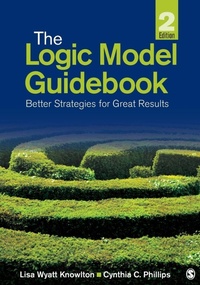
The Logic Model Guidebook
Better Strategies for Great Results
2nd Edition
Published on 23. October 2012
Book
Paperback/Softback
192 pages
978-1-4522-1675-1 (ISBN)
Description
The Logic Model Guidebook offers clear, step-by-step support for creating logic models and the modeling process in a range of contexts. Lisa Wyatt Knowlton and Cynthia C. Phillips describe the structures, processes, and language of logic models as a robust tool to improve the design, development, and implementation of program and organization change efforts. The text is enhanced by numerous visual learning guides (sample models, checklists, exercises, worksheets) and many new case examples. The authors provide students, practitioners, and beginning researchers with practical support to develop and improve models that reflect knowledge, practice, and beliefs. The Guidebook offers a range of new applied examples. The text includes logic models for evaluation, discusses archetypes, and explores display and meaning. In an important contribution to programs and organizations, it emphasizes quality by raising issues like plausibility, feasibility, and strategic choices in model creation.
Reviews / Votes
"The Guidebook fills a niche in the skills and knowledge needed by nonprofit managers to be successful in their work. It leads the field in providing both the theory and practice of using logic models as a critical management tool." -- Kathryn Agard, Ph.D. "The material in this book has enduring value. It is a 'keeper' for students and me." -- Simon Fass, Ph.D. "This book should be in the library of every individual involved in program development and evaluation. It is a powerful tool for practitioners and students." -- Sylvie Taylor, Ph.D. "Regardless of sector, logic models are valuable tools to design systems and improve strategy." -- Kori ReedMore details
Edition
2nd Revised edition
Language
English
Place of publication
Thousand Oaks
United States
Target group
College/higher education
Professional and scholarly
Edition type
Revised edition
Dimensions
Height: 254 mm
Width: 178 mm
Thickness: 11 mm
Weight
373 gr
ISBN-13
978-1-4522-1675-1 (9781452216751)
Copyright in bibliographic data and cover images is held by Nielsen Book Services Limited or by the publishers or by their respective licensors: all rights reserved.
Schweitzer Classification
Other editions
Previous edition
Lisa Wyatt Knowlton | Cynthia C. Phillips
The Logic Model Guidebook
Better Strategies for Great Results
Book
11/2008
1st Edition
SAGE Publications Inc
€60.84
Article exhausted; check for reprint
Persons
Lisa Wyatt Knowlton, Ed.D.
Lisa is a cycling enthusiast, Lake Michigan fan, adoption advocate and voracious reader. She holds a BA in International Relations from Michigan State University, an MPA from Western Michigan University, and an EdD in Management and Policy from Western Michigan University. Her work history includes senior roles in programming and management of private, community, and corporate philanthropy along with organizational development and government relations. She has managed many large change projects for the W. K. Kellogg Foundation as well as the Aspen Institute, Bill and Melinda Gates Foundation, Independent Sector, Ball, Nokomis, and Kauffman Foundations. Lisa is a W. K. Kellogg National Leadership Fellow with deep experience in Central America, Asia, and Europe. Lisa authors a blog called tinker. She is a contributor to Leadership in Nonprofit Organizations (Sage, 2011). Her areas of specialization include strategy, organization development, leadership, change management, and systems thinking. She is Chief Strategy Officer, management guru, and learning coach with Phillips Wyatt Knowlton, Inc. She also speaks Spanish. You can reach her via e-mail at: lisawk@pwkinc.com.
Cynthia C. Phillips, Ph.D.
Cynthia is a birder, recovering aerobics instructor with 30 million meters rowed, and cyber-sleuth. She received a BS in Biology and Chemistry from Indiana University, an MA in Educational Leadership from Western Michigan University, and a PhD in Measurement, Research & Evaluation from Western Michigan University. Her experience includes consultation with the W. K. Kellogg Foundation, Ball Foundation, Bill and Melinda Gates Foundation, Nokomis, Kauffman, and the David and Lucile Packard Foundations in the design and implementation of evaluation, evaluation training, and knowledge management projects. She is the author of the W. K. Kellogg Foundation Logic Model Development Guide. Cynthia is a sought-after presenter on logic models and knowledge management. Her areas of specialization and expertise include evaluation/measurement; knowledge management; organizational learning; logic models, quantitative methods, and qualitative methods; and electronic data collection and dissemination. Cynthia offers a user-friendly approach to evaluation capacity building. She is Chief Idea Engineer, and measurement expert with Phillips Wyatt Knowlton, Inc. You can reach her via e-mail at: cynthiap@pwkinc.com.
Lisa is a cycling enthusiast, Lake Michigan fan, adoption advocate and voracious reader. She holds a BA in International Relations from Michigan State University, an MPA from Western Michigan University, and an EdD in Management and Policy from Western Michigan University. Her work history includes senior roles in programming and management of private, community, and corporate philanthropy along with organizational development and government relations. She has managed many large change projects for the W. K. Kellogg Foundation as well as the Aspen Institute, Bill and Melinda Gates Foundation, Independent Sector, Ball, Nokomis, and Kauffman Foundations. Lisa is a W. K. Kellogg National Leadership Fellow with deep experience in Central America, Asia, and Europe. Lisa authors a blog called tinker. She is a contributor to Leadership in Nonprofit Organizations (Sage, 2011). Her areas of specialization include strategy, organization development, leadership, change management, and systems thinking. She is Chief Strategy Officer, management guru, and learning coach with Phillips Wyatt Knowlton, Inc. She also speaks Spanish. You can reach her via e-mail at: lisawk@pwkinc.com.
Cynthia C. Phillips, Ph.D.
Cynthia is a birder, recovering aerobics instructor with 30 million meters rowed, and cyber-sleuth. She received a BS in Biology and Chemistry from Indiana University, an MA in Educational Leadership from Western Michigan University, and a PhD in Measurement, Research & Evaluation from Western Michigan University. Her experience includes consultation with the W. K. Kellogg Foundation, Ball Foundation, Bill and Melinda Gates Foundation, Nokomis, Kauffman, and the David and Lucile Packard Foundations in the design and implementation of evaluation, evaluation training, and knowledge management projects. She is the author of the W. K. Kellogg Foundation Logic Model Development Guide. Cynthia is a sought-after presenter on logic models and knowledge management. Her areas of specialization and expertise include evaluation/measurement; knowledge management; organizational learning; logic models, quantitative methods, and qualitative methods; and electronic data collection and dissemination. Cynthia offers a user-friendly approach to evaluation capacity building. She is Chief Idea Engineer, and measurement expert with Phillips Wyatt Knowlton, Inc. You can reach her via e-mail at: cynthiap@pwkinc.com.
Content
Preface
Acknowledgments
About the Authors
PART I. CONSTRUCTION
1. Introducing Logic Models
2. Building and Improving Theory of Change Logic Models
3. Creating Program Logic Models
4. Modeling: Improving Program Logic Models
PART II. APPLICATIONS
5. Logic Models for Evaluation
6. Display and Meaning
7. Exploring Archetypes
8. Action Profiles
Name Index
Subject Index
Acknowledgments
About the Authors
PART I. CONSTRUCTION
1. Introducing Logic Models
2. Building and Improving Theory of Change Logic Models
3. Creating Program Logic Models
4. Modeling: Improving Program Logic Models
PART II. APPLICATIONS
5. Logic Models for Evaluation
6. Display and Meaning
7. Exploring Archetypes
8. Action Profiles
Name Index
Subject Index