

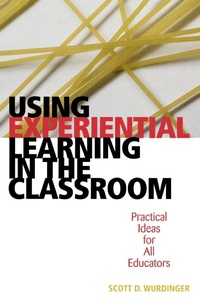
Using Experiential Learning in the Classroom
Practical Ideas for All Educators
Published on 13. April 2005
Book
Paperback/Softback
112 pages
978-1-57886-240-5 (ISBN)
Description
While research and common sense tells us that experiential learning is more effective than the more traditional process of information assimilation (where teachers lecture, test, and grade), high school, college, and university teachers continue to use paper-and-pencil tests as their primary grading and assessment tool. Many students fail to see the relevance of these sort of tests and are bored with passive methods of learning. Using Experiential Learning in the Classroom: Practical Ideas for All Educators explains what experiential learning is, why it works, and how it can be used in both high school and post-secondary educational settings. Tools for assessing experiential learning are also provided. A must-have resource for high school teachers and college professors.
Reviews / Votes
Wurdinger explains what experiential learning is, why it works, and how it can be used in both high school and post-secondary settings. * Reference and Research Book News *More details
Language
English
Place of publication
United States
Publishing group
Bloomsbury Publishing Plc
Target group
Professional and scholarly
Dimensions
Height: 229 mm
Width: 152 mm
Thickness: 6 mm
Weight
175 gr
ISBN-13
978-1-57886-240-5 (9781578862405)
Copyright in bibliographic data and cover images is held by Nielsen Book Services Limited or by the publishers or by their respective licensors: all rights reserved.
Schweitzer Classification
Other editions
Additional editions
E-Book
04/2005
1st Edition
R & L Education
€45.49
Available for download
E-Book
04/2005
1st Edition
Rowman & Littlefield Education
€45.49
Available for download
Person
Scott D. Wurdinger is the coordinator of the Experiential Education Graduate Program at Minnesota State University. He has been involved in experiential education since 1984.
Content
Part 1 Preface
Part 2 Acknowledgments
Chapter 3 1 Changing Teaching Formats
Chapter 4 2 What Is Experiential Learning?
Chapter 5 3 Why Experiential Leaning Works
Chapter 6 4 Experiential Schools
Chapter 7 5 Using Experiential Learning in Classroom Settings
Chapter 8 6 Assessing Experiential Learning
Chapter 9 7 Barriers to Overcome
Part 10 References
Part 11 About the Author
Part 2 Acknowledgments
Chapter 3 1 Changing Teaching Formats
Chapter 4 2 What Is Experiential Learning?
Chapter 5 3 Why Experiential Leaning Works
Chapter 6 4 Experiential Schools
Chapter 7 5 Using Experiential Learning in Classroom Settings
Chapter 8 6 Assessing Experiential Learning
Chapter 9 7 Barriers to Overcome
Part 10 References
Part 11 About the Author