

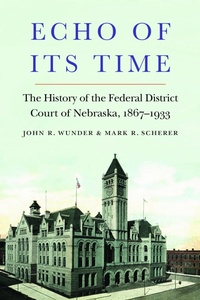
Echo of Its Time
The History of the Federal District Court of Nebraska, 1867-1933
Published on 1. February 2019
Book
Hardback
376 pages
978-1-4962-1214-6 (ISBN)
Description
Throughout its existence the Federal District Court of Nebraska has echoed the dynamics of its time, reflecting the concerns, interests, and passions of the people who have made this state their home. Echo of Its Time explores the court's development, from its inception in 1867 through 1933, tracing the careers of its first four judges: Elmer Dundy, William Munger, Thomas Munger (no relation), and Joseph Woodrough, whose rulings addressed an array of issues and controversies echoing macro-level developments within the state, nation, and world. Echo of Its Time both informs and entertains while using the court's operations as a unique and accessible prism through which to explore broader themes in the history of the state and the nation.
The book explores the inner workings of the court through Thomas Munger's personal correspondence, as well as the court's origins and growing influence under the direction of its legendary first judge, Elmer Dundy. Dundy handled many notable and controversial matters and made significant decisions in the field of Native American law, including Standing Bear v. Crook and Elk v. Wilkins. From the turn of the century through 1933 the court's docket reflected the dramatic and rapid changes in state, regional, and national dynamics, including labor disputes and violence, political corruption and Progressive Era reform efforts, conflicts between cattle ranchers and homesteaders, wartime sedition and "slacker" prosecutions, criminal enterprises, and the endless battles between government agents and bootleggers during Prohibition.
The book explores the inner workings of the court through Thomas Munger's personal correspondence, as well as the court's origins and growing influence under the direction of its legendary first judge, Elmer Dundy. Dundy handled many notable and controversial matters and made significant decisions in the field of Native American law, including Standing Bear v. Crook and Elk v. Wilkins. From the turn of the century through 1933 the court's docket reflected the dramatic and rapid changes in state, regional, and national dynamics, including labor disputes and violence, political corruption and Progressive Era reform efforts, conflicts between cattle ranchers and homesteaders, wartime sedition and "slacker" prosecutions, criminal enterprises, and the endless battles between government agents and bootleggers during Prohibition.
Reviews / Votes
"Echo of Its Time makes an important contribution to the sometimes clouded working of the federal courts. Because much Great Plains legal history has focused on the nineteenth century, this book is especially welcome, delving as it does into the often neglected twentieth century. I have taught Nebraska history for almost twenty years but I still learned a great deal about the state's federal judges and the types of cases that ended up in federal court."-Mark R. Ellis, professor of history at the University of Nebraska Kearney and author of Law and Order in Buffalo Bill's Country: Legal Culture and Community on the Great Plains, 1867-1910 "Echo of Its Time is an excellent title for a book which shows how the judges of the Federal District Court of Nebraska addressed major issues as the Great Plains frontier jurisdiction evolved into an early twentieth-century rural-urban Midwestern society. . . . Wunder and Scherer have done an excellent job in showing us how our courts, their judges, and other officers are at the heart of the American experience."-Harl Dalstrom, professor of history emeritus at the University of Nebraska OmahaMore details
Language
English
Place of publication
Lincoln
United States
Target group
Professional and scholarly
Product notice
Cloth over boards
Illustrations
19 illustrations, index
Dimensions
Height: 236 mm
Width: 218 mm
Thickness: 33 mm
Weight
680 gr
ISBN-13
978-1-4962-1214-6 (9781496212146)
Copyright in bibliographic data and cover images is held by Nielsen Book Services Limited or by the publishers or by their respective licensors: all rights reserved.
Schweitzer Classification
Other editions
Additional editions
John R. Wunder | Mark R. Scherer
Echo of Its Time
The History of the Federal District Court of Nebraska, 1867-1933
E-Book
02/2019
1st Edition
University of Nebraska Press
€55.49
Available for download
John R. Wunder | Mark R. Scherer
Echo of Its Time
The History of the Federal District Court of Nebraska, 1867-1933
E-Book
02/2019
1st Edition
University of Nebraska Press
€49.49
Available for download
Persons
John R. Wunder is a professor emeritus of history at the University of Nebraska-Lincoln. He is the author or editor of numerous books, including The Nebraska-Kansas Act of 1854 (Nebraska, 2008) and Native American Sovereignty. Mark R. Scherer is a professor of history at the University of Nebraska Omaha. He is the author of Rights in the Balance: Free Press, Fair Trial, and Nebraska Press Association v. Stuart and Imperfect Victories: The Legal Tenacity of the Omaha Tribe, 1945-1995 (Nebraska, 1999).
Content
List of Illustrations
Introduction
Chapter 1: In the Beginning
Chapter 2: The Dundy Years
Chapter 3: Native Americans and Judge Dundy
Chapter 4: Railroads and the Ermine of the Bench
Chapter 5: The Politics of Transition, 1896-1897
Chapter 6: The "One Munger" Court: 1897-1907
Chapter 7: The "Cattle Barons" Cases: Land Fraud, Illegal Fencing, and a Six-Hour Jail Sentence
Chapter 8: The "Two Munger" Court, 1907-1915
Chapter 9: The Early Munger/Woodrough Years, 1916-1923
Chapter 10: Prohibition, a Divided Court, and the Dennison Trial, 1919-1933
Bibliography
Introduction
Chapter 1: In the Beginning
Chapter 2: The Dundy Years
Chapter 3: Native Americans and Judge Dundy
Chapter 4: Railroads and the Ermine of the Bench
Chapter 5: The Politics of Transition, 1896-1897
Chapter 6: The "One Munger" Court: 1897-1907
Chapter 7: The "Cattle Barons" Cases: Land Fraud, Illegal Fencing, and a Six-Hour Jail Sentence
Chapter 8: The "Two Munger" Court, 1907-1915
Chapter 9: The Early Munger/Woodrough Years, 1916-1923
Chapter 10: Prohibition, a Divided Court, and the Dennison Trial, 1919-1933
Bibliography