

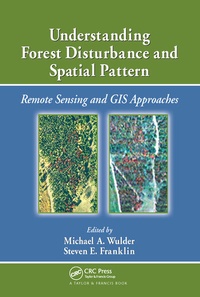
Understanding Forest Disturbance and Spatial Pattern
Remote Sensing and GIS Approaches
1st Edition
Published on 30. June 2020
Book
Paperback/Softback
268 pages
978-0-367-57783-4 (ISBN)
Description
Remote sensing and GIS are increasingly used as tools for monitoring and managing forests. Remotely sensed and GIS data are now the data sources of choice for capturing, documenting, and understanding forest disturbance and landscape pattern. Sitting astride the fields of ecology, forestry, and remote sensing/GIS, Understanding Forest Disturbance and Spatial Pattern: Remote Sensing and GIS Approaches takes you through the general biological or landscape ecological context of forest disturbance to remote sensing and GIS technological approaches and pattern description and analysis, with compelling applied examples of integration and synthesis.
Written by experts, peer-reviewed to adhere to the strictest standards and highest quality criteria, these chapters discuss natural and human-caused forest change and consider factors such as biological setting, monitoring approaches, scale issues, and pattern analysis. The book explores forest disturbance and spatial pattern from an ecological point-of-view within the context of structure, function, pattern, and change. It concludes with a summary of the issues related to detection and mapping of forest disturbances with remotely sensed and GIS data. The authors elucidate how the elements presented, from ecological underpinnings, data considerations, change detection method, and pattern analysis, combine into a problem solving, information generating approach.
You may find this subject covered briefly in a small sub-section in remote sensing forestry texts, or in limited technical detail in the ecology literature. The in-depth, detailed information provided in this book allows you to develop an understanding of the application of BOTH remote sensing and GIS technologies to forest change and the impacts of fire, insect infestation, forest harvesting, and other potential change influences - such as extreme weather events. This book provides guidance on how to master the challenges of capturing and characterizing forest disturbance and spatial patterns.
Written by experts, peer-reviewed to adhere to the strictest standards and highest quality criteria, these chapters discuss natural and human-caused forest change and consider factors such as biological setting, monitoring approaches, scale issues, and pattern analysis. The book explores forest disturbance and spatial pattern from an ecological point-of-view within the context of structure, function, pattern, and change. It concludes with a summary of the issues related to detection and mapping of forest disturbances with remotely sensed and GIS data. The authors elucidate how the elements presented, from ecological underpinnings, data considerations, change detection method, and pattern analysis, combine into a problem solving, information generating approach.
You may find this subject covered briefly in a small sub-section in remote sensing forestry texts, or in limited technical detail in the ecology literature. The in-depth, detailed information provided in this book allows you to develop an understanding of the application of BOTH remote sensing and GIS technologies to forest change and the impacts of fire, insect infestation, forest harvesting, and other potential change influences - such as extreme weather events. This book provides guidance on how to master the challenges of capturing and characterizing forest disturbance and spatial patterns.
Reviews / Votes
". . . this book seriously integrates the use of remote sensing and GIS techniques to help forestry researchers, resource management professionals, and conservation biologists meet the challenges of capturing and characterizing forest disturbance and their spatial patterns . . . well-researched and makes a significant contribution to the forestry, remote sensing and landscape ecology bodies of literature."- Kin M. Ma, Geography and Planning Department, Grand Valley State University, in Photogrammetric Engineering & Remote Sensing, November 2008
More details
Language
English
Place of publication
London
United Kingdom
Publishing group
Taylor & Francis Ltd
Target group
Professional and scholarly
Professional
Dimensions
Height: 234 mm
Width: 156 mm
Weight
500 gr
ISBN-13
978-0-367-57783-4 (9780367577834)
Copyright in bibliographic data and cover images is held by Nielsen Book Services Limited or by the publishers or by their respective licensors: all rights reserved.
Schweitzer Classification
Other editions
Additional editions
Michael A. Wulder | Steven E. Franklin
Understanding Forest Disturbance and Spatial Pattern
Remote Sensing and GIS Approaches
Book
07/2006
1st Edition
CRC Press
€253.30
Shipment within 15-20 days
Michael A. Wulder | Steven E. Franklin
Understanding Forest Disturbance and Spatial Pattern
Remote Sensing and GIS Approaches
E-Book
07/2006
CRC Press
€68.49
Available for download
Michael A. Wulder | Steven E. Franklin
Understanding Forest Disturbance and Spatial Pattern
Remote Sensing and GIS Approaches
E-Book
07/2006
CRC Press
€68.49
Available for download
Persons
Michael A. Wulder, Steven E. Franklin
Content
Introduction: Structure, Function, and Change of Forest Landscapes. Identifying and Describing Forest Disturbance and Spatial Pattern: Data Selection Issues and Methodological Implications. Remotely Sensed Data in the Mapping of Forest Harvest Patterns. Remotely Sensed Data in the Mapping of Insect Defoliation. Using Remote Sensing to Map and Monitor Fire Damage in Forest Ecosystems. Integrating GIS and Remotely Sensed Data for Mapping Forest Disturbance and Change. New Directions in Landscape Pattern Analysis and Linkages with Remote Sensing. Characterizing Stand-Replacing Harvest and Fire Disturbance Patches in a Forested Landscape: A Case Study from Cooney Ridge. Conclusion: Understanding Forest Disturbance and Spatial Pattern, Information Needs, and New Approaches. Index.