

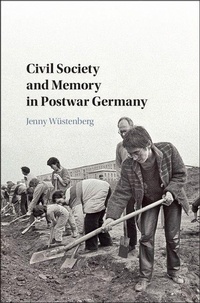
Civil Society and Memory in Postwar Germany
Published on 7. September 2017
Book
Hardback
352 pages
978-1-107-17746-8 (ISBN)
Description
Blending history and social science, this book tracks the role of social movements in shaping German public memory and values since 1945. Drawn from extensive original research, it offers a fresh perspective on the evolution of German democracy through civic confrontation with the violence of its past. Told through the stories of memory activists, the study upends some of the conventional wisdom about modern German political history. An analysis of the decades-long struggle over memory and democracy shows how grassroots actors challenged and then took over public institutions of memorialization. In the process, confrontation of the Holocaust has been pushed to the centre of political culture. In unified Germany, memory politics have shifted again, as activists from East Germany have brought attention to the crimes of the East German state. This book delivers a novel and important contribution to scholarship about postwar Germany and the wider study of memory politics.
Reviews / Votes
'Emphasizing the role of memory activists in civil society - and their entanglement with state institutions and actors - Jenny Wuestenberg makes a compelling case for the force of contentious memories in reshaping the landscape of democratic remembrance. Her bottom-up approach brings memory agency to the fore and provides a necessary new perspective on a history we thought we already knew: the development of the public memory of National Socialism, the Holocaust, and communist repression in the postwar Federal Republic of Germany. Civil Society and Memory in Postwar Germany is important reading for all scholars in memory studies, Holocaust studies, and German studies.' Michael Rothberg, author of Multidirectional Memory: Remembering the Holocaust in the Age of Decolonization 'Where does memory come from, and where does it take place? In contrast to conventional approaches that emphasize either the state as a producer of memory or the private sphere as the location of non-state memory, Jenny Wuestenberg's important book highlights the neglected role of memory activists. This book is a truly significant contribution to the literature, both about Germany and about memory politics, providing nuanced interpretations and novel theoretical insights. A major accomplishment!' Jeffrey Olick, University of Virginia 'This absorbing and carefully researched book has clearly been a labour of love for its author. It will be of interest to students and researchers in an array of disciplines, including History, Sociology, Politics, Museum Studies, Geography, German Studies and Cultural Studies. As we approach the 30th anniversary of the fall of the Berlin Wall, Wustenberg's fascinating research on memory activists is a timely reminder of the importance for our contemporary society of confronting and memorializing difficult pasts.' Deirdre Byrnes, European History QuarterlyMore details
Language
English
Place of publication
Cambridge
United Kingdom
Target group
College/higher education
Illustrations
Worked examples or Exercises; 36 Halftones, black and white
Dimensions
Height: 235 mm
Width: 157 mm
Thickness: 24 mm
Weight
666 gr
ISBN-13
978-1-107-17746-8 (9781107177468)
Copyright in bibliographic data and cover images is held by Nielsen Book Services Limited or by the publishers or by their respective licensors: all rights reserved.
Schweitzer Classification
Other editions
Additional editions
Jenny Wuestenberg
Civil Society and Memory in Postwar Germany
Book
12/2018
Cambridge University Press
€55.20
Shipment within 15-20 days
Jenny Wustenberg
Civil Society and Memory in Postwar Germany
E-Book
09/2017
Cambridge University Press
€24.49
Available for download
Jenny Wuestenberg
Civil Society and Memory in Postwar Germany
E-Book
08/2017
Cambridge University Press
€29.49
Available for download
Person
Jenny Wuestenberg is DAAD Visiting Assistant Professor of Political Science at York University, Toronto. She has been active in developing the field of memory studies, most notably as co-chair of the Research Network on Transnational Memory and Identity in the Council for European Studies and as co-founder of the Memory Studies Association.
Content
List of illustrations; Preface; Acknowledgements; Abbreviations and German terms; 1. Civil society activism, memory politics and democracy; 2. Memorial politics and civil society since 1945; 3. Building negative memory: civic initiatives for memorials to Nazi terror; 4. Dig where you stand: the History Movement and grassroots memorialization; 5. Memorial aesthetics and the memory movements of the 1980s; 6. A part of history that continues to smolder: remembering East Germany from below; 7. Hybrid memorial institutions and democratic memory; Interviews; Bibliography; Index.