

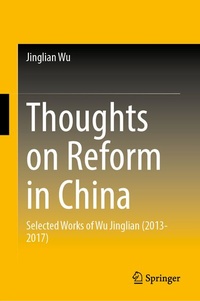
Thoughts on Reform in China
Description
This volume brings together a selection of important articles by the distinguished economist Wu Jinglian, published between 2013 and 2017. These writings reflect his insights on a range of major issues shaping China's reform and development. Over this period, Professor Wu has advanced reform with notable dedication and professionalism, exerting significant influence both domestically and internationally.
The collection addresses fundamental topics such as the overall reform agenda, economic system transition, and the transformation of the development model. It also offers in-depth analyses of key economic and social issues, including the "new normal," supply-side structural reform, state-owned enterprise reform, financial reform, property rights protection, and institutional anti-corruption. This book provides valuable perspectives for understanding the course of China's reform, assessing economic trends, and exploring future development pathways. It will be of interest to all readers concerned with China's reform and economic progress.
More details
Person
Wu Jinglian, recipient of the inaugural China Economics Award for Outstanding Contribution, is currently a Senior Research Fellow at the Development Research Center of the State Council. He also serves as a professor at the Graduate School of the Chinese Academy of Social Sciences (GSCASS), Chair Professor of Baosteel Economics at CEIBS, Adviser to the Executive Committee of the International Economic Association (IEA), Honorary President of the IEA, and a member of the International Management Institute.
Professor Wu's research focuses on theoretical economics, comparative institutional analysis, and the theories and policies of China's economic reform. He has long advocated market-oriented, law-based, and democratic reforms, making significant contributions to both the theory and practice of China's reform. As a pioneer in comparative economic systems, he has also played a key role in introducing modern economic theories and international experience to China, thereby supporting its reform and development.
Content
Chapter 1. Introduction: The Future Direction of China's Economy (December 2012).- Part I: Opening a New Reform Journey.- Chapter 2. A Proposal for the Swift Creation of a Central Working Group to Coordinate the Creation of an Integrated Reform Plan (January 2013).- Chapter 3. Why and How to Develop an Integrated Plan for Reform? (February 2013).- Chapter 4. Empowerment Through Markets, Prosperity Through Competition (February 2013).- Chapter 5. The Integrated Plan and Current Measures for Reform in China (April 2013).- Chapter 6. Embarking on a New Journey of Reform at a New Historical Starting Point (December 2013).- Chapter 7. Challenges and Options for China's Economy (November 2015).- Chapter 8. The Direction of Reform Is Clear, the Key Is in Execution (December 2016).- Part II: Investigating Particular Reform Initiatives.- Chapter 9. Price Reform, a Crucial Step in Comprehensively Deepening Reform (October 2015).- Chapter 10. Restoring Farmers' Land Contract Rights (May 2015).- Chapter 11. Action Plan for Enhancing the Property Rights Protection System (November 2016).- Chapter 12. The Importance of Strengthening Competition Policy (November 2015).- Chapter 13. Establishment of the Fundamental Position of Competition Policy (June 2016).- Chapter 14. Strengthening the Discourse on Industrial Policy (November 2016).- Chapter 15. Capital Management: A Fundamental Element of SOE Reform (July 2012).- Chapter 16. Research on Establishing Market-Oriented State-Owned Capital Operating Institutions: International Experience (October 2014).- Chapter 17. SOE Reform: Capital Management and Pilot Projects for Two Types of Companies (May 2015).- Chapter 18. Establishing a Market-Oriented RMB Exchange Rate (July 2013).- Chapter 19. Establishing a Deposit Insurance System to Aid Financial Reform (April 2014).- Chapter 20. Separating Financing of Medical Expenses from Provision of Medical Services (February 2013).- Chapter 21. Giving Adequate Attention to the Establishment and Functioning of Social Security Funds (November 2013).- Chapter 22. Toward a Healthcare System That Fits China: Balancing Benefits and Challenges (August 2015).- Chapter 23. Reducing the Use of Administrative Measures for Environmental Governance (June 2014).- Chapter 24. Toward a Green Economy: The Opportunity Presented by the Shift in Economic 7.3 Development toward a New Normal (August 2015).- Chapter 25. Defeating Corruption through Comprehensive Reform (August 2014).- Chapter 26. Enhancing the Role of Government in Promoting the Healthy Development of Industries (June 2013).- Chapter 27. Proper Definition of Local Government Functions Is Essential for Delegating Financial Power to the Local Level (November 2013).- Chapter 28. Guiding Urbanization with a Market-Oriented Approach (November 2013).- Chapter 29. The Significance of Civilian Chambers of Commerce in Governance Modernization (November 2014).- Part III: Controlling Risks, Focusing on Reform, and Improving Supply Efficiency.- Chapter 30. Growth Deceleration, Development Transition, and Reform Restart (September 2013).- Chapter 31. Approaches and Techniques for Managing Financial Risks (October 2014).- Chapter 32. Embracing Reform for a Desirable New Normal (November 2014)0- Chapter 33. Strategies for Entrepreneurs in the New Economic Normal (December 2014).- Chapter 34. Reflections on Embracing the New Normal (February 2015).- Chapter 35. Cautionary Reminder: No Bubble Is Indestructible in This World (April 2015).- Chapter 36. Analyzing the Current Macroeconomic Situation and Providing Policy Recommendations (September 2015).- Chapter 37. Advancing Structural Reform to Enhance Supply Quality (February 2016).- Chapter 38. Reform Is Key in Deleveraging and Risk Prevention (June 2016).- Chapter 39. - What Is Structural Reform and Why Is It Important? (June 2016).- Chapter 40. Deepening Structural Reform and Achieving Effective Adjustments (February 2017).- Chapter 41. Creating a Market for Ideas and Examining Fundamental Issues to Discover a Path of Long-Term Development in China (April 2017).- Part IV: Exploring China's Transformational Path.- Chapter 42. The Systemic Prerequisite for the Active Role of Development Clusters: A Response to Professor Torsten Persson's Paper Titled "Governance Systems and Capabilities and Economic Development: China's Problems and My Suggestions" (December 2013).- Chapter 43. Conversation with János Kornai: China's Transformational Path (2013 December).- Chapter 44. Facing the Era of Great Transformation: Preface to the book Facing the Era of Great Transformation (January 2014).- Chapter 45. The Context and Direction of China's Reforms (April 2014).- Chapter 46. Mechanism Design and Development Expectations in the New Normal: A Conversation with Huang Ming, Eric S. Maskin and Other Professors (November 2014).- Chapter 47. Transformation of China's Economic Structure and Growth Model: Exchange of economists from China and Japan (March 2015).- Chapter 48. Further Efforts Needed in Implementing Reforms for Market Economic Development in China (May 2015).- Chapter 49. Two Essential Concerns That Must Be Addressed: Structural Reform and Growth Transformation (March 2017).- Part V: Literary Encounters, Treasured Friends, and Special Occasions.- Chapter 50. A Social Scientist's Journey Toward True Knowledge (February 2013).- Chapter 51.- Academic Courage and Social Responsibility: A Tribute to My Beloved Friend, Lu Xueyi (May 2013).- Chapter 52. In Honor of Professor Masahiko Aoki's Memory: A Foreign Friend Committed to Aiding China's Reform and Social Progress (September 2015).- Chapter 53. Path Dependence and China's Reform: A Tribute to Professor Douglass North (November 2015).- 54. A Great Company's Green Journey (May 2014).- Chapter 55. Journeying Together Toward the Light (November 2014).- Chapter 56. With Freedom in Thought and Critical Insight, Independent from Political or Ideological Plight (October 2015).- Chapter 56. The Spirit of Professionalism and the Courage of Theory (December 2016).- Chapter 57. Let Beautiful Music Accompany Us (June 2017).