

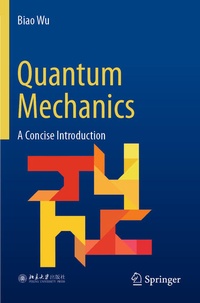
Quantum Mechanics
A Concise Introduction
Published on 28. March 2024
Book
Paperback/Softback
XVI, 188 pages
978-981-19-7628-5 (ISBN)
Description
This textbook highlights a concise introduction to quantum mechanics in a readable and serious manner. Being readable, the book intends to present the beauty and magic of quantum mechanics to the mass public. Being serious, the book uses mathematics to describe the most profound results in quantum mechanics. To balance the two, the book assumes that the readers are familiar with high-school mathematics and instructs the least possible advanced mathematics necessary for the understanding of quantum mechanics.
The book first covers the history of quantum mechanics and then introduces the magical quantum world, including quantum states living in Hilbert space, indistinguishable particles, linear superposition, Heisenberg's uncertainty relations, quantum entanglement, Bell's inequality, quantum energy levels, Schrödinger's cat and many-worlds theory, etc. To compare with classic physics, the book also covers the classic mechanics before introducing quantum mechanics.At last, the book briefly covers quantum computing and quantum communications.
Besides readers of other majors, the book is also a good reference for students in physics. It helps physics students to develop a solid understanding of the basics of quantum mechanics, preventing them from getting lost in solving the Schrödinger equation. The book also discusses quantum entanglement and quantum information which traditional quantum mechanics textbooks do not cover.
The Foreword is written by Frank Wilczek, Nobel Laureate in physics, 2004.
This book is a translation of an original Chinese edition. The translation was done with the help of artificial intelligence (machine translation by the service DeepL.com). A subsequent human revision was done primarily in terms of content, so that the book will read stylistically differently from a conventional translation.
The book first covers the history of quantum mechanics and then introduces the magical quantum world, including quantum states living in Hilbert space, indistinguishable particles, linear superposition, Heisenberg's uncertainty relations, quantum entanglement, Bell's inequality, quantum energy levels, Schrödinger's cat and many-worlds theory, etc. To compare with classic physics, the book also covers the classic mechanics before introducing quantum mechanics.At last, the book briefly covers quantum computing and quantum communications.
Besides readers of other majors, the book is also a good reference for students in physics. It helps physics students to develop a solid understanding of the basics of quantum mechanics, preventing them from getting lost in solving the Schrödinger equation. The book also discusses quantum entanglement and quantum information which traditional quantum mechanics textbooks do not cover.
The Foreword is written by Frank Wilczek, Nobel Laureate in physics, 2004.
This book is a translation of an original Chinese edition. The translation was done with the help of artificial intelligence (machine translation by the service DeepL.com). A subsequent human revision was done primarily in terms of content, so that the book will read stylistically differently from a conventional translation.
More details
Edition
2023 ed.
Language
English
Place of publication
Singapore
Singapore
Illustrations
1 farbige Abbildung, 63 s/w Abbildungen
XVI, 188 p. 64 illus., 1 illus. in color.
Dimensions
Height: 235 mm
Width: 155 mm
Thickness: 11 mm
Weight
355 gr
ISBN-13
978-981-19-7628-5 (9789811976285)
DOI
10.1007/978-981-19-7626-1
Schweitzer Classification
Other editions
Additional editions
Persons
Dr. Biao Wu is Professor at the International Center of Quantum Materials, School of Physics, Peking University. He received his Ph.D. from the University of Texas, Austin, in 2001. He did postdoctoral work at Oak Ridge National Lab during 2001-2004. He then worked as Professor in the Institute of Physics, Chinese Academy of Sciences during 2004-2009. He moved to Peking University in 2010. His research interests include quantum dynamics, quantum algorithm, ultra-cold atomic gas, and nonlinear dynamics.
Content
Chapter 1. What is quantum?.- Chapter 2. Brief history of quantum mechanics.- Chapter 3. Classical mechanics and old quantum theories.- Chapter 4. Complex number and linear algebra.- Chapter 5. Quantum entanglement and Bell's inequality.- Chapter 6. Quantum measurement.- Chapter 7. Quantum computing.- Chapter 8. Quantum communications.