

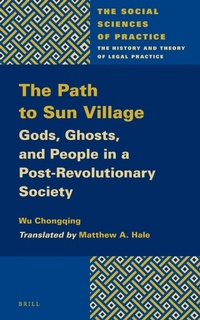
The Path to Sun Village
Gods, Ghosts, and People in a Post-Revolutionary Society
Published on 27. July 2017
Book
Hardback
328 pages
978-90-04-34871-4 (ISBN)
Description
This book is a product of over ten years of work. It addresses intermarriage circles, transformations of customs, the rise and fall supernatural forces, power relations among gods, ghosts and people in "synchronic communities," and tongxiangtongye (same hometown, same industry) economies based on rural sociocultural networks in the author's native Sun Village in Putian. The author explores the details of microhistory by examining changes and continuities in everyday life to show the grand through the minute.
This exciting book possesses important theoretical significance, including reflections on binary frameworks such as state vs. society and tradition vs. modernity or revolution, along with new arguments about commonly used concepts such as "the cultural nexus of power" and "the hollowing-out of the rural."
This exciting book possesses important theoretical significance, including reflections on binary frameworks such as state vs. society and tradition vs. modernity or revolution, along with new arguments about commonly used concepts such as "the cultural nexus of power" and "the hollowing-out of the rural."
More details
Series
Language
English
Place of publication
Leiden
Netherlands
Target group
Professional and scholarly
Product notice
sewn/stitched
Cloth over boards
Dimensions
Height: 236 mm
Width: 160 mm
Thickness: 23 mm
Weight
612 gr
ISBN-13
978-90-04-34871-4 (9789004348714)
Copyright in bibliographic data and cover images is held by Nielsen Book Services Limited or by the publishers or by their respective licensors: all rights reserved.
Schweitzer Classification
Persons
Wu Chongqing, Ph.D. (1991), Sun Yat-sen University, is Professor in the Department of Philosophy at that university, Director of South China Rural Research Centre, and Editor-in-Chief of Open Times. He has edited Mapping China: Peasants, Migrant Workers and Informal Labor (Brill, 2016).
Content
Preface: A Village Path alongside China's Highway of Development
List of Illustrations
1 Intermarriage Spheres and Affinal Networks
?Part 1: Intermarriage Spheres: Social Change and the Expansion and Contraction of Intermarriage Regions
??The Rural Social Space of Sun Village
??The Situation of Intermarriage and Its Revision of "Common Sense"
??Why the Distance of Intermarriage is Shrinking
?Part 2: Affinal Networks: Continuity and Transformation in the Conventions of Marriage and Affinal Relations
??Old Conventions in the Mao Era: Protecting Traditional Core Values of Marriage and the Family
??"Walking Rites": The Goodness of Uniting Two Surnames
??Changing Conventions in the "Era of Black Marriages" and Thereafter
??Conclusion: From "Many Branches" to "Deep Roots"
2 The Realms of Yin and Yang
?Part 1: Synchronic Communities: Gods, Ghosts, and People in a Post-revolutionary Era
??From the Imperial to the Post-revolutionary Era
??"We are Both Wretched Vagabonds in a Strange Land"
??"Fallen to the Earth and Crushed to Dust, Only the Fragrance Remains"
??When the Boundary between Yin and Yang is Breached: The Persistence of Affective Bonds between Ghosts and the Living
??Synchronic Communities
?Appendix to Part 1 of Chapter 2
?part 2: Efficacy Depending on Faith: The Scope and Cycles of Tongji Power
??The Vast Distance between Heaven and the Living
??"My Identity as a Woman"
??Preference for Secular over Supernatural Decision-Making
??The Authority of Each Medium Lasts Two or Three Years
?Part 3: Pretending that Gods Exist: Relations between People and Gods in Collective Rituals
??Block Divination
??Yuanxiao at Yongjin Temple
??Welcoming the Gods
??"Going Out to Run around the Territory"
??"Running Across the Arena" and "Calming Down to Dismount"
??"Selecting the Next Year's Ritual Heads"
??Distributing "Boy Biscuits"
??The Utilitarianization of Supernatural Relations in Collective Rituals
?Part 4: A Thin Interface: The "Balanced Rationality" among Gods, People, and Horses
??Keeping Pace to Entertain Gods: From "Using Horses for Work" to "Using Horses for Ritual"
??The Tracks of a Thousand Troops and Ten Thousand Horses: "Horse Agents" and "Horse-Leaders"
??In the Spring, Hooves Gallop Gaily: Horse-Leaders, Horse Markets, and Clients during Yuanxiao
??Those on Horseback Cannot See the Situation on the Ground: Horse-Leaders, Horses, and Gods
??Society and Culture as Matrix
3 Building Roads: "The Cultural Nexus of Power"
?Accounting and the State
?The Weakening of Popular Authority before 1949
?Political Consolidation and the Resurgence of Religious Authority (1949-1985)
?The Interaction between Popular Authorities and State Brokers (1986 to the Present)
4 "Beyond the Boundary": A Countermovement to the Hollowing-out of Rural China
?Social Networks in a Peripheral Region
?From Periphery to Center: The On-site Concentration of Dajin Resources
?Gaining the Upper Hand through Hometown-Based Economic Networks
?The Mutual Activation of Rural Social Resources and Tongxiang Tongye Economy
?A Countermovement against the "Hollowing-Out" of Rural China
Appendix: A Micro-History of Rural Society: Sun Village before and during the Revolutionary Period
?i?Livelihood
?ii?Epidemics
?iii?Clans
?iv?Water Resource Management
?v?"People's Schools"
?vi?"Able-Bodied Men"
?vii?"Personages"
?viii?Modern Schools
?ix?Bandits
?x?Land Reform
?xi?"Fording the Famine"
?xii?The "Socialist Education" Campaign
?xiii?The Cultural Revolution
Postscript
Bibliography
List of Illustrations
1 Intermarriage Spheres and Affinal Networks
?Part 1: Intermarriage Spheres: Social Change and the Expansion and Contraction of Intermarriage Regions
??The Rural Social Space of Sun Village
??The Situation of Intermarriage and Its Revision of "Common Sense"
??Why the Distance of Intermarriage is Shrinking
?Part 2: Affinal Networks: Continuity and Transformation in the Conventions of Marriage and Affinal Relations
??Old Conventions in the Mao Era: Protecting Traditional Core Values of Marriage and the Family
??"Walking Rites": The Goodness of Uniting Two Surnames
??Changing Conventions in the "Era of Black Marriages" and Thereafter
??Conclusion: From "Many Branches" to "Deep Roots"
2 The Realms of Yin and Yang
?Part 1: Synchronic Communities: Gods, Ghosts, and People in a Post-revolutionary Era
??From the Imperial to the Post-revolutionary Era
??"We are Both Wretched Vagabonds in a Strange Land"
??"Fallen to the Earth and Crushed to Dust, Only the Fragrance Remains"
??When the Boundary between Yin and Yang is Breached: The Persistence of Affective Bonds between Ghosts and the Living
??Synchronic Communities
?Appendix to Part 1 of Chapter 2
?part 2: Efficacy Depending on Faith: The Scope and Cycles of Tongji Power
??The Vast Distance between Heaven and the Living
??"My Identity as a Woman"
??Preference for Secular over Supernatural Decision-Making
??The Authority of Each Medium Lasts Two or Three Years
?Part 3: Pretending that Gods Exist: Relations between People and Gods in Collective Rituals
??Block Divination
??Yuanxiao at Yongjin Temple
??Welcoming the Gods
??"Going Out to Run around the Territory"
??"Running Across the Arena" and "Calming Down to Dismount"
??"Selecting the Next Year's Ritual Heads"
??Distributing "Boy Biscuits"
??The Utilitarianization of Supernatural Relations in Collective Rituals
?Part 4: A Thin Interface: The "Balanced Rationality" among Gods, People, and Horses
??Keeping Pace to Entertain Gods: From "Using Horses for Work" to "Using Horses for Ritual"
??The Tracks of a Thousand Troops and Ten Thousand Horses: "Horse Agents" and "Horse-Leaders"
??In the Spring, Hooves Gallop Gaily: Horse-Leaders, Horse Markets, and Clients during Yuanxiao
??Those on Horseback Cannot See the Situation on the Ground: Horse-Leaders, Horses, and Gods
??Society and Culture as Matrix
3 Building Roads: "The Cultural Nexus of Power"
?Accounting and the State
?The Weakening of Popular Authority before 1949
?Political Consolidation and the Resurgence of Religious Authority (1949-1985)
?The Interaction between Popular Authorities and State Brokers (1986 to the Present)
4 "Beyond the Boundary": A Countermovement to the Hollowing-out of Rural China
?Social Networks in a Peripheral Region
?From Periphery to Center: The On-site Concentration of Dajin Resources
?Gaining the Upper Hand through Hometown-Based Economic Networks
?The Mutual Activation of Rural Social Resources and Tongxiang Tongye Economy
?A Countermovement against the "Hollowing-Out" of Rural China
Appendix: A Micro-History of Rural Society: Sun Village before and during the Revolutionary Period
?i?Livelihood
?ii?Epidemics
?iii?Clans
?iv?Water Resource Management
?v?"People's Schools"
?vi?"Able-Bodied Men"
?vii?"Personages"
?viii?Modern Schools
?ix?Bandits
?x?Land Reform
?xi?"Fording the Famine"
?xii?The "Socialist Education" Campaign
?xiii?The Cultural Revolution
Postscript
Bibliography