

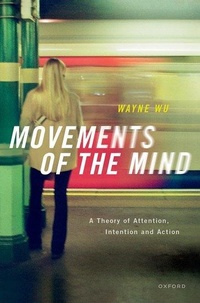
Movements of the Mind
A Theory of Attention, Intention and Action
Published on 1. June 2023
Book
Hardback
264 pages
978-0-19-286689-9 (ISBN)
Description
Movements of the Mind is about what it is to be an agent. Focusing on mental agency, it integrates multiple approaches, from philosophical analysis of the metaphysics of agency to the activity of neurons in the brain. Philosophical and empirical work are combined to generate concrete explanations of key features of the mind. The book should be relevant and accessible to philosophers and scientists interested in mind and agency.
Wu argues that actions have a core psychological structure where attention plays a necessary role in guiding the agent's response and intentions function as memory for work, a practical memory. Attention and memory are accordingly central parts of an agent's intentionally doing things. These claims are supported by synthesizing philosophical and empirical work to produce a theory of intention and attention in action. The account explains three phenomena of current philosophical interest: (a) the basis of positively and negatively biased action where attention often leads to implicit bias, (b) the dynamics of deductive reasoning as the focusing of a thinker's cognitive attention and the development of cognitive skills, and (c) the psychology of introspective access to conscious perceptual experience, making clear when introspection can intelligibly fail and when it can succeed.
The book provides a theory of agency, whether human or non-human, along with technical notions of automaticity and control, a theory of attention as selection to guide behavior, an account of intention as memory whose dynamics are revealed in empirical investigation of working memory, explications of sustained attention and vigilance, an explanation of biased behavior driven by biases on attention, normative aspects of attention as a skill, the role of learning in cognitive skill, a theory of deduction as a sharpening of attention, and a psychologically plausible model of introspection that speaks to its accuracy and reliability.
Wu argues that actions have a core psychological structure where attention plays a necessary role in guiding the agent's response and intentions function as memory for work, a practical memory. Attention and memory are accordingly central parts of an agent's intentionally doing things. These claims are supported by synthesizing philosophical and empirical work to produce a theory of intention and attention in action. The account explains three phenomena of current philosophical interest: (a) the basis of positively and negatively biased action where attention often leads to implicit bias, (b) the dynamics of deductive reasoning as the focusing of a thinker's cognitive attention and the development of cognitive skills, and (c) the psychology of introspective access to conscious perceptual experience, making clear when introspection can intelligibly fail and when it can succeed.
The book provides a theory of agency, whether human or non-human, along with technical notions of automaticity and control, a theory of attention as selection to guide behavior, an account of intention as memory whose dynamics are revealed in empirical investigation of working memory, explications of sustained attention and vigilance, an explanation of biased behavior driven by biases on attention, normative aspects of attention as a skill, the role of learning in cognitive skill, a theory of deduction as a sharpening of attention, and a psychologically plausible model of introspection that speaks to its accuracy and reliability.
Reviews / Votes
This book puts forward a theory of action. It synthesises Wayne Wu's extensive work on action and attention going back over a decade, and also substantially extends this foundation... The result is excellent. The book is wide-ranging, systematic, very original, and crammed full of interesting ideas. It draws together scientific work with philosophical argumentation in a way that is both rigorous and unusually readable. I have no doubt that it will be important to thinkers interested in action and attention, as well as philosophers of cognitive science more generally. * Henry Taylor, University of Birmingham, Notre Dame Philosophical Reviews * In this excellent book, Wu, a philosopher of mind and cognitive science, focuses on such mental movements as thinking, remembering, reasoning, introspecting, and attending to understand what it means to be an agent. Highly recommended. Advanced undergraduates through faculty. * Choice * Wayne Wu's book is about mental action, and how various psychological elements fit together to explain mental agency. The book is fill of interesting claims and arguments; it contains incisive treatments of a wide range of empirical work; it should be read by philosophers of action (who often give psychology minimal attention) and philosopher of cognitive science(who often give action minimal attention). * Joshua Shepherd, Australian Journal of Phlosophy *More details
Language
English
Place of publication
Oxford
United Kingdom
Target group
College/higher education
Product notice
sewn/stitched
Cloth over boards
Dimensions
Height: 239 mm
Width: 159 mm
Thickness: 21 mm
Weight
626 gr
ISBN-13
978-0-19-286689-9 (9780192866899)
Copyright in bibliographic data and cover images is held by Nielsen Book Services Limited or by the publishers or by their respective licensors: all rights reserved.
Schweitzer Classification
Other editions
Additional editions
E-Book
04/2023
1st Edition
OUP eBook
€59.49
Available for download
E-Book
04/2023
1st Edition
OUP eBook
€59.49
Available for download
Person
Wayne Wu is a philosopher of mind and cognitive science. He studied biology and chemistry at MIT and did doctoral work in molecular and cell biology at UC Berkeley as a Howard Hughes Predoctoral Fellow before shifting to philosophy, receiving his PhD from Berkeley in 2005. At Carnegie Mellon University, he has been associate director of the Center for the Neural Basis of Cognition and is currently associate professor in Philosophy and in the Neuroscience Institute.
Content
Introduction
Part I
1: The Structure of Acting
Appendix 1
2: Attention and Attending
Part II
3: Intention as Practical Memory
4: Intending as Practical Remembering
Part III
5: Automatic Bias, Experts and Amateurs
6: Deducing, Skill and Knowledge
7: Introspecting Perceptual Experience
Epilogue
Bibliography
Part I
1: The Structure of Acting
Appendix 1
2: Attention and Attending
Part II
3: Intention as Practical Memory
4: Intending as Practical Remembering
Part III
5: Automatic Bias, Experts and Amateurs
6: Deducing, Skill and Knowledge
7: Introspecting Perceptual Experience
Epilogue
Bibliography