

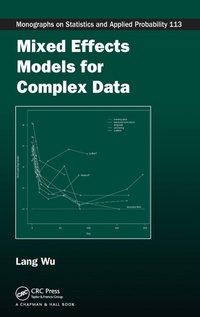
Mixed Effects Models for Complex Data
1st Edition
Published on 11. November 2009
Book
Hardback
440 pages
978-1-4200-7402-4 (ISBN)
Description
Although standard mixed effects models are useful in a range of studies, other approaches must often be used in correlation with them when studying complex or incomplete data. Mixed Effects Models for Complex Data discusses commonly used mixed effects models and presents appropriate approaches to address dropouts, missing data, measurement errors, censoring, and outliers. For each class of mixed effects model, the author reviews the corresponding class of regression model for cross-sectional data.
An overview of general models and methods, along with motivating examples
After presenting real data examples and outlining general approaches to the analysis of longitudinal/clustered data and incomplete data, the book introduces linear mixed effects (LME) models, generalized linear mixed models (GLMMs), nonlinear mixed effects (NLME) models, and semiparametric and nonparametric mixed effects models. It also includes general approaches for the analysis of complex data with missing values, measurement errors, censoring, and outliers.
Self-contained coverage of specific topicsSubsequent chapters delve more deeply into missing data problems, covariate measurement errors, and censored responses in mixed effects models. Focusing on incomplete data, the book also covers survival and frailty models, joint models of survival and longitudinal data, robust methods for mixed effects models, marginal generalized estimating equation (GEE) models for longitudinal or clustered data, and Bayesian methods for mixed effects models.
Background materialIn the appendix, the author provides background information, such as likelihood theory, the Gibbs sampler, rejection and importance sampling methods, numerical integration methods, optimization methods, bootstrap, and matrix algebra.
Failure to properly address missing data, measurement errors, and other issues in statistical analyses can lead
An overview of general models and methods, along with motivating examples
After presenting real data examples and outlining general approaches to the analysis of longitudinal/clustered data and incomplete data, the book introduces linear mixed effects (LME) models, generalized linear mixed models (GLMMs), nonlinear mixed effects (NLME) models, and semiparametric and nonparametric mixed effects models. It also includes general approaches for the analysis of complex data with missing values, measurement errors, censoring, and outliers.
Self-contained coverage of specific topicsSubsequent chapters delve more deeply into missing data problems, covariate measurement errors, and censored responses in mixed effects models. Focusing on incomplete data, the book also covers survival and frailty models, joint models of survival and longitudinal data, robust methods for mixed effects models, marginal generalized estimating equation (GEE) models for longitudinal or clustered data, and Bayesian methods for mixed effects models.
Background materialIn the appendix, the author provides background information, such as likelihood theory, the Gibbs sampler, rejection and importance sampling methods, numerical integration methods, optimization methods, bootstrap, and matrix algebra.
Failure to properly address missing data, measurement errors, and other issues in statistical analyses can lead
Reviews / Votes
This book could serve as a text for an advanced course at the Ph.D. level and as a reference to analysts who are familiar with basic statistical methodology for mixed effects models. -Tena I. Katsaounis, Technometrics, November 2011 What I was most impressed by was the sheer breadth of complex models considered. Furthermore, unlike much of the research in the area, the book examines each of the complications, not merely in isolation, but in various combinations. ... Considering the complexity of some of these models, the fact that the book does a good job of describing how to fit them in a clear manner is noteworthy. ... The book is clear and lucidly written. It is set at an appropriate level for graduates and should be accessible to practitioners with at least some knowledge of mixed model methodology. It should also be of interest to researchers who might want to learn different modelling techniques. -John T. Ormerod, Statistics in Medicine, 2011, 30 ... as an introduction to what it says in the title of the book, the author has done an excellent job-the coverage is pretty comprehensive, detailed without too much mathematical technicality, and (most importantly) readable. I believe that it will become a useful reference in many libraries, personal and public. -International Statistical Review (2010), 78, 3More details
Language
English
Place of publication
Oxford
United Kingdom
Publishing group
Taylor & Francis Ltd
Target group
Professional and scholarly
Professional Practice & Development
Product notice
Paper over boards
Illustrations
22 s/w Abbildungen, 19 s/w Tabellen
19 Tables, black and white; 22 Illustrations, black and white
Dimensions
Height: 240 mm
Width: 161 mm
Thickness: 28 mm
Weight
822 gr
ISBN-13
978-1-4200-7402-4 (9781420074024)
Copyright in bibliographic data and cover images is held by Nielsen Book Services Limited or by the publishers or by their respective licensors: all rights reserved.
Schweitzer Classification
Other editions
Additional editions
Book
09/2019
1st Edition
Chapman & Hall/CRC
€97.10
Shipment within 15-20 days
E-Book
11/2009
Chapman and Hall
€89.99
Available for download
E-Book
11/2009
Chapman & Hall/CRC
€89.99
Available for download
Person
Lang Wu is an associate professor in the Department of Statistics at the University of British Columbia in Vancouver, Canada.
Content
Introduction. Mixed Effects Models. Missing Data, Measurement Errors, and Outliers. Mixed Effects Models with Missing Data. Mixed Effects Models with Covariate Measurement Errors. Mixed Effects Models with Censoring. Survival Mixed Effects (Frailty) Models. Joint Modeling Longitudinal and Survival Data. Robust Mixed Effects Models. Generalized Estimating Equations (GEEs). Bayesian Mixed Effects Models. Appendix. References. Index. Abstract.