

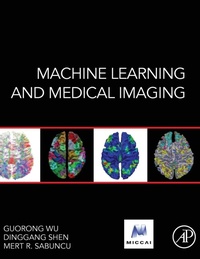
Machine Learning and Medical Imaging
Published on 11. August 2016
Book
Hardback
512 pages
978-0-12-804076-8 (ISBN)
Description
Machine Learning and Medical Imaging presents state-of- the-art machine learning methods in medical image analysis. It first summarizes cutting-edge machine learning algorithms in medical imaging, including not only classical probabilistic modeling and learning methods, but also recent breakthroughs in deep learning, sparse representation/coding, and big data hashing. In the second part leading research groups around the world present a wide spectrum of machine learning methods with application to different medical imaging modalities, clinical domains, and organs.
The biomedical imaging modalities include ultrasound, magnetic resonance imaging (MRI), computed tomography (CT), histology, and microscopy images. The targeted organs span the lung, liver, brain, and prostate, while there is also a treatment of examining genetic associations. Machine Learning and Medical Imaging is an ideal reference for medical imaging researchers, industry scientists and engineers, advanced undergraduate and graduate students, and clinicians.
The biomedical imaging modalities include ultrasound, magnetic resonance imaging (MRI), computed tomography (CT), histology, and microscopy images. The targeted organs span the lung, liver, brain, and prostate, while there is also a treatment of examining genetic associations. Machine Learning and Medical Imaging is an ideal reference for medical imaging researchers, industry scientists and engineers, advanced undergraduate and graduate students, and clinicians.
More details
Series
Language
English
Place of publication
San Diego
United States
Publishing group
Elsevier Science Publishing Co Inc
Target group
Professional and scholarly
Computer scientists, electronic and biomedical engineers researching in medical imaging, undergraduate and graduate students.
Product notice
Laminated cover
Dimensions
Height: 244 mm
Width: 197 mm
Thickness: 32 mm
Weight
1247 gr
ISBN-13
978-0-12-804076-8 (9780128040768)
Copyright in bibliographic data and cover images is held by Nielsen Book Services Limited or by the publishers or by their respective licensors: all rights reserved.
Schweitzer Classification
Other editions
Additional editions
Guorong Wu | Dinggang Shen | Mert Sabuncu
Machine Learning and Medical Imaging
E-Book
08/2016
Academic Press
€89.95
Available for download
Persons
Guorong Wu is an Assistant Professor of Radiology and Biomedical Research Imaging Center (BRIC) in the University of North Carolina at Chapel Hill. Dr. Wu received his PhD degree from the Department of Computer Science in Shanghai Jiao Tong University in 2007. After graduation, he worked for Pixelworks and joined University of North Carolina at Chapel Hill in 2009. Dr. Wu's research aims to develop computational tools for biomedical imaging analysis and computer assisted diagnosis. He is interested in medical image processing, machine learning and pattern recognition. He has published more than 100 papers in the international journals and conferences. Dr. Wu is actively in the development of medical image processing software to facilitate the scientific research on neuroscience and radiology therapy. Dinggang Shen, PhD is a Professor and a Founding Dean with School of Biomedical Engineering, ShanghaiTech University, Shanghai, China, and also a Co-CEO of United Imaging Intelligence (UII), Shanghai. He is a Fellow of IEEE, AIMBE, IAPR and MICCAI. He was a Jeffrey Houpt Distinguished Investigator and a Full Professor (Tenured) with the University of North Carolina at Chapel Hill (UNC-CH), Chapel Hill, NC, USA. His research interests include medical image analysis, computer vision and pattern recognition. He has published more than 1,500 peer-reviewed papers in the international journals and conference proceedings, with H-index 130 and over 70K citations.
Mert Sabuncu is an Assistant Professor in Electrical and Computer Engineering, with a secondary appointment in Biomedical Engineering, Cornell University. His research interests are in biomedical data analysis, in particular imaging data, and with an application emphasis on neuroscience and neurology. He uses tools from signal/image processing, probabilistic modeling, statistical inference, computer vision, computational geometry, graph theory, and machine learning to develop algorithms that allow learning from large-scale biomedical data.
Mert Sabuncu is an Assistant Professor in Electrical and Computer Engineering, with a secondary appointment in Biomedical Engineering, Cornell University. His research interests are in biomedical data analysis, in particular imaging data, and with an application emphasis on neuroscience and neurology. He uses tools from signal/image processing, probabilistic modeling, statistical inference, computer vision, computational geometry, graph theory, and machine learning to develop algorithms that allow learning from large-scale biomedical data.
Editor
Assistant Professor of Radiology and Biomedical Research Imaging Center, University of North Carolina, Chapel Hill, USA
Professor, Department of Radiology and BRIC, UNC-Chapel Hill, USA
Assistant Professor, Electrical and Computer Engineering, Secondary Appointment in Biomedical Engineering, Cornell University
Content
Part 1: Cutting-Edge Machine Learning Techniques in Medical Imaging
Chapter 1: Functional connectivity parcellation of the human brain
Chapter 2: Kernel machine regression in neuroimaging genetics
Chapter 3: Deep learning of brain images and its application to multiple sclerosis
Chapter 4: Machine learning and its application in microscopic image analysis
Chapter 5: Sparse models for imaging genetics
Chapter 6: Dictionary learning for medical image denoising, reconstruction, and segmentation
Chapter 7: Advanced sparsity techniques in magnetic resonance imaging
Chapter 8: Hashing-based large-scale medical image retrieval for computer-aided diagnosis
Part 2: Successful Applications in Medical Imaging
Chapter 9: Multitemplate-based multiview learning for Alzheimer's disease diagnosis
Chapter 10: Machine learning as a means toward precision diagnostics and prognostics
Chapter 11: Learning and predicting respiratory motion from 4D CT lung images
Chapter 12: Learning pathological deviations from a normal pattern of myocardial motion: Added value for CRT studies?
Chapter 13: From point to surface: Hierarchical parsing of human anatomy in medical images using machine learning technologies
Chapter 14: Machine learning in brain imaging genomics
Chapter 15: Holistic atlases of functional networks and interactions (HAFNI)
Chapter 16: Neuronal network architecture and temporal lobe epilepsy: A connectome-based and machine learning study
Chapter 1: Functional connectivity parcellation of the human brain
Chapter 2: Kernel machine regression in neuroimaging genetics
Chapter 3: Deep learning of brain images and its application to multiple sclerosis
Chapter 4: Machine learning and its application in microscopic image analysis
Chapter 5: Sparse models for imaging genetics
Chapter 6: Dictionary learning for medical image denoising, reconstruction, and segmentation
Chapter 7: Advanced sparsity techniques in magnetic resonance imaging
Chapter 8: Hashing-based large-scale medical image retrieval for computer-aided diagnosis
Part 2: Successful Applications in Medical Imaging
Chapter 9: Multitemplate-based multiview learning for Alzheimer's disease diagnosis
Chapter 10: Machine learning as a means toward precision diagnostics and prognostics
Chapter 11: Learning and predicting respiratory motion from 4D CT lung images
Chapter 12: Learning pathological deviations from a normal pattern of myocardial motion: Added value for CRT studies?
Chapter 13: From point to surface: Hierarchical parsing of human anatomy in medical images using machine learning technologies
Chapter 14: Machine learning in brain imaging genomics
Chapter 15: Holistic atlases of functional networks and interactions (HAFNI)
Chapter 16: Neuronal network architecture and temporal lobe epilepsy: A connectome-based and machine learning study