

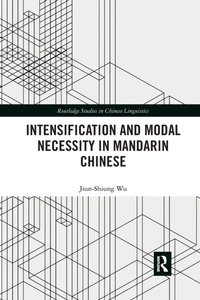
Intensification and Modal Necessity in Mandarin Chinese
1st Edition
Published on 14. August 2020
Book
Paperback/Softback
190 pages
978-0-367-59678-1 (ISBN)
Description
This book addresses intensification and modal necessity in Mandarin Chinese.
Intensification is used in this book to describe the speaker's emphasis on a proposition, because, by emphasizing on a proposition, the speaker intensifies the degree of his/her confidence and affirmativeness toward the truth of a proposition, cf. the distinction between 'weaker' and 'stronger'. Modal necessity discussed in this book refers either to the speaker's certainty regarding the truth of an inference, judgment or stipulation, that is, epistemic necessity or to the speaker's certainty concerning the obligatoriness of a proposition, based on rules or regulations, i.e., deontic necessity. This book examines a series of lexical items in Mandarin Chinese that express either intensification or modal necessity, provides a unified semantics and also presents how these lexical items are semantically distinct.
Intensification and Modal Necessity in Mandarin Chinese is aimed at instructors, researchers and post-graduate students of Chinese Linguistics.
Intensification is used in this book to describe the speaker's emphasis on a proposition, because, by emphasizing on a proposition, the speaker intensifies the degree of his/her confidence and affirmativeness toward the truth of a proposition, cf. the distinction between 'weaker' and 'stronger'. Modal necessity discussed in this book refers either to the speaker's certainty regarding the truth of an inference, judgment or stipulation, that is, epistemic necessity or to the speaker's certainty concerning the obligatoriness of a proposition, based on rules or regulations, i.e., deontic necessity. This book examines a series of lexical items in Mandarin Chinese that express either intensification or modal necessity, provides a unified semantics and also presents how these lexical items are semantically distinct.
Intensification and Modal Necessity in Mandarin Chinese is aimed at instructors, researchers and post-graduate students of Chinese Linguistics.
More details
Series
Language
English
Place of publication
London
United Kingdom
Publishing group
Taylor & Francis Ltd
Target group
College/higher education
Dimensions
Height: 234 mm
Width: 156 mm
Thickness: 11 mm
Weight
316 gr
ISBN-13
978-0-367-59678-1 (9780367596781)
Copyright in bibliographic data and cover images is held by Nielsen Book Services Limited or by the publishers or by their respective licensors: all rights reserved.
Schweitzer Classification
Other editions
Additional editions
Jiun-Shiung Wu
Intensification and Modal Necessity in Mandarin Chinese
Book
11/2018
1st Edition
Routledge
€232.90
Shipment within 10-20 days
Jiun-Shiung Wu
Intensification and Modal Necessity in Mandarin Chinese
E-Book
11/2018
1st Edition
Routledge
€68.49
Available for download
Jiun-Shiung Wu
Intensification and Modal Necessity in Mandarin Chinese
E-Book
11/2018
1st Edition
Routledge
€68.49
Available for download
Person
Jiun-Shiung Wu is a Professor of Linguistics and Director of the Institute of Linguistics at National Chung Cheng University, Chiayi, Taiwan. He received a Ph.D. degree in linguistics from University of Texas at Austin, Texas, U.S.A, May, 2003. He served as the President of Linguistic Society of Taiwan from February, 2010 to January, 2012. He is a board member of International Association of Chinese Linguistics. He is the author of Temporal and Atemporal Relations in Mandarin. Taiwan Journal of Linguistics Monograph Series No. 2. He also publishes more than a dozen of journal papers and has more than thirty conference presentations.
Content
List of Abbreviations. Introduction. Chapter 2: Review of Previous Studies. Chapter 3: The Most General Case: Yiding. Chapter 4: Intra-sentential Resolution: Tieding. Chapter 5: Certainty Confirmation: Kending. Chapter 6: Certainty Expression: D?ding. Chapter 7: Causing: Biran. Chapter 8: Anti-causing: Biding. Chapter 9: Underspecified Modal Base: Shibi. Chapter 10: Addressee's To-Do List: Wubi. Chapter 11: Archaic Strong Modal Epistemic Necessity and Intensification: Bi. Chapter 12: General Discussion. Chapter 13: Conclusion. References.