

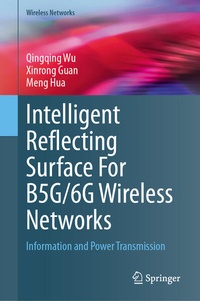
Intelligent Reflecting Surface For B5G/6G Wireless Networks
Description
This book provides comprehensive insights into the theory, models, and unique characteristics of intelligent reflecting surface (IRS) and its appealing applications in wireless information and power transmission for B5G/6G. It is organized as follows:
Chapter 1 gives an overview of the fundamentals of IRS, including the signal and channel models of IRS, its hardware architecture, advantages and practical constraints. Chapter 2, 3 and 4 focus on how to optimize the joint design of active and passive beamforming for three types of IRS-aided wireless information/energy transmission systems, namely IRS-aided power transfer (WPT), IRS-aided simultaneous wireless information and power transfer (SWIPT) and IRS-aided wireless powered communication networks (WPCN).
Chapter 2 specifically presents a general framework design for IRS-aided WPT systems from the perspectives of energy beamforming design and channel estimation, while the dynamic IRS beamforming design is also discussed.
Chapter 3 thoroughly studies the IRS-aided SWIPT for achieving better R-E trade-off, wherein two different designs based on weighted sum-power maximization at energy users (EUs) and under individual quality-of-service (QoS), requirements at both information users (IUs) and EUs are investigated.
Chapter 4 presents three paradigms of IRS-aided WPCN, i.e., IRS-aided half-duplex (HD) WPCN, IRS-aided full-duplex (FD) WCPN and IRS-aided multiple-input-multiple-output (MIMO) FD WPCN. The authors present some related emerging topics, e.g., active IRS aided wireless communications and IRS-aided unmanned aerial vehicle (UAV) communications in chapter 5.
This book targets postgraduate students studying electrical engineering and computer science, and can be used as a secondary textbook. Professionals, researchers and engineers working in wireless networks will also find this book useful as a reference.More details
Other editions
Additional editions
Persons
Xinrong Guan received both the B.Eng. degree in Communications Engineering and the Ph.D. degree in Communications and Information Systems from the College of Communications Engineering, PLA University of Science and Technology, Nanjing, China in 2009 and 2014, respectively. From 2014, he worked as a lecturer at the College of Communications Engineering, Army Engineering University of PLA. His current research interests include physical layer security, wireless key generation, and intelligent reflecting surface (IRS).
Meng Hua received Ph.D. degree in School of Information Science and Engineering, Southeast University, Nanjing, China, in 2021. From 2021-2023, he was working at the State Key Laboratory of Internet of Things for Smart City, University of Macau as a Postdoc. He was the recipient of the Outstanding Ph.D. Thesis Award of Chinese Institute of Electronics in 2021. His current research interests include localization, integrated sensing and communication, and intelligent reflecting surface.