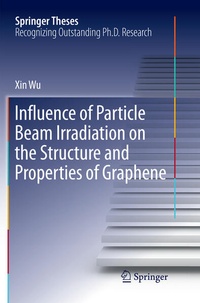
This thesis focuses on the nanomanufacturing of graphene-a newly discovered, two-dimensional material with extraordinary properties-in order to realize its numerous potential applications. Combining experimental implementation with theoretical modelling, it investigates three classes of graphene nanostructure fabrication using particle beam irradiation: (i) doping of graphene using low energy nitrogen irradiation; (ii) joining of graphene sheets with laser and C, N, and Ar ion beam irradiation; and (iii) fabrication of graphene nanopores by means of focused ion beam and electron beam irradiation. The feasibility of the nanomanufacture of graphene using particle beam irradiation is demonstrated by various experimental methods, and the mechanisms involved under different types of beam irradiation are revealed using theoretical calculations. Further, the book analyzes the mechanical and electrical properties of the fabricated graphene nanostructures by means of atomic simulations to predict the application potentials of the proposed methods. The findings help promote the implementation of graphene-structure applications in industry.
Series
Edition
Softcover reprint of the original 1st ed. 2018
Language
Place of publication
Target group
Professional and scholarly
Illustrations
115 farbige Abbildungen, 10 s/w Abbildungen
XV, 182 p. 125 illus., 115 illus. in color.
Dimensions
Height: 235 mm
Width: 155 mm
Thickness: 12 mm
Weight
ISBN-13
978-981-13-4883-9 (9789811348839)
DOI
10.1007/978-981-10-6457-9
Schweitzer Classification
Xiang Ji graduated from the School of Earth Sciences and Engineering, Nanjing University. His main research interest is geochemistry, and he has been a researcher at Zhejiang Provincial Institute of Cultural Relics and Archeology since graduation and has participated in research programs concerning the Liangzhu archeological site. His recent papers include "A Study on the Properties and Origin of the Stones Used in the Making of Stone Artifacts at Liangzhu Archeological site," "Restorartion of the Paleoenvironment outside the Ancient City of Liangzhu," and "The Characteristics and Provenance of the Sr-Nd Isotope in the Liangzhu Remains and its Significance on the Extinction of the Ancient Culture."
Shu Song holds a master's degree in Archeozoology from Jilin University. She is a researcher at the Zhejiang Provincial Institute of Cultural Relics and Archeology, where she focuses on studies of animal remains at the Liangzhu archeological site. She has participated in excavation projects at Weijiawopu in Inner Mongolia, Houtaomuga in Jilin, and Hebosuo in Yunan and has published a number of articles, including "A Study on the Animal Bone Remains Excavated at Heibei Archeological Site in Wangqing, Jilin," "A Study on G1 Animal Bone Remains Discovered at Houtaomuga Archeological Site in Daan, Jilin," and "A Summary of the Animial Remains Unearthed at Liangzhu Archeological Site."
Xin Wu is a researcher at Zhejiang Provincial Institute of Cultural Relics and Archeology. She completed her postgraduate studies in Archeobotany at the School of History and Culture, Shandong University. She is responsible for the academic studies on plant remains at the Liangzhu archeological site, and she has also been involved in exploration work at Luhe in Jiaxian county, Guanzhuang in Xingyang county, and Dalaidian in Hebi city, Henan province.