

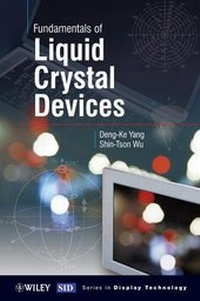
Fundamentals of Liquid Crystal Devices
1st Edition
Published on 28. July 2006
Book
Hardback
394 pages
978-0-470-01542-1 (ISBN)
Description
From laptop computers and mobile phones to digital cinema, Liquid Crystal Displays (LCDs) are integral components in an increasing array of highly desirable consumer electronics and communication devices, and are already the predominant technology used in flat panel displays.
This inter-disciplinary book is intended as an introductory guide to the fundamental properties of liquid crystals and their applications in display and photonic devices, providing a basic understanding of the physics, optics, electro-optics, and material aspects for state-of-the-art display and photonic devices.
Fundamentals of Liquid Crystal Devicesincludes:
* A comprehensive overview of LCDs including liquid crystal physics, electro-optical properties, simulation techniques and display and photonic applications.
* Numerous examples and case studies, solved problems and challenging homework conundrums starting with basic physics and gradually introducing advanced device concepts and structures.
* The principles for designing advanced specialist transmissive, reflective, and transflective liquid crystal displays.
* Chapters on emerging technologies such as tuneable liquid crystal photonic devices including laser beam steering, light switches for telecommunication and tunable-focus lenses.
Fundamentals of Liquid Crystal Devices is a valuable resource for advanced undergraduate and graduate students following display systems courses, who will benefit from its systematic approach. The introduction of advanced device concepts and structures means that display engineers, scientists, and technicians active in the field can also utilise this unique resource, as can developers of a wide range of systems and applications.
This inter-disciplinary book is intended as an introductory guide to the fundamental properties of liquid crystals and their applications in display and photonic devices, providing a basic understanding of the physics, optics, electro-optics, and material aspects for state-of-the-art display and photonic devices.
Fundamentals of Liquid Crystal Devicesincludes:
* A comprehensive overview of LCDs including liquid crystal physics, electro-optical properties, simulation techniques and display and photonic applications.
* Numerous examples and case studies, solved problems and challenging homework conundrums starting with basic physics and gradually introducing advanced device concepts and structures.
* The principles for designing advanced specialist transmissive, reflective, and transflective liquid crystal displays.
* Chapters on emerging technologies such as tuneable liquid crystal photonic devices including laser beam steering, light switches for telecommunication and tunable-focus lenses.
Fundamentals of Liquid Crystal Devices is a valuable resource for advanced undergraduate and graduate students following display systems courses, who will benefit from its systematic approach. The introduction of advanced device concepts and structures means that display engineers, scientists, and technicians active in the field can also utilise this unique resource, as can developers of a wide range of systems and applications.
More details
Series
Edition
1. Auflage
Language
English
Place of publication
Chichester
United Kingdom
Publishing group
John Wiley and Sons Ltd
Target group
Professional and scholarly
Illustrations
Illustrations
Dimensions
Height: 24.4 cm
Width: 16.8 cm
Thickness: 28 mm
Weight
898 gr
ISBN-13
978-0-470-01542-1 (9780470015421)
Schweitzer Classification
Other editions
New editions
Deng-Ke Yang | Shin-Tson Wu
Fundamentals of Liquid Crystal Devices
Book
11/2014
2nd Edition
Wiley
€135.50
Shipment within 15-20 days
Additional editions
Shin-Tson Wu | Deng-Ke Yang
Fundamentals of Liquid Crystal Devices
E-Book
08/2006
Wiley
€101.99
Available for download
Persons
Deng-Ke Yang, Liquid Crystal Institute, Kent State University, Kent, OH 44242Deng-Ke Yang is currently Professor of the Chemical Physics Program at Kent State University. He has previously co-authored Reflective Liquid Crystal Displays (Wiley, 2001), written over 80 articles on liquid crystals and other displays and has 15 patents. His fields of research are in Liquid Crystal and Polymer Physics and Liquid Crystal Displays and his affiliations include the American Physical Society, the Society for Information Display and the International Liquid Crystal Society.
Dr Shin-Tson Wu, College of Optics and Photonics, University of Central Florida. Shin-Tson Wu is a provost-distinguished Professor of Optics at the College of Optics and Photonics, University of Central Florida. He is also a fellow of the IEEE, SID and OSA and has co-authored Introduction to Microdisplays (Wiley, 2006), Reflective Liquid Crystal Displays (Wiley, 2001), and Optics and Nonlinear Optics of Liquid Crystals (World Scientific, 1993), and written over 300 articles. His research interests are in liquid crystal displays and materials, bio-photonics, and optical communication. Previous to his current role, Dr. Wu worked as a Senior Research Scientist at Hughes Research Laboratories (Malibu, California) for 18 years.
Dr Shin-Tson Wu, College of Optics and Photonics, University of Central Florida. Shin-Tson Wu is a provost-distinguished Professor of Optics at the College of Optics and Photonics, University of Central Florida. He is also a fellow of the IEEE, SID and OSA and has co-authored Introduction to Microdisplays (Wiley, 2006), Reflective Liquid Crystal Displays (Wiley, 2001), and Optics and Nonlinear Optics of Liquid Crystals (World Scientific, 1993), and written over 300 articles. His research interests are in liquid crystal displays and materials, bio-photonics, and optical communication. Previous to his current role, Dr. Wu worked as a Senior Research Scientist at Hughes Research Laboratories (Malibu, California) for 18 years.
Content
Foreword.
Series Editor's Foreword.
Preface.
1. Liquid crystal physics.
* Introduction.
* Thermodynamics and statistic physics.
* Orientational order.
* Elastic properties of liquid crystals.
* Response of liquid crystals to electro-magnetic fields.
* Anchoring effects of nematic liquid crystal at surfaces.
Homework problems.
2. Propagation of light in anisotropic optical medium.
* Electromagnetic wave.
* Polarization.
* Propagation of light in uniform anisotropic optical media.
* Propagation of light in cholesteric liquid crystals.
Homework problems.
3. Optical modeling methods.
* Jones matrix method.
* Mueller matrix method.
* Berreman 4x4 method.
Homework problems.
4. Effects of Electric field on Liquid Crystals.
* Dielectric interaction.
* Flexoelectric Effect.
* Ferroelectricity in liquid crystals.
Homework.
5. Freedericksz transition.
* Calculus of variation.
* The Fredeericksz transition: statics.
* The Freedericksz transition: dynamics.
Homework problems.
6. Liquid Crystal Materials.
* Introduction.
* Refractive indices.
* Dielectric constants.
* Rotational Viscosity.
* Elastic constant.
* Figure-of-merits.
* Refractive index matching between liquid crystals and polymers.
Homework problems.
7. Modeling of liquid crystal director configuration.
* Electric energy of liquid crystals.
* Modeling electric field.
* Simulation of liquid crystal director configuration.
Homework problems.
8. Transmissive liquid crystal display.
* Introduction.
* Twisted nematic cells.
* In plane switching (IPS) mode.
* Vertical alignment (VA) mode.
* Multi-domain Vertical Alignment (MVA) Cells.
* Optically compensated bend (OCB) cell.
Homework problems.
9. Reflective and Trasreflective display.
* Introduction.
* Reflective liquid crystal displays.
* Transflector.
* Classification of Transflective LCDs.
* Dual-cell-gap Transflective LCDs.
* Single-cell-gap Transflective LCDs.
* Performance of transflective LCDs.
Homework problems.
10. Liquid crystal display matrices, drive schemes and bistable displays.
* Segmented displays.
* Passive matrix displays and drive scheme.
* Active Matrix Displays.
* Bistable ferroelectric liquid crystal displays and drive scheme.
* Bistable nematic displays.
* Bistable cholesteric reflective display.
Homework problems.
11. Liquid crystal/polymer composites.
* Introduction.
* Phase separation.
* Scattering properties of liquid crystal/polymer composites.
* Polymer dispersed liquid crystals.
* Polymer stabilization liquid crystals.
* Displays from liquid crystal/polymer composites.
Homework problems.
12. Tunable liquid crystal photonic devices.
* Introduction.
* Laser beam steering.
* Variable Optical Attenuators.
* Tunable-Focus Lens.
* Polarization-Independent LC Devices.
Homework problems.
Index.
Series Editor's Foreword.
Preface.
1. Liquid crystal physics.
* Introduction.
* Thermodynamics and statistic physics.
* Orientational order.
* Elastic properties of liquid crystals.
* Response of liquid crystals to electro-magnetic fields.
* Anchoring effects of nematic liquid crystal at surfaces.
Homework problems.
2. Propagation of light in anisotropic optical medium.
* Electromagnetic wave.
* Polarization.
* Propagation of light in uniform anisotropic optical media.
* Propagation of light in cholesteric liquid crystals.
Homework problems.
3. Optical modeling methods.
* Jones matrix method.
* Mueller matrix method.
* Berreman 4x4 method.
Homework problems.
4. Effects of Electric field on Liquid Crystals.
* Dielectric interaction.
* Flexoelectric Effect.
* Ferroelectricity in liquid crystals.
Homework.
5. Freedericksz transition.
* Calculus of variation.
* The Fredeericksz transition: statics.
* The Freedericksz transition: dynamics.
Homework problems.
6. Liquid Crystal Materials.
* Introduction.
* Refractive indices.
* Dielectric constants.
* Rotational Viscosity.
* Elastic constant.
* Figure-of-merits.
* Refractive index matching between liquid crystals and polymers.
Homework problems.
7. Modeling of liquid crystal director configuration.
* Electric energy of liquid crystals.
* Modeling electric field.
* Simulation of liquid crystal director configuration.
Homework problems.
8. Transmissive liquid crystal display.
* Introduction.
* Twisted nematic cells.
* In plane switching (IPS) mode.
* Vertical alignment (VA) mode.
* Multi-domain Vertical Alignment (MVA) Cells.
* Optically compensated bend (OCB) cell.
Homework problems.
9. Reflective and Trasreflective display.
* Introduction.
* Reflective liquid crystal displays.
* Transflector.
* Classification of Transflective LCDs.
* Dual-cell-gap Transflective LCDs.
* Single-cell-gap Transflective LCDs.
* Performance of transflective LCDs.
Homework problems.
10. Liquid crystal display matrices, drive schemes and bistable displays.
* Segmented displays.
* Passive matrix displays and drive scheme.
* Active Matrix Displays.
* Bistable ferroelectric liquid crystal displays and drive scheme.
* Bistable nematic displays.
* Bistable cholesteric reflective display.
Homework problems.
11. Liquid crystal/polymer composites.
* Introduction.
* Phase separation.
* Scattering properties of liquid crystal/polymer composites.
* Polymer dispersed liquid crystals.
* Polymer stabilization liquid crystals.
* Displays from liquid crystal/polymer composites.
Homework problems.
12. Tunable liquid crystal photonic devices.
* Introduction.
* Laser beam steering.
* Variable Optical Attenuators.
* Tunable-Focus Lens.
* Polarization-Independent LC Devices.
Homework problems.
Index.